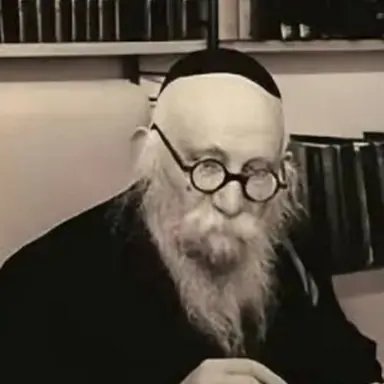
Rabbi Shlomo Yosef Zevin, of Blessed Memory
13 min read2,584 words
Summary
This survey presents the many-sided figure of Rabbi Shlomo Yosef Zevin, one of the most important Torah thinkers and authors of the twentieth century, who combined Chabad Hasidism, Lithuanian scholarship and Religious Zionism. The text details his revolutionary contribution to the method of halakhic analysis, which found expression in his monumental works, foremost among them the Talmudic Encyclopedia, a life's project that changed the way the Oral Torah is made accessible to the broad public. Alongside his literary achievements, the source stresses the Rabbi's public involvement, and especially his resolute halakhic position in favour of drafting yeshiva students in an obligatory war (milchemet mitzvah). Through a combination of biography, methodological analysis and a list of prizes, the article portrays the Rabbi as the architect of modern Torah scholarship who succeeded in bridging the world of tradition and the established institutions of the young State of Israel.
A Life's Project of Scholarship, Synthesis and Accessibility: The Torah Teaching and Halakhic Work of the Gaon Rabbi Shlomo Yosef Zevin, of Blessed Memory
The history of the world of halakha and Torah literature in the twentieth century is identified to a great extent with processes of transition from local communities and dispersed traditions toward established, systematic and nationwide institutions. One of the central architects of this transition was the Gaon Rabbi Shlomo Yosef Zevin (Zewin), of blessed memory (5647–5738; 1886–1978), a unique figure who bridged in an extraordinary way cultural, ideological and political worlds between which there is seemingly an inherent contradiction.[1] Rabbi Zevin acted as a Chabad Hasid by origin on the one hand, as a distinctly Lithuanian scholar who enriched the Brisk method on the other hand, and, on yet another hand, as a leading spiritual figure in Religious Zionism who ascribed holy religious value to the State of Israel.[1] His contribution went beyond the bounds of local halakhic ruling; he brought about a far-reaching methodological and formal revolution in the way Talmudic topics are analyzed, defined and presented to the student and the researcher in the modern era.[1, 2]
His Life, Family Lineage and the Shaping of His Torah Personality
Rabbi Shlomo Yosef Zevin was born on the festival of Hanukkah in the year 5647 (December 1886) in the town of Kazimirov in the Pinsk district, in those days under the rule of the Russian Empire.[1] He grew up in a home steeped in Torah and Hasidism; his mother was Rebbetzin Chaya, and his father was the Gaon Rabbi Aharon Mordechai Zevin, who served as rabbi of the local Chabad community in Kazimirov.[1] The father's early death, when Rabbi Shlomo Yosef was only 17, forced the young son to take on a heavy burden of leadership and to fill his father's place in the rabbinate of the community.[1]
Rabbi Zevin acquired the main part of his Torah and scholarly education at the famous Mir Yeshiva in Belarus, where he gained complete mastery of the methods of analysis accepted in the Lithuanian yeshiva world.[1] Later he deepened his studies in a select kollel of young married scholars in the city of Bobruisk, under the guidance of the Admor Rabbi Shmaryahu Noach Schneersohn of Bobruisk, from whom he also received rabbinic ordination.[1] Apart from this ordination, Rabbi Zevin was ordained by two of the greatest decisors and scholars of the generation: the Gaon Rabbi Yosef Rosen (known by his epithet "the Rogatchover") and Rabbi Yechiel Michel Epstein, author of the monumental halakhic work "Arukh HaShulchan."[1]
In his personal life he was married to Rebbetzin Leah (née Levin), who accompanied him throughout the years of his work in Russia and in the Land of Israel until her death in 1952.[1] The couple had a son and a daughter.[1]
His Scholarly Teaching and the Meeting between the World of Halakha and the World of Hasidism
Rabbi Zevin's scholarly distinctiveness found expression in his ability to refine and enrich the Brisker method of study in an unprecedented way.[1] This method of study, which was developed by Rabbi Chaim Soloveitchik of Brisk, focused on breaking legal and halakhic concepts down into abstract basic components, distinguishing between laws attributed to the object (laws of the "cheftza") and those attributed to the obligated person (laws of the "gavra").[1] Whereas the classic Brisker scholars tended to leave these distinctions at the level of a local novel insight on the page of Gemara, Rabbi Zevin used these methodological tools to build complete, systematic and clear structures of entire halakhic topics.[1]
His great scholarly achievement in this field found expression in his well-known book "Ishim ve-Shitot" ("Personalities and Methods"), which was later published by "Kol Mevaser" and appeared in many editions (among them the Jerusalem edition of 5767, which includes a comprehensive biographical introduction by his grandson).[1, 4] In this book Rabbi Zevin carried out an extraordinary scholarly, analytical and critical analysis of the halakhic methods of study of ten of the greatest rabbis and decisors of recent generations.[1, 4] From an analysis of their writing he distilled the character traits unique to each of them, and illustrated how their basic scholarly assumptions directly influence their practical rulings.[1, 4]
Alongside Lithuanian scholarship, the spirit of Chabad Hasidism was the breath of Rabbi Zevin's life.[1] He did not see Hasidism and halakha as two separate realms, but strove to create a harmonious synthesis between them.[1] In his various articles Rabbi Zevin made use of deep and abstract Hasidic Chabad ideas in order to explain by means of them complex legal principles found in halakha and in the topics of the Gemara.[1] A prominent example of this meeting is his well-known article "The Wondrous Figure of the Baal HaTanya" (published in the Torah forum "Shanah be-Shanah" in 5724), in which he showed how the philosophical and Hasidic system of Rabbi Shneur Zalman of Liadi blends without partitions with his halakhic system in the Shulchan Arukh HaRav.[1]
His method of study was also distinguished by an uncompromising insistence on clear, fluent and modern Hebrew, avoiding traditional rhyming or archaic yeshiva jargon that made comprehension difficult for a learner unaccustomed to it.[1, 2] This accessibility served both the traditional world of Torah and the world of academic research, and made his writings sought after in all strata of the public.[1, 2]
The Corpus of His Works and His Torah-Halakhic Creativity
Rabbi Zevin's writing was extraordinarily wide-ranging and varied, and included books that became classic assets in every Jewish and Torah home.[1, 4] He combined pure halakhic writing, historical-critical research, thought on the weekly Torah portion and the collection of popular Hasidic stories.[1]
The Talmudic Encyclopedia Project: A Project of the Generations
If we are required to point to the undisputed crowning glory of Rabbi Zevin's work, it is the Talmudic Encyclopedia.[1, 6] This monumental project, which was launched in the year 5702 (1942), was originally conceived by Rabbi Meir Bar-Ilan, who took part in editing the first volume, and was managed for decades with extraordinary devotion by Rabbi Yehoshua Hutner.[1, 3] The aim of the project was pioneering and unprecedented: to condense all the Talmudic and halakhic discussions found throughout the expanses of the Oral Torah, presenting the main positions of the Rishonim and the Acharonim, in encyclopedic entries arranged in alphabetical order.[3, 7]
Rabbi Zevin was the editor-in-chief and the scientific and scholarly pathfinder of the project.[3] It was he who determined the comprehensive list of entries (which included about 2,000 main entries) and the secondary entries, and formulated the precise method of analysis.[6] Under his direction, every entry was required to present a precise definition, biblical and Talmudic sources, detailed reasoning and the various positions of halakhic ruling.[6]
Out of a deep personal commitment, Rabbi Zevin wrote the first twelve volumes in his own hand, and his refined and clear writing style became the prototype and model for imitation for all the writers and editors who came after him.[6] The project received many blessings and warm encouragement from the great Torah figures of all circles, foremost among them the Lubavitcher Rebbe, Rabbi Menachem Mendel Schneerson.[1, 3]
Evidence of the enormous influence of this project on other worlds can be found in the project led by Rabbi Yoel Kahn in the 1960s at the instruction of the Lubavitcher Rebbe: the preparation of "Sefer HaErkhim – Chabad," which was intended to gather the entries and concepts of Hasidic teaching.[3] The Rebbe took care to send Rabbi Zevin every new volume of this book, in recognition of his structural authority.[3] When the third volume appeared, Rabbi Zevin remarked with his characteristic integrity that Sefer HaErkhim contains too much length and detail, whereas in an encyclopedia the key to success is brevity and concision.[3] The Rebbe accepted his remarks and answered him on this in detail.[3]
His National and Public Positions and the Controversy over Drafting Yeshiva Students
Rabbi Zevin did not shut himself up within the four cubits of theoretical scholarship; he was deeply involved in the pressing problems of the Jewish Yishuv and of the young State of Israel, and expressed incisive positions that combined deep halakhic commitment with a comprehensive national outlook.[1]
His Attitude toward the State of Israel and Independence Day
Rabbi Zevin defined the establishment of the State of Israel as a "miracle and wonder" and as the most important historical event of the Jewish people in recent generations.[1] Although he refrained from defining the State dogmatically as "the beginning of the redemption" (atchalta di-geula), out of a theological position holding that the secrets of divine providence are not fully revealed to us, he held that the existence of independent Jewish sovereignty is an immense divine kindness that requires practical thanksgiving.[1]
For this reason Rabbi Zevin used to hold a festive se'udat mitzvah (a meal in honor of a commandment) in his home every year on Independence Day, and took care to pray in the synagogue of Mossad HaRav Kook, where Hallel was recited with a blessing.[1] In his view, a person who does not thank God for the establishment of the State commits the grave sin of ingratitude toward Heaven.[1]
The Pamphlet "On the Question of Drafting Yeshiva Students" and the Halakhic-Moral Discussion
During the War of Independence, when the Jewish Yishuv was fighting for its life against the Arab armies, Rabbi Zevin published anonymously (under the pseudonym "One of the Rabbis") a revolutionary pamphlet addressed directly to the heads of the yeshivas and to the leaders of the Haredi public, entitled: On the Question of Drafting Yeshiva Students.[1, 5] In this pamphlet Rabbi Zevin presented an uncompromising position rejecting the blanket exemption from conscription for yeshiva students in time of war.[5]
The central arguments he raised in the pamphlet combine distinctly halakhic foundations with a sharp moral demand:
Defining the situation as an obligatory war: Rabbi Zevin determined that a war to save the Jewish Yishuv from the hand of an enemy seeking to destroy it is a "milchemet mitzvah" (obligatory war) of the first rank.[5] According to the ruling of the Rambam and the Mishnah in Tractate Sotah, in an obligatory war everyone is obligated to go out to battle, and even a bridegroom and bride are not exempt from it.[5] Accordingly, he expressed grave astonishment at the heads of yeshivas who publish a "da'at Torah" (Torah opinion) instructing students not to report and not to be counted at all.[5]
Rejecting the argument "Rabbis do not need protection" (rabbanan la ba'i netiruta): the heads of the yeshivas sought to justify the exemption by relying on the Talmudic rule in Tractate Bava Batra, which states that Torah scholars do not need physical protection since the merit of the Torah protects them.[5] Rabbi Zevin dismantled this argument on four levels:
- The prohibition of relying on a miracle: halakha categorically forbids relying on a miracle in a place where there is tangible and immediate danger to life.[5]
- The Hebron massacre (5689): Rabbi Zevin cited as a painful and bloody historical example the murder of the young students of the Hebron Yeshiva by Arab rioters, and asked with an outcry: "Those holy ones, did they need protection, or did they not need protection?"[5] He stressed that the enemy now facing the Yishuv is that same murderous enemy.[5]
A halakhic distinction between routine protection and an emergency: Rabbi Zevin clarified that the rule in the Gemara was stated only regarding participation in financing the city walls in routine days of peace, and has no relevance or validity in a situation of national danger to life (pikuach nefesh) and an obligatory war.[5]
The practical conduct of Torah scholars: he proved that even the very greatest Torah figures take worldly measures of protection in time of war, sticking paper on the windows against bomb shrapnel in accordance with the instructions of the general home-front command, and fleeing from border neighbourhoods exposed to sniper fire, without relying on the protective virtue of "they do not need protection."[5]
Rabbi Zevin concluded that the use of the "protection" argument in the case of conscription was made at the wrong time and in the wrong place.[5] In his view, the correct and halakhic way is for the sons of Torah to take an active part in the military campaign alongside their brothers, and the merit of their Torah study will protect them and their comrades-in-arms within the battlefield itself, and not serve as an excuse for evading it.[5]
State Recognition, Honours and Prizes
Rabbi Zevin's immense Torah and cultural work received broad and extraordinary recognition throughout his life, both from the Torah establishment and from the state establishment of the State of Israel.[1] This recognition found expression in a series of prestigious prizes awarded to him, detailed below:
Summary and the Legacy of the Architect of Modern Torah Scholarship
The Torah teaching and halakhic work of the Gaon Rabbi Shlomo Yosef Zevin, of blessed memory, constitute one of the most glorious chapters of the Jewish bookshelf in the twentieth century.[1, 2] His contribution is not limited only to the number of books he wrote or the entries he edited, but lies mainly in the general change of consciousness he brought about in the ways of studying the Oral Torah and making it accessible.[2, 3]
Rabbi Zevin knew how to take the best of the three worlds in which he grew and worked: he took simplicity and feeling from Chabad Hasidism [1], sharpness and conceptual analysis from the yeshivas of Lithuania [1], and national responsibility, statesmanship and systematic order from the world of Religious Zionism and the young State of Israel.[1] By fusing these worlds he created a new halakhic language, a clear, systematic and precise language, which opened the gates of the Talmud and halakha to generations of learners and researchers.[2, 6]
His legacy continues to pulse every day in the study halls, in the yeshivas, in the universities and on the Torah websites that draw directly on the Talmudic Encyclopedia project and his many writings.[2, 3] Rabbi Zevin proved that absolute loyalty to tradition and uncompromising scholarly quality can dwell together with modernity, structural innovation and public openness, and thereby shaped the face of Jewish Torah scholarship for generations to come.[2, 6]
Sources7
- 1.שלמה יוסף זוין - ויקיפדיה, he.wikipedia.org/wiki/שלמה_יוסף_זוין
- 2.שלמה יוסף זוין - Custom Page | Pomeranz Bookseller, pomeranzbooks.co.il/author_details?data=15264
- 3.אנציקלופדיה תלמודית - חב"דפדיה, chabadpedia.co.il/index.php?title=אנציקלופדיה_תלמודית
- 4.אישים ושיטות הרב זוין - אוצר הספרים, sefer.org.il/items/3734166-אישים-ושיטות-הרב-זוין-הוצאה-לאור-קול-מבשר
- 5.האמנם פטורים בני ישיבות מגיוס? / הרב שי פירון - נאמני תורה ועבודה, toravoda.org.il/כתבה/האמנם-פטורים-בני-ישיבות-מגיוס-הרב-שי-פ/
- 6.אנציקלופדיה תלמודית - ויקיפדיה, he.wikipedia.org/wiki/אנציקלופדיה_תלמודית
- 7.הוצאת אנציקלופדיה תלמודית בע"מ (חל"צ) - Jgive, jgive.com/new/he/ils/charity-organizations/987