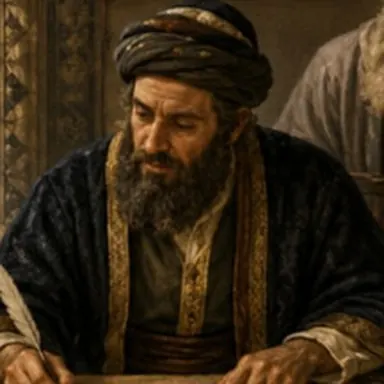
Rabbi Shlomo ben Shimon Duran (the Rashbash)
18 min read3,565 words
Summary
This source surveys the life and work of Rabbi Shlomo ben Shimon Duran (the Rashbash), a key figure in the leadership of Algerian Jewry in the 15th century who served as a connecting link between Spanish Jewry and the new Torah center in North Africa. The text presents the Rashbash as a rationalist polymath who combined scientific and philosophical erudition with supreme halakhic authority, rejecting the teaching of Kabbalah and using Maimonidean intellectualism to shape communal identity. Throughout its chapters, the source analyzes his legal and public approach, from his defense of the Talmud against the Christian mission in his work "Milchemet Mitzvah," through his sensitivity to social justice and to the status of women in his responsa, to the establishment of the procedures of civil law in his work "Tikkun Soferim." The purpose of the article is to highlight his long-term halakhic legacy, which became one of the pillars of the "Shulchan Arukh" and decisively influenced halakhic ruling for generations.
The Hegemony of the Sages of Algiers: The Halakhic Teaching, Public Work and Torah Legacy of Rabbi Shlomo ben Shimon Duran (the Rashbash)
Chapter 1: The Transitional Generation and the Historical Setting of the Rashbash's Work
The 15th century in the history of the Jewish people is marked by a sharp geopolitical and cultural transformation, forming the bridge between the decline of the splendid Torah center in Spain and the rise of the communities of North Africa as independent and influential centers. At the heart of this transformation stands the figure of Rabbi Shlomo ben Shimon Duran, known by his appellation the Rashbash. His work is perceived not merely as a direct continuation of a rabbinic dynasty, but as an act of establishing a new halakhic identity in the Maghreb, while meticulously preserving the Catalan and Majorcan tradition of learning.[1, 2, 3]
To understand the strength of the Rashbash's influence, one must examine the reality into which he was born in Algiers in 1400 (5160). His father, Rabbi Shimon ben Tzemach Duran (the Rashbatz), had fled Majorca following the persecutions of 5151 (1391), which destroyed many communities in the Iberian Peninsula.[4, 5] The move from a European-Christian civilization to an Islamic realm confronted the sages of the generation with unprecedented challenges: adapting Jewish law to a reality of Muslim rule, coping with a stream of refugees trying to preserve their customs in the face of the local "residents," and the need to fortify Jewish judicial autonomy.[2]
The Rashbash represents the first generation born into this reality, but raised on the early Jewish-Renaissance learning that characterized the sages of Spain. He was not only a halakhic authority in the narrow sense, but a polymath whose erudition in the natural sciences, medicine and philosophy served as an instrument in his hands for shaping his Torah worldview.[1, 6] This combination of a deep ancestral tradition with intellectual openness enabled him to become the supreme authority not only for the Jews of Algeria, but for communities throughout the Mediterranean basin, including Jerusalem.[1, 2]
Milestones in the Duran Dynasty and Their Historical Context
Chapter 2: The Torah Laboratory—the Rashbash's Training and Method
The Rashbash's Torah training was unique in that it took place in a "closed environment" of excellence. He studied almost exclusively under his father, the Rashbatz, who saw in him his natural successor. The relationship between the two was not only one of teacher and disciple, but of active intellectual partnership. Already at a young age the Rashbash joined his father's rabbinic court, and, as emerges from the dates of his responsa, he began answering halakhic questions while still a youth.[1, 6]
An analysis of his early responsa reveals that the Rashbash adopted a style of writing known as "melitzah"—a sophisticated use of the language of the Talmud and of Aramaic idioms to convey complex messages. A famous letter he wrote to Nathan Najara in Constantine made so strong an impression that the recipient declared that he was destined to sit on his father's throne, comparing him to King Solomon, the heir of David.[6, 8] This rhetorical skill was not merely ornamental, but a legal tool that enabled him to formulate clear and unequivocal decisions.
The Halakhic Methodology: The Talmud as the Supreme Source and Maimonides (Rambam) as the Code
At the center of the Rashbash's teaching stands absolute fidelity to the Babylonian Talmud. In every halakhic discussion, he takes care to return to the Talmudic source and to analyze the issue from its foundation, using the analytical methods of the Catalan Rishonim.[2] However, the reality in North Africa compelled him to contend with the dominance of the rulings of Maimonides (Rambam). The communities of the region had accepted the "Mishneh Torah" as a binding authority, and the Rashbash, as part of this tradition, treated Maimonides (Rambam) with enormous respect.[2]
The tension between the inclination toward independent study of the Talmudic discussion and the commitment to the Maimonidean code produced a complex approach in the Rashbash:
- Justifying Maimonides (Rambam): In most cases, the Rashbash invested considerable interpretive effort to reconcile the rulings of Maimonides (Rambam) with the discussions in the Talmud, even when they appeared at first sight to be contradictory.
- Recognition of custom: The Rashbash gave decisive weight to the custom of the place (the custom of Algiers). He ruled that in places where the custom had become fixed contrary to the view of Maimonides (Rambam), one should continue to follow the custom, since it expresses the community's acceptance of the Torah.[2]
- Independence of thought: In rare cases, when he believed that Maimonides (Rambam) had erred in understanding the facts, or that the Talmudic discussion unambiguously compelled a different conclusion, the Rashbash did not shrink from disagreeing with him.[2]
This approach brought him into head-on conflict with other sages in the region, such as Rabbi Moshe Shneor of Bejaia. The latter represented a "French" halakhic tradition (that of the Tosafists) that had penetrated Algeria, and opposed exclusive reliance on Maimonides (Rambam). The Rashbash, in a vigorous defense of the local tradition, repelled the attempts to change the accepted procedures of ruling in Algiers.[2]
Chapter 3: The Responsa of the Rashbash—a Road Map of Jewish Life in the 15th Century
The Rashbash's principal work is a collection of questions and answers (responsa) containing 635 sections in its original edition.[2] This book is not merely a collection of halakhic rulings, but a comprehensive socio-historical document that illuminates daily life in the Jewish communities under Islamic rule. The responsa excel in their brevity and concision, but they sometimes include long and in-depth discussions ("kuntresim") on subjects the Rashbash considered especially important, even without having been asked about them directly.[2]
Legal Ethics and Interpersonal Relations
In his responsa, the Rashbash emerges as a judge who tries to balance the demands of the law with complex human reality. He dealt extensively with disputes between neighbors, laws of inheritance and business partnerships. One of the prominent features of his rulings is the attempt to prevent social injustices by using formal legal tools. He insisted on the absolute integrity of the judges and on the right of every person, even the poorest, to a fair hearing in the rabbinic court.[2, 6]
The Status of Women and Family Law under Environmental Pressure
One of the most profound insights emerging from research on the Rashbash's responsa is the influence of the Islamic environment on the status of the Jewish woman. The Rashbash notes that the cultural atmosphere in the Maghreb led to a certain tendency toward "lowering" the legal status of women, compared with the communities of Spain and France.[2] Nevertheless, precisely because of this, the Rashbash developed a system of legal safeguards intended to protect women from economic and social harm.
In the laws of the ketubah, for example, he worked to secure the rights of the wife in the event of divorce, taking into account the special ordinances his father had enacted (the Ordinances of Algiers).[2, 4] He dealt extensively with resolving problems of agunot, and sought creative ways to release women whose husbands had disappeared in wars or on trading voyages by sea. His sensitivity to the "legal weakness" of women made him a central address for communities seeking a balance between tradition and social justice.[2]
Education and the Status of Teachers: Economy and Society
The Rashbash's responsa provide a rare glimpse into the Jewish educational system of that period. His responsa concerning "melamdim" (teachers) reveal a harsh economic reality. The melamdim were employees of the community or of groups of parents, and their social status was relatively low.[9] The Rashbash discusses at length the terms of their employment, their right to compensation and their professional duty toward their pupils.
It is interesting to note that the Rashbash ruled that melamdim engaged in this sacred work are entitled to exemption from communal taxes, like Torah scholars, even though they receive a salary for their work.[9] This ruling expresses his view of education as the backbone of Jewish existence, overriding the budgetary considerations of the community.
Chapter 4: "Milchemet Mitzvah"—the Great Shield of the Talmud
In 1438, under the shadow of the Christian missionary threat that had grown following the Disputation of Tortosa, the Rashbash wrote his polemical work "Milchemet Mitzvah."[1, 6] The book was written as a direct response to the claims of the apostate Joshua Lorki (Gerónimo de Santa Fe), who attacked the Talmud, claiming that it contains blasphemies, immorality and absurd beliefs.[6]
The Rashbash was not content with a polite defense. In this work he displayed astonishing erudition not only in the Jewish sources, but also in the Christian scriptures and in the practices of the Church. He dismantled Lorki's claims one by one:
- Defense of the aggadah: The Rashbash explained how the aggadot of the Sages are to be understood as profound philosophical parables and not as literal descriptions, thereby neutralizing the attempts to present the Talmud as a book of "superstitions."[6]
- Ethics and society: He proved that the Talmud promotes high standards of modesty, lovingkindness and justice, and showed that it was precisely in the Christian environment of his time that moral corruption was rampant (which he called in sharp language "peccato dei frati"—the sin of the friars).[6]
- Counterattack: The Rashbash used logical and philosophical tools to point out contradictions in the Christian religion, arguing that the apostates used the Talmud in a distorted way in order to win the favor of the Church.[6]
"Milchemet Mitzvah" is not only a defensive work; it is a document of Jewish pride in a period of decline. The Rashbash gave the Jewish communities the intellectual tools to stand up to the pressures to convert, and the book became one of the most important works in the literature of Jewish-Christian disputation.[6, 8]
Chapter 5: "Tikkun Soferim" and Applied Jewish Law
Alongside his engagement with abstract halakha and religious polemic, the Rashbash was a practical man who understood the importance of everyday legal tools. His work "Tikkun Soferim" deals with the drafting of deeds, contracts and ketubot.[2, 8, 10] In the reality of the 15th century, in which Jews traded between continents and were subject to different legal systems, there was a vital need for Jewish deeds with unchallengeable validity.
In this book, the Rashbash gathers ancient traditions of drafting deeds, adapting them to the custom of Algiers and of Spain. He discusses subjects such as:
- Linguistic precision: the importance of every word in a deed in order to prevent forgeries or mistaken interpretations in the courts.
- Testimony: the precise rules for the signing of witnesses and their qualification, especially in situations where the community is dispersed.
- Adaptation to economic reality: the creation of formulas for deeds of partnership and sale suited to the new ways of trade in the Mediterranean.[2, 10]
"Tikkun Soferim" was adopted by generations of scribes of STaM and judges, and it remains to this day a central source for understanding the development of Jewish civil law.[10]
Chapter 6: Philosophy, Theology and Opposition to Kabbalah
The Rashbash lived in a period in which the esoteric teaching (Kabbalah) began to gather momentum and to influence the world of halakha. Unlike many of his contemporaries, he maintained a consistent rationalist line, faithful to the legacy of his father and of Maimonides (Rambam). His attitude toward Kabbalah was highly reserved, and at times even hostile.[6, 8]
In a famous responsum he declares: "I am not one of the men of the secret," and expresses sharp opposition to the doctrine of the ten sefirot, which he perceived as a danger to the absolute unity of God.[6, 8] For him, Judaism is a religion of law and reason, and the attempt to penetrate mystical worlds was perceived as a deviation from the paved path of the Sages.
Between Miracle and Nature: Biblical Interpretation
Nevertheless, this rationalism was not without limits. The Rashbash opposed extreme allegorical interpretation of the biblical miracles. When he was asked whether events such as the speaking of Balaam's she-ass or Jacob's struggle with the angel were dreams or actual events, he ruled emphatically (following Nahmanides (Ramban)) that these were entirely real events.[1, 6] This approach expresses the delicate balance he maintained: the use of reason to understand halakha and nature, but absolute fidelity to the plain meaning of Scripture where the Torah testifies to divine intervention.
The Question of the World's Permanence and Its Creation
Another theological discussion the Rashbash engaged in concerns the question of the destruction of the world. Whereas Maimonides (Rambam) held that the world will exist forever in accordance with the laws of nature established by the Creator, the Rashbash inclined toward the Talmudic view and that of Nahmanides (Ramban), that the world is destined to be destroyed after six thousand years.[6] He drew an important distinction: whereas belief in the creation of the world "ex nihilo" is a binding principle of faith, the question of the end of the world is a matter of tradition and interpretation, and no single view is compulsory in it.[6]
A Comparison of Theological Positions: The Rashbash versus His Father and Maimonides (Rambam)
Chapter 7: The Land of Israel in the Rashbash's Teaching—between Longing and Reality
The bond with the Land of Israel occupies a central place in the Rashbash's writings. He regarded dwelling in the Land of Israel as a commandment of Torah law that is binding even in the present time. In one of his responsa he sharply attacks a local sage (Chaggai ben Alzuk) who claimed that there is no special value in immigrating to the Land and that spiritual perfection can be attained anywhere.[6] The Rashbash made clear that the holiness of the Land is intrinsic and bound up with the special commandments that can be fulfilled only there.
Nevertheless, his ruling regarding actual immigration was complex and influenced by the security conditions of his time. He ruled that because of "the many dangers on the roads" in the 15th century, spouses cannot compel each other to immigrate to the Land of Israel.[1] This ruling shows his halakhic realism: the ideal of settling the Land does not override immediate danger to life. This ruling was later brought as halakha in the Shulchan Arukh, and it serves as a basis for discussions of the limits of the obligation to immigrate to the Land in the modern era as well.[11]
Chapter 8: Economy and Halakha—Trade in Animals and Urban Life
The economic activity of the Jews of Algiers was varied, and the Rashbash was called upon to give it a halakhic response. A fascinating example is the trade in monkeys, which was widespread in 15th-century Algeria. According to the original halakha, it is forbidden to trade in impure animals intended for food.[12] The Rashbash, following a family tradition, permitted the trade in monkeys on the grounds that they are not intended for food but for amusement, ornament or work.[12]
This ruling attests to an attempt to preserve the community's sources of livelihood without breaching the bounds of halakha. Here the Rashbash combines zoological knowledge with a legal analysis of the concept of "a thing not fit for food," thereby enabling Jews to be part of the international economic fabric of their time.[12]
Chapter 9: The Rashbash's Influence on the "Beit Yosef" and the "Shulchan Arukh"
The Rashbash's importance in the history of halakha stems to a great extent from the standing accorded him by Rabbi Yosef Karo, the author of the Shulchan Arukh. In his monumental work "Beit Yosef," the Rashbash is quoted hundreds of times as a decisive authoritative source, especially in places where he represents the "tradition of the West" (North Africa), which combines the rulings of Maimonides (Rambam) with the approach of the Rivash and the Rashbatz.[6, 7]
A number of the Rashbash's rulings became cornerstones of the Shulchan Arukh:
- Laws of prayer and rain: the possibility of instituting a special prayer concerning excessive rains that harm agriculture.[1, 11]
- Laws of immigration to the Land: the reservation about compelling immigration where there is danger.[11]
- Laws of circumcision: the special text of the prayer for the circumcision of the sons of anusim who had returned to Judaism.[11]
- Festival customs: his rulings regarding the custom of "kapparot" on the eve of Yom Kippur and the use of a rooster, explaining the halakhic and symbolic reasons for it.[13]
The fact that the rulings of a rabbi from 15th-century Algiers were accepted as part of the binding code of the entire Jewish people in the 16th century (and in the generations that followed) attests to the depth and universality of his Torah teaching.
Chapter 10: The Scientific and Medical Legacy of the House of Duran
The Rashbash was not only a man of halakha; he was part of a dynasty that saw science as an aid to understanding the Creator. His father the Rashbatz was a famous physician, and the Rashbash continued along this path.[1, 2, 3] In his writings one can find many references to matters of medicine, anatomy and astronomy.
He used his medical knowledge to decide questions of terefot in animals, analyzing the internal organs with surgical precision. In the field of astronomy, he dealt with the calculation of the new moons and the festivals, using mathematical models that were advanced for his time.[2, 3] This approach, which combines "chokhmah" (science) with "Torah," characterized the sages of Spain and was transmitted through the Rashbash to the new center in Algiers.
Chapter 11: His Books and Works—an Extended Bibliographical Survey
The Rashbash's literary enterprise is wide-ranging and reflects the many facets of his personality. Although many of his writings remained in manuscript for hundreds of years, those that were printed became classics.
List of the Principal Works
Chapter 12: Summary and Conclusions—the Rashbash as a Bridge between Eras
The figure of Rabbi Shlomo ben Shimon Duran (the Rashbash) stands like a firm rock in the Torah history of the Maghreb. He was not merely "the son of the Rashbatz," but a leader in his own right who shaped the character of Algerian Jewry for generations.
In a period of instability, of flight from Spain and of contending with a dominant Islamic culture and an aggressive Christian mission, the Rashbash provided his community and the entire Jewish people with a halakhic and spiritual anchor. His teaching was characterized by three fundamental principles:
- Fidelity to tradition: meticulous preservation of the Spanish tradition of learning and veneration of Maimonides (Rambam).
- Sober rationalism: opposition to innovative Kabbalah and reliance on reason and science as interpretive tools.
- Social responsibility: sensitivity to the status of women, care for education and for the economic needs of the community.
The Rashbash's influence extends beyond the borders of 15th-century Algiers. Through his citations in the "Beit Yosef" and the "Shulchan Arukh," his rulings continue to guide the Jewish world to this day. He knew how to build a firm bridge between the golden age of Spain and the new world of North Africa and the East, thereby ensuring the continuity of the chain of Torah transmission.
The Rashbash remains an exemplary figure of a sage who combines theoretical depth with everyday practicality, a resolute defense of the religion of Israel with a deep understanding of changing human needs. His work is a living testimony to the power of the Jewish spirit to renew itself and to flourish even out of ruin and migration, creating a legal and moral code that has remained relevant for hundreds of years.
Sources15
- 1.שלמה בן שמעון דוראן – ויקיפדיה, he.wikipedia.org/wiki/שלמה_בן_שמעון_דוראן
- 2.Duran, Solomon b. Simon - Brill Reference Works, referenceworks.brill.com/display/entries/EJIO/SIM-0006810.xml
- 3.DURAN - JewishEncyclopedia.com, jewishencyclopedia.com/articles/13725-simeon-b-zemah-duran
- 4.רבי שמעון בן צמח דוראן – ויקישיבה, yeshiva.org.il/wiki/index.php/רבי_שמעון_בן_צמח_דוראן
- 5.שמעון בן צמח דוראן - חב"דפדיה, chabadpedia.co.il/index.php/שמעון_בן_צמח_דוראן
- 6.Duran, Solomon ben Simeon | Encyclopedia.com, encyclopedia.com/religion/encyclopedias-almanacs-transcripts-and-maps/duran-solomon-ben-simeon
- 7.שמעון בן צמח דוראן - ויקיפדיה, he.wikipedia.org/wiki/שמעון_בן_צמח_דוראן
- 8.Solomon ben Simon Duran - Wikipedia, en.wikipedia.org/wiki/Solomon_ben_Simon_Duran
- 9.The Economic and Social Status of the Melamed as Reflected in the Responsa of Shimon and Shlomo Duran - The 18th World Congress of Jewish Studies, program.eventact.com/Agenda/Lecture/243233?code=2375203
- 10.Shlomo ben Shimon Duran | Texts from the Sefaria Library, sefaria.org/topics/shlomo-ben-shimon-duran
- 11.רבי שלמה בן שמעון דוראן – ויקישיבה, yeshiva.org.il/wiki/index.php/רבי_שלמה_בן_שמעון_דוראן
- 12.'There is no concern of prohibition against their trade': A responsum by Rashbatz on the trade in monkeys practiced by Algerian Jews in the middle ages - SciELO South Africa, scielo.org.za/scielo.php?script=sci_arttext&pid=S0259-94222018000100018
- 13.Shulchan Arukh, Orach Chayim 605:1 | Sefaria Library, sefaria.org/Shulchan_Arukh,_Orach_Chayim.605.1
- 14.ספריית ספריא - תשובות הרשב"ש, sefaria.org.il/Teshuvot_HaRashbash
- 15.שו"ת הרשב"ש – מכון ירושלים - Machon Yerushalayim, machon-y.com/product/שות-הרשבש/