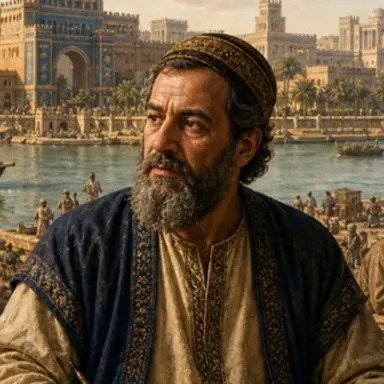
Rav Yosef bar Chama: The Scholarly Aristocracy of Mechoza
14 min read2,898 words
Summary
This article surveys the figure of Rav Yosef bar Chama, a Babylonian sage of the third generation, and presents him as a crucial link in the shaping of the scholarly aristocracy of Mechoza. The text emphasizes how Rav Yosef combined wealth and eminence with spiritual nourishment from the two giants of the generation—Rav Sheshet and Rav Nachman—thereby creating a unique synthesis between Tannaitic erudition and practical law. Beyond his halakhic rulings and his moral homilies, his central importance lies in his having been the father and educator of Rava, who is regarded as the architect of the Babylonian Talmud, while he invested his economic and social resources in establishing a splendid dynasty of Torah scholars. Ultimately, the source seeks to shed light on Rav Yosef's work not merely as that of a secondary figure, but as that of the one who laid the intellectual and social infrastructure that enabled Mechoza to become the leading Torah center in Babylonia.
The Work, Teaching and Torah Contribution of Rav Yosef bar Chama: The Scholarly Aristocracy of Mechoza
The Figure of Rav Yosef bar Chama in the Fabric of the Generations of the Babylonian Amoraim
An examination of Talmudic historiography of the third and fourth centuries CE reveals the figure of Rav Yosef bar Chama as a central, if sometimes understated, link in the consolidation of the Torah center of Mechoza. Rav Yosef bar Chama was active in the third generation of the Amoraic period in Babylonia, a period marked by the gradual shift of the weight of spiritual leadership from the old academies of Sura and Nehardea toward the new centers that grew up on the banks of the Tigris.[1, 2] His standing derives not only from his being a Torah scholar in his own right, but also from his historical role as the father and educator of Rava, one of the most influential figures in shaping the Babylonian Talmud and in establishing the dialectical method of study identified with Mechoza and Pumbedita.[3, 4]
Rav Yosef bar Chama was born and active in Mechoza, a city that was a suburb of Ctesiphon, the capital of the Sasanian Empire. This location is not a mere geographical detail; Mechoza was an economic and cultural crossroads where great wealth, proximity to the central government and a lively Jewish population that included merchants, craftsmen and many converts came together.[4, 5] Rav Yosef bar Chama belonged to the elite of this city, and is described in the sources as a very wealthy and highly respected sage, a fact that laid the economic and social infrastructure for the future growth of his son's study hall.[6, 7]
Recognizing Rav Yosef bar Chama as a key figure requires an analysis from three main angles: his Torah education in the shadow of the giants of the generation, his halakhic rulings and his moral thought as preserved in the Talmud, and his decisive influence on the shaping of the figure of his son Rava, who determined the halakha for generations.[1, 4]
The Scholarly Tradition: The Axis of Rav Sheshet and Rav Nachman
Rav Yosef bar Chama represents to a great extent the scholarly synthesis of Mechoza in the third generation. He was the foremost disciple of Rav Sheshet, but at the same time transmitted many traditions in the name of Rav Nachman bar Yaakov.[1] This combination of the two teachers attests to a complex method of study that joins phenomenal erudition in the Tannaitic traditions (Rav Sheshet) with legal acuity and practical experience as a judge (Rav Nachman).[7, 8]
Rav Sheshet as His Principal Teacher
The relationship between Rav Yosef bar Chama and Rav Sheshet was deep and long-lasting. Rav Sheshet, who was blind and renowned for his vast erudition in baraitot and toseftot, served as a counterweight to the pilpul method of the Pumbedita academy.[8] Rav Yosef bar Chama served as a conduit for transmitting Rav Sheshet's traditions to Mechoza. In the Talmud we find him raising difficulties before Rav Sheshet (for example in Bava Metzia 72b) and discussing with him the details of complex laws.[9] The ability to challenge Rav Sheshet, whose memory was regarded as a source of supreme authority, attests to a high scholarly level and to intellectual self-confidence on the part of Rav Yosef bar Chama.[8]
Rav Sheshet's influence is especially evident in Rav Yosef bar Chama's tendency to be precise in the wording of a tradition. Since Rav Sheshet was "erudite" (beki), as opposed to Rav Nachman, who was "sharp" (charif), his disciples were required to preserve the wording of the Tannaitic sources carefully. This trait was passed on to Rava as well, who, despite his fame as a master of reasoning and acuity, always took care to base his words on stable Tannaitic sources.[2, 4]
Rav Nachman and the Legal Tradition
In parallel with his studies under Rav Sheshet, Rav Yosef bar Chama was part of Rav Nachman's inner circle in Mechoza. Rav Nachman, who was the son-in-law of the Reish Galuta (the Exilarch) and the Av Beit Din of Mechoza, represented the practical side of halakha—judging, monetary law and the order of government.[7, 10] Rav Yosef bar Chama quotes Rav Nachman in key discussions in tractates Gittin and Chullin, which shows his active involvement in the legal life and public leadership of the city.[1, 2]
The combination of Rav Sheshet and Rav Nachman created a model of the "complete Torah scholar"—one who holds a wealth of baraitot in his bag but also knows how to apply them in the complex economic reality of Mechoza. Rav Yosef bar Chama, himself a wealthy man of property, found in Rav Nachman's method tools for dealing with questions of ownership, contracts and agency, areas that were critical for members of his class.[6, 11]
His Halakhic Teaching: Selected Discussions and Their Analysis
Rav Yosef bar Chama's teaching is scattered across the expanses of the Talmud, and focuses mostly on clarifying the words of his teachers or on citing legal precedents. An analysis of the discussions in which he appears reveals an inclination toward the laws of evidence, agency, and the forbidden and the permitted.
The Laws of Agency and Bills of Divorce
In tractate Gittin (14a) a tradition of Rav Yosef bar Chama in the name of Rav Nachman is cited, dealing with the laws of "take a maneh to so-and-so."[2] This discussion touches the heart of the laws of acquisition and agency: when the money becomes the property of the recipient, and what responsibility rests on the agent. The concern with agency in bills of divorce and in monetary matters reflects Mechoza's need to clarify legal powers, since the city served as a commercial center in which agents acted on behalf of merchants and businessmen.[11, 12]
In another discussion (Gittin 43b), his view is cited concerning a slave who is half free and half slave, a subject that combines the laws of acquisition with the laws of prohibition (the ability to marry).[13] These rulings reveal a broad legal outlook, which examines a person's personal status from a perspective of law and social justice.
Expertise in the Laws of Terefot
Tractate Chullin (56b) is another example of Rav Yosef bar Chama's erudition. There he transmits a tradition in the name of Rav Sheshet concerning a perforated rectum.[2, 13] The laws of terefot require a great deal of technical and anatomical knowledge, and the fact that Rav Yosef bar Chama was entrusted with transmitting these details attests that he was considered an authority in the field of practical inspection. The move from the pure logic of monetary law to the details of physiological reality in the laws of terefot underscores his being a multidisciplinary sage.[1, 14]
Thought, Ethics and Aggadah: The Social Perspective
Rav Yosef bar Chama did not limit himself to "pure" halakha, but also dealt with questions of ethics and society. His sayings in this area sometimes reflect the class and religious tensions of Mechoza.
The Cunning Wicked Man and Social Influence
In tractate Sotah (21a) Rav Yosef bar Chama appears in a homily that defines the "cunning wicked man" as a person who "sways others by his ways."[15] This is a profound socio-psychological insight: the cunning wicked man is not only one who breaks the law in secret, but one who uses charisma or social manipulation to shape public opinion in favor of his crooked way. In the context of an aristocratic city such as Mechoza, where social and economic power was great, this warning against hypocrisy and spiritual manipulation takes on added force.[15, 16]
The Moral Status of the Nations of the World
Another homily attributed to him (in the context of traditions in the name of Rav Sheshet or Rav Yosef) deals with the verse from Habakkuk, "He beheld, and released (va-yater) the nations."[17] According to the homily, the Holy One, blessed be He, examined the seven Noahide commandments and saw that the nations did not observe them, and therefore "released them to them"—that is, took from them the reward for observing them as one who is commanded and performs.[17] This homily reflects a theological reflection on the relationship between Israel and the nations, a subject that was very present in the daily life of the Jews of Mechoza, who lived in the heart of the Sasanian Empire and maintained close interaction with the gentile environment.[4, 6]
Mechoza as a Social and Torah Laboratory
To understand the work of Rav Yosef bar Chama, one must delve into the unique structure of his city, Mechoza. The city was not only a residential center, but a laboratory in which a new Jewish-Babylonian worldview took shape. The people of Mechoza were known as "shapirei" (handsome and elegant), possessed of a heightened aesthetic sensitivity and a certain hedonism.[18] Rav Yosef bar Chama, as part of the city's wealthy stratum, represented the model of "Torah and greatness in one place."[6, 7]
Rav Yosef bar Chama's wealth was no accident; it stemmed from his integration into the economic fabric of the capital. The Talmud mentions that the people of Mechoza engaged in international trade, and Rav Yosef bar Chama, in his homilies on the "cunning wicked man" and on the laws of agency, sought to bring the norms of the Torah into the stormy world of business.[11, 15] His wealth also enabled him to maintain a study hall and to invest in the education of his sons, which led to his family becoming a dynasty of Torah scholars.[7]
The Father behind Rava: The Family Legacy
Perhaps the greatest contribution of Rav Yosef bar Chama to Jewish history is the raising of his son, Rava (Abba ben Yosef bar Chama). Rava is not just "another Amora"; he is the chief architect of the Babylonian Talmud as we know it.[3, 4] The appellation "Rava son of Rav Yosef bar Chama" appears hundreds of times in the Talmud, something not common to such a degree among other Amoraim, and it attests that Rava's identity was interwoven with the identity of his father and with the legacy he received from him.[2, 4]
Education and Investment in His Sons
Rav Yosef bar Chama made sure that his son Rava studied with the greatest sages of the generation: Rav Chisda in Sura, Rav Yehuda in Pumbedita, and above all Rav Nachman in Mechoza.[4, 7] Rava's ability to move between the various Torah centers stemmed from his father's economic and spiritual backing. Rav Yosef bar Chama not only financed his son's studies, but also bequeathed to him his ties with Rav Sheshet and Rav Nachman, which became cornerstones of Rava's teaching.[1, 8]
The Talmud relates a story that tells of Rav Yosef bar Chama's prayer and his longing to see his offspring engaged in Torah. When he saw his sons and grandsons becoming Torah scholars, he knew that his prayer had been answered.[7] This bond between father and son also found expression in the respectful attitude that Rava held toward those of his teachers whose name was the same as his father's (such as Rav Yosef bar Chiya), an attitude steeped in paternal reverence.[3, 7]
Rami bar Chama and Mar Ukva bar Chama: Brothers?
There is disagreement and discussion among scholars as to whether Rami bar Chama, Rava's colleague, was also a son of Rav Yosef bar Chama (and thus Rava's brother). In some sources Rami bar Chama is mentioned as a foremost disciple of Rav Sheshet, like Rav Yosef bar Chama.[8, 18] Rava and Rami bar Chama studied together under Rav Chisda, and both even married (at different times) Rav Chisda's daughter.[4, 5] If they were indeed brothers, then Rav Yosef bar Chama raised two Torah giants who shaped the face of the fourth generation in Babylonia. Even if they were not biological brothers, the connection of both of them to Rav Yosef bar Chama and to his scholarly milieu in Mechoza is clear.[18]
The Encounter between "Rav Yosef" and "Rav Yosef bar Chama"
A critical point for students of the Talmud is the distinction between Rav Yosef (unqualified), that is, Rav Yosef bar Chiya, and Rav Yosef bar Chama. Rav Yosef bar Chiya was Rava's teacher and was known by the epithet "Sinai" because of his vast erudition, whereas Rav Yosef bar Chama was Rava's father.[3, 7]
The confusion between them is not accidental; both were active in the same scholarly milieu and both had a strong connection to Rava. Nevertheless, Rav Yosef bar Chama represents the generation that preceded Rav Yosef bar Chiya (or at the very least was among its elders). The essential difference lies in their role: Rav Yosef bar Chiya was the head of the Pumbedita academy, whereas Rav Yosef bar Chama was the founding figure of the Torah-aristocratic class in Mechoza.[7, 13]
The famous story of Rava, who would walk backward before Rav Yosef until his feet bled, refers to his teacher, Rav Yosef bar Chiya.[3, 7] Nevertheless, scholars point out that Rava's absolute admiration for his teacher may have stemmed from the identity of name with his late father, Rav Yosef bar Chama. Rav Yosef bar Chiya became for Rava a kind of spiritual father figure who continued the line of his biological father.[3, 19]
Political Aspects and Ties with the Sasanian Monarchy
Mechoza, because of its proximity to Ctesiphon, was a focus of political activity. Rav Yosef bar Chama, as an exceedingly wealthy man and a close associate of Rav Nachman (who had official standing before the crown), was probably involved in dealings with the Persian authorities.[4, 6] Although the explicit sources on ties with Queen Ifra Hormiz (the mother of Shapur II) refer to Rava, it is clear that the groundwork for these ties was laid by the father.[4, 5]
The ability to hold great wealth in the Sasanian Empire required a profound understanding of the laws of the kingdom and connections with government officials. Rav Yosef bar Chama knew how to combine loyalty to Jewish law with his functioning as a senior and respected citizen of the empire. His rulings in monetary matters and agency sometimes reflect the need to adapt Jewish law to a reality of international trade in which Jews and gentiles alike were involved.[6, 11]
His Death and Spiritual Testament
Rav Yosef bar Chama died in Mechoza, and his legacy passed to his son Rava. After the deaths of Rav Yosef (Rava's teacher) and of Abaye, Mechoza under Rava's leadership became the sole Torah center of Babylonia.[3, 4] This process would not have been possible without the firm foundations laid by Rav Yosef bar Chama—both on the economic and social level and on the scholarly level.[6, 7]
He will be remembered in Talmudic history not only as "Rava's father," but as the one who built the bridge between the ancient erudition of Rav Sheshet and the bursting creativity of Mechoza. His teaching, although it does not appear in whole volumes, is present on every page of the Gemara through his son, who continued to bear his name proudly: "Rava son of Rav Yosef bar Chama."[1, 2]
In sum, the work of Rav Yosef bar Chama is a clear example of quiet but influential leadership. He did not seek the crown of heading an academy for himself, but invested all his energy in building an infrastructure that would enable the next generation to reach new heights. Rava's Mechoza is to a great extent the fruit of the vision and toil of Rav Yosef bar Chama, the scholarly aristocrat who understood that wealth and spirit are not contradictory, but can complement each other in building the world of Torah.[4, 7, 18]
Sources19
- 1.רב יוסף בר חמא - ויקיפדיה, he.wikipedia.org/wiki/רב_יוסף_בר_חמא
- 2.Joseph bar Hama - Wikipedia, en.wikipedia.org/wiki/Joseph_bar_Hama
- 3.רבא - ויקיפדיה, he.wikipedia.org/wiki/רבא
- 4.Rava (Abba ben Joseph bar Ḥama) - Breslev – Israel, breslev.com/260176/
- 5.Rava (amora) - Wikipedia, en.wikipedia.org/wiki/Rava_(amora)
- 6.RABA (B. JOSEPH B. ḤAMA) - JewishEncyclopedia.com, jewishencyclopedia.com/articles/12469-raba-b-joseph-b-hama
- 7.Rav Joseph - Chabad.org, chabad.org/library/article_cdo/aid/112297/jewish/Rav-Joseph.htm
- 8.רב ששת - ויקיפדיה, he.wikipedia.org/wiki/רב_ששת
- 9.תולדות תנאים ואמוראים/ש/רב ששת - ויקיטקסט, he.wikisource.org/wiki/תולדות_תנאים_ואמוראים/ש/רב_ששת
- 10.Sages of the Talmud - Jewish Knowledge Base - Chabad.org, chabad.org/search/keyword_cdo/kid/12574/jewish/Sages-of-the-Talmud.htm
- 11.תורת המשא ומתן, asif.co.il/wp-content/uploads/2024/08/תורת-המשא-ומתן-א.pdf
- 12.חברותא - גיטין - תורת אמת, toratemetfreeware.com/online/f_02355.html
- 13.רב יוסף בר חמא – ויקישיבה, yeshiva.org.il/wiki/index.php/רב_יוסף_בר_חמא
- 14.רבא – ויקישיבה, yeshiva.org.il/wiki/index.php/רבא
- 15.ביאור:בבלי סוטה דף כא - ויקיטקסט, he.wikisource.org/wiki/ביאור:בבלי_סוטה_דף_כא
- 16.Untitled, asif.co.il/wp-content/uploads/2021/04/מחוזא-היהודית-הביטים-חברתיים.pdf
- 17.חברותא - עבודה זרה - תורת אמת, toratemetfreeware.com/online/f_02363.html
- 18.תולדות תנאים ואמוראים/ר/רבא (סתם) - ויקיטקסט, he.wikisource.org/wiki/תולדות_תנאים_ואמוראים/ר/רבא_(סתם)
- 19.פרשת במדבר: "אם אדם משים עצמו כמדבר זה שהכל דשין בו, תורה ניתנה לו במתנה" - מכון הרטמן, heb.hartman.org.il/parashat-hashavua-bemidbar-about-the-desert/