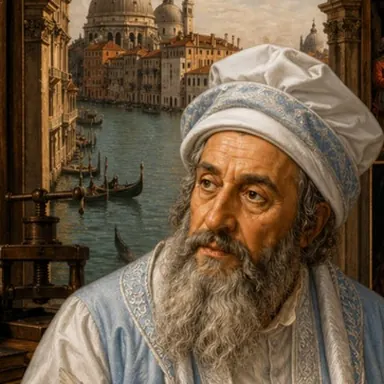
The Work and Torah Teaching of Rabbi Moshe Zacuto: Architect of Kabbalah, Halakha and Hebrew Drama in the Seventeenth Century
13 min read2,594 words
Summary
The text surveys the multidimensional figure of Rabbi Moshe Zacuto (the Ramaz), a 17th-century man of the spirit who served as a cultural junction between the mystical tradition of Safed and the communities of Italy and the West. The structure of the article examines his work as an architect of Kabbalah and halakha, emphasizing his decisive contribution to the dissemination of the writings of the Ari and to the shaping of the prayer book and of halakhic ruling in the light of the esoteric teaching. Alongside his Torah work, the text highlights the Ramaz's innovation as a pioneer of Hebrew drama, who used European literary tools to express profound Jewish content in the face of the challenges of the period. The central aim of the source is to present the Ramaz as an "all-encompassing sage" who sought to mend the rifts of the Jewish world through a unique synthesis of grammar, poetry, halakha and Kabbalah.
Introduction: The Encounter between the Renaissance and Kabbalah in Seventeenth-Century Italy
The seventeenth century in Italy was a period of momentous spiritual and political transformations, in which the currents of thought of the late Renaissance met the outburst of the Kabbalah of the Ari from Safed into the Jewish centers of Europe. At the heart of this process stands the mighty figure of Rabbi Moshe Zacuto (the Ramaz), a many-sided personality who served as a connecting link between the world of the conversos (anusim) in Portugal and the world of the yeshivot of Venice and Mantua, and between the plain meaning of pure halakha and the depths of the mystical secrets.[1, 2] The Ramaz was not only a halakhic decisor and a Kabbalist, but a groundbreaking creator who shaped the face of modern Hebrew drama, using European literary tools to express profound Jewish theological content.[2, 3]
The teaching of the Ramaz is a unique synthesis that sought to mend the rifts created in the Jewish world after the expulsion from Spain and against the background of the Sabbatean crisis. His work in correcting the texts of the prayers, in disseminating the writings of the Ari and in creating a new literary language made him a spiritual authority whose influence is evident to this day in the prayer book and in the relationship between halakha and Kabbalah.[1] His figure reflects the ideal type of the "all-encompassing sage", able to master the treasures of grammar and liturgical poetry alongside subtle study of the partzufim (configurations) of Atzilut and the rules of ruling of the Shulchan Arukh.[4]
Life History and the Course of His Spiritual Development
Rabbi Moshe ben Mordechai Zacuto was born in 1625 (some place his birth earlier) in Amsterdam, to a family of Portuguese origin that had emigrated to Holland after generations of life as conversos.[2] This family background is a key to understanding his personality; he grew up within a community that had returned openly to Judaism out of tremendous spiritual passion, but carried with it a broad cultural baggage that included familiarity with foreign languages and Christian literary structures.[3]
In Venice, which was a world center of printing, the Ramaz worked at proofreading books, a craft that demanded phenomenal erudition and linguistic precision. There, too, he began to establish a wide circle of disciples, among them Rabbi Binyamin HaKohen of Reggio (the Rabach) and Rabbi Avraham Rovigo, who became the continuers of his path in disseminating the esoteric teaching.[1] In 1673 he moved to Mantua following a proposal of his disciples, where he served as rabbi until his passing on 16 Tishrei 5458, leaving behind a spiritually shaped community and an extensive literary legacy.[1]
The Enterprise of Disseminating the Kabbalah of the Ari and Its Influence on Prayer
One of the most significant achievements of the Ramaz, which changed the face of Judaism in Europe, is his decisive role in the preservation and dissemination of the writings of Rabbi Chaim Vital. Until the days of the Ramaz, the Kabbalah of the Ari was the possession of a select few, and the original manuscripts were kept in the hands of a few families.[1]
The Ramaz as a Channel for Transmitting the Teaching of Safed to the West
Through his connections with Rabbi Binyamin HaLevi in Verona, who was a direct disciple of the Maharchu, the Ramaz gained access to the authentic writings of the Kabbalah of the Ari. He worked energetically to copy accurate manuscripts, proofread them and disseminate them among the circles of Kabbalists in Italy.[1] This activity was not merely technical; the Ramaz created an interpretive system that sought to make the abstract concepts of the Ari accessible to students, while taking care to keep the text clean of corruptions.[5]
His influence on the order of prayer was dramatic. The Ramaz was among the leaders in incorporating the customs instituted by the Jews of Safed into the Italian and Sephardic prayer book.[1] He stressed the importance of the kavanot (mystical intentions) of prayer not only as an intellectual act, but as an existential need for the repair of the upper worlds.[1] Customs such as Kabbalat Shabbat, Tikkun Chatzot and orders of prayer based on the Zohar received through him halakhic and public sanction, and thereby he contributed to the universalization of Jewish mysticism.[6]
His Halakhic Teaching: The Interplay between the Revealed and the Hidden
The Ramaz did not see a contradiction between the plain meaning of halakha and the words of Kabbalah as an obstacle, but as an opportunity to deepen the understanding of the will of God. He developed a halakhic methodology that gives great specific weight to the Book of the Zohar, while remaining faithful to the Talmudic framework.[4]
Rules of Ruling in the Light of Kabbalah
In his halakhic life's work, as reflected in his responsa and letters, the Ramaz applied a number of principles of decision that became foundations of later halakhic ruling:
The authority of the Zohar where the Gemara is silent: wherever there is no explicit decision in the Talmud, or where there is a dispute among the decisors, the opinion of the Zohar and of the Kabbalists is decisive.[4]
The supremacy of Kabbalah in the repair of the soul: in commandments connected with prayer, blessings and the purity of the soul, the Ramaz preferred the opinion of the Kabbalists even if it required a change from earlier customs.[4]
Dealing with "It is not in heaven": the Ramaz argued that the sages of the Zohar and the Ari were giants of the world in the revealed Torah, and that the holy spirit that hovered over them only helped them to uncover the halakha as it is inscribed in its supernal root.[4]
Applied Examples of His Halakhic Influence
The Ramaz influenced a series of everyday laws, some of which seem self-evident today but in his time required a courageous decision:
In addition, the Ramaz dealt with complex questions of the integrity and sanctity of books. In a period when books were rare, he dealt with dilemmas of the disgrace of holy writings and the prevention of their profanation.[7] He saw in every letter in the Torah scroll and in the holy books a representation of supernal lights, and therefore was very stringent in the laws of proofreading and writing.[1]
The Dramatic and Literary Work: From "Yesod Olam" to "Tofteh Arukh"
The uniqueness of the Ramaz in the rabbinic sphere stems to a great extent from his ability to combine dry halakhic language with stormy dramatic creation. He is regarded as the first revolutionary playwright in Hebrew, who succeeded in bridging a gap of a hundred years of Jewish dramatic silence.[3]
"Yesod Olam": A Manifesto of Faith in the Trial by Fire
The play "Yesod Olam" is a work of the Ramaz's youth, and it is a milestone in the history of Hebrew literature. The play deals with the story of Abraham our father, who smashes the idols of Terah and is cast into the fiery furnace by Nimrod.[2]
- Topical context: although the subject is biblical, the Ramaz wrote the play as a response to the suffering of the conversos in Portugal and Spain. The figure of Abraham standing before the fire is the personification of the proud Jew standing before the stake of the Inquisition.[3]
- Theological irony: the Ramaz uses Christian motifs (such as the crown of thorns) and performs an "ironic reversal" on them in order to strengthen Jewish faith and to show its superiority over modern idolatry.[3]
- Dramatic structure: the play is divided into acts and scenes according to the European model, which was a complete innovation in the rabbinic world of the 17th century.[2]
"Tofteh Arukh": A Cosmic Journey of the Soul
In his later work "Tofteh Arukh", the Ramaz moved from the rational debate of "Yesod Olam" to a mystical and moral description of the world of the inferno. The work, written in rhyme, describes in detail the journey of the soul after death and the punishments awaiting sinners in Gehinnom.[2, 3]
The book became one of the most influential works of mussar (ethics) in the communities of Italy and the East. The Ramaz used the vivid descriptions of Gehinnom not as a mere tool of intimidation, but as a means for the repair of the soul and guidance toward repentance.[1] Alongside "Tofteh Arukh" (on Gehinnom) he also wrote "Eden Arukh" (on the Garden of Eden), completing the cosmic map of reward and punishment.[1]
The Poetry of the Ramaz and Its Style
The Ramaz was a prolific poet who combined the classical Italian meters with Kabbalistic content. His poetry, collected in the scholarly edition "Esa et Levavi", includes sacred poems, occasional poems and liturgical poems (piyyutim) accompanying the Jewish life cycle.[1, 2] His well-known poem "Malakhei Shalom Hadar Tzur Hashmi'u" reflects his conception of the direct connection between the world of the angels and the deeds of man in this world.[2]
The Letters of the Ramaz: Jewish Leadership at a Crossroads
The book "Iggerot HaRamaz" (The Letters of the Ramaz) is a rare window onto the life of the Jewish community in the 17th century. The letters reveal the Ramaz as an involved leader, managing a ramified network of connections with the sages of his generation and with distant communities.[1, 8]
The Public Agenda of the Ramaz
In his letters the Ramaz dealt with a wide variety of burning issues:
- Affairs of the Land of Israel: the Ramaz saw in the settlement of the Land of Israel and in aiding its poor a supreme spiritual value. He conducted an extensive correspondence with the emissaries of the Land of Israel (shadarim) and worked to strengthen the connection between the diaspora and the spiritual center in Safed and Jerusalem.[2]
- The struggle against Sabbateanism: the Ramaz lived in the period of the upheaval of Shabbetai Zevi. Although at first there was messianic expectation among many, after the conversion to Islam the Ramaz acted resolutely to cleanse the communities of the movement's influences and to return faith to its traditional course.[1]
- Halakhic and Kabbalistic counsel: the rabbis of Italy turned to him with questions of establishing the text of the writings of the Ari and with intricate halakhic questions connected with the daily life of small and isolated communities.[1]
Commentaries on the Zohar: "Mikdash Melekh" and the Systematic Esoteric Teaching
The crowning achievement of his theoretical work is his comprehensive commentary on the Book of the Zohar, quoted extensively in the work "Mikdash Melekh". This commentary is regarded as one of the earliest and most successful attempts to give a systematic interpretation of the Zohar according to the way of the Ari.[5]
The Methodology of Kabbalistic Interpretation
In his commentary, the Ramaz applies the teaching of the partzufim and the sefirot to the Zoharic text meticulously:
- Conceptual analysis: the Ramaz breaks down the obscure words in the Zohar and shows how they allude to specific aspects in the world of Atzilut. In his interpretation of the word "ad", for example, he connects it with the sefirah of Yesod and the sefirah of Binah ("Imma"), using complex gematriot of holy names.[5]
- Unifying the hidden: the Ramaz strives to create harmony between the dramatic descriptions of the Zohar and the abstract mechanics of the Ari. He explains the influence of the supernal lights on the lower reality as a river flowing from its source.[5]
- Ethics and mysticism: for the Ramaz, the study of the Zohar is not merely theoretical study but a tool for refining the soul. He stresses that by virtue of the study of the Zohar Israel will go out of exile, since the light hidden in it is able to illuminate the darkness of exile.[6]
Further Torah Works and the Precision of Halakha
The Ramaz did not neglect the fundamental studies, and his works in the fields of the Mishnah and of names attest to a holistic conception of Torah study.
"Kol HaRamaz" on the Mishnah
A short and matter-of-fact commentary on the six orders of the Mishnah. Unlike his Kabbalistic commentaries, here the Ramaz adhered to the plain meaning of the words and to establishing the decided halakha, with the aim of enabling the student to acquire a basic mastery of the sources of the Oral Torah.[1]
"Sefer HaShemot" (The Book of Names)
This is a practical work critical for Jewish family life. The book deals with maximal precision in writing the names of people and places for the purpose of bills of divorce (gittin) and marriage contracts (ketubot).[1] The Ramaz understood that an error in a name could invalidate a get and cause grave halakhic problems of agunah status and mamzerut, and therefore he invested great effort in collecting traditions of writing from Romaniote, Sephardic and Ashkenazi communities.[1]
"Sefer HaYuchasin" (The Book of Lineage)
It deals with documenting the chain of tradition from Moses our teacher to his own days. The Ramaz saw tremendous importance in establishing the legitimacy of the Oral Tradition against challenges of Karaites or early maskilim, and he appended to the work responsa of the Geonim to strengthen rabbinic authority.[1]
Summary and Assessment of His Figure: The Kabbalist Who Shaped Generations
Rabbi Moshe Zacuto passed away in 1697, but his legacy continued to shape the face of Judaism in Italy and throughout the world. He was a rare figure who succeeded in preserving the tension between the written word and dramatic poetry, and between the mystical secret and halakhic law.[1, 3]
His Long-Term Influences
The Ramaz proved that the Hebrew language can serve as a tool for expressing complex ideas of identity, faith and human existence in the trial of exile. His figure remains a model of a rabbinate combining theoretical depth with artistic sensitivity, public leadership and uncompromising religious devotion.[3] His works, from the historical letters to the abstract commentaries on the Zohar, constitute one of the most glorious and influential chapters in the history of the Jewish spirit in the seventeenth century.[1, 5, 8]
Sources8
- 1.רבי משה זכות – ויקישיבה, yeshiva.org.il/wiki/index.php/רבי_משה_זכות
- 2.משה זכות - דף יוצר - פרויקט בן־יהודה, benyehuda.org/author/2295
- 3.יוצרים - משה בן מרדכי זכות – הרמ"ז ... - מוזיאון און-ליין של התיאטרון היהודי, jewish-theatre.com/he/artists/144
- 4.מבוא לשו"ת • אתר הרב מרדכי אליהו, harav.org/books/mahamar_mordechay_shot1-m1/
- 5.מקדש מלך, פירוש הרמ"ז על ספר הזהר ב׳:כ״ג א | ספריית ספריא, sefaria.org.il/Mikdash_Melekh,_RaMaZ_Commentary_on_Zohar.2.23a
- 6.ספר הזוהר - חב"דפדיה, chabadpedia.co.il/index.php/ספר_הזוהר
- 7.אם יש ללמוד הלכה מן התנך - מנחת אשר, minchasasher.com/he/shiur/פרשה-שיעורים/אם-יש-ללמוד-הלכה-מן-התנך-תשעו/
- 8.אגרות הרמ"ז / ר' משה זכותא - אוצר הספרים, sefer.org.il/items/3727388-אגרות-הרמ-ז-ר-משה-זכותא