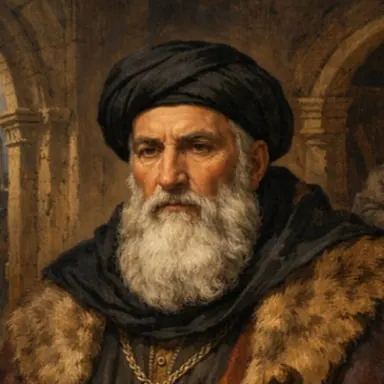
Rabbi Yitzchak ben Yehuda on the Formation of the Ashkenazi Tradition
12 min read2,437 words
Summary
This text surveys the wide-ranging figure of Rabbi Yitzchak ben Yehuda, one of the most important sages of Ashkenaz in the 11th century, who served as a central junction in shaping the halakhic and exegetical tradition of European Jewry. The article emphasizes his decisive role as the foremost teacher of Rashi and as the architect of the method of study in Mainz, focusing on his efforts to establish the text of the Talmud and to ground the supremacy of local custom as a binding legal instrument. Through the description of his stringent rulings and his contribution to the responsa literature, a portrait emerges of a spiritual leader who connected the tradition of the Geonim with the needs of the hour, and thereby laid the spiritual and communal foundation that survived even the upheavals of history. Ultimately, the source seeks to illuminate the hidden yet profound influence of this sage, whose presence is imprinted on every page of Gemara and on the Ashkenazi orders of prayer and custom to this day.
The Pillar of Mainz: The Work, Teaching and Halakhic Influence of Rabbi Yitzchak ben Yehuda on the Formation of the Ashkenazi Tradition
The eleventh century in Ashkenaz marked one of the most formative periods in the history of Jewish law and exegesis. At the center of this process stood the figure of Rabbi Yitzchak ben Yehuda, a sage who served not only as a link in the chain of transmission between the period of the Geonim and the period of the Rishonim, but as a true architect of the method of study and ruling in the Torah center of Mainz. As the foremost teacher of Rashi and as the continuer of the path of Rabbenu Gershom, Light of the Exile, Rabbi Yitzchak ben Yehuda shaped an entire generation of Torah scholars who determined the face of Judaism in Europe for hundreds of years.[1, 2]
The Historical and Geographical Background: The Flowering of the Rhineland Cities
The emergence of the Torah center in Ashkenaz did not take place in a vacuum. It was the result of processes of migration and economic growth that drew sages from Lorraine and northern France to the cities of the Rhine – Magentza (Mainz), Warmaisa (Worms) and Shpira (Speyer). Rabbi Yitzchak ben Yehuda, who was born around 1010, embodied in his personality this encounter between the different traditions. His origin in Lorraine, a region that was under both French and German cultural influence, gave him the intellectual basis that combined textual precision with loyalty to the customs of the ancients.[2, 3, 4]
At that time, the yeshiva of Mainz was the leading institution in the Jewish world north of the Alps. Under the leadership of sages such as Rabbenu Gershom and Rabbi Eliezer ha-Gadol – the teacher of Rabbi Yitzchak ben Yehuda – the yeshiva became a focus of halakhic and public authority.[2, 3] Rabbi Yitzchak, who was appointed head of the yeshiva, continued this enterprise while fortifying its standing as a center no longer absolutely subordinate to the centers in Babylonia, but creating independent norms adapted to the conditions of life in Christian Europe.[1]
Biographical Aspects and Family Lineage
Little is known about the personal details of Rabbi Yitzchak ben Yehuda, but the existing information reveals the figure of a spiritual leader whose life was interwoven with the history of his community. He served as head of the yeshiva in Mainz, and there is evidence that he held a similar post in Worms as well, where he apparently began to teach the young Rashi.[3, 4] There is a scholarly dispute regarding his stay in Paris; certain sources mention him as head of a yeshiva there, but modern scholars tend to see this as a mistaken attribution arising from confusion between sages with similar names.[3, 4]
The dates of his death are disputed among scholars, which attests to the upheavals these communities underwent at the end of the 11th century. Some place his death as early as 1080, while others place it as late as 1093.[1] The family tragedy that befell his house in the Tatnu decrees (1096) is a chilling testimony to the destruction of these centers: his son, Rabbi Yehuda, who was among the continuers of his path and the transmitters of his teaching, was murdered together with his wife Yehudit and their son Yitzchak for the sanctification of God's name.[1, 5] The remnants of his teaching survived mainly thanks to his disciples, who preserved his writings and his customs in the collections of the following generations.[1]
The Method of Study: Establishing the Text and Plain-Sense Interpretation
The contribution of Rabbi Yitzchak ben Yehuda to the study of the Talmud in Ashkenaz was revolutionary. In a period in which the Talmudic texts suffered from many copying errors, he devoted enormous efforts to establishing the precise text. The importance of this enterprise is expressed in the immense esteem Rashi held for him, preferring in many cases the readings of Rabbi Yitzchak over any other manuscript.[6]
The Commentaries Attributed to Rabbenu Gershom
Historical studies and textual analyses have shown that the commentaries printed in the editions of the Talmud under the name "Rabbenu Gershom" on many tractates are in fact a collective work of the beit midrash of Rabbi Yitzchak ben Yehuda.[2] These commentaries constitute a critical link in the development of exegesis; they are characterized by adherence to the plain meaning, by the explanation of difficult words (at times using la'azim, vernacular glosses) and by striving to understand the structure of the Talmudic passage.
This exegetical work in the beit midrash in Mainz laid the foundations for the method of Rashi, who learned from Rabbi Yitzchak the importance of precision and brevity.[1, 2]
The Halakhic Teaching: Between the Authority of the Geonim and Local Custom
The rulings of Rabbi Yitzchak ben Yehuda were characterized by a unique combination of loyalty to the Babylonian tradition of the Geonim together with a deep recognition of the validity of the emerging Ashkenazi custom. He was among the sages who enhanced the standing of the Babylonian Talmud as the supreme authority in Ashkenaz, at times at the expense of the Jerusalem Talmud, out of a desire to create halakhic uniformity.[1]
The Principle "Custom Overrides Halakha"
One of the most prominent guiding lines in the teaching of Rabbi Yitzchak was his attitude to the custom of the community. He held that custom is not merely an addition to halakha, but a legal instrument that can, in certain situations, uproot a written law.[1, 7] For him, custom is the living expression of the will of the community and of its holiness, and it constitutes testimony to a tradition passed down from generation to generation.
He used this principle not in order to be lenient, but often in order to fortify local stringencies. He saw the preservation of the customs of the fathers as a Torah-level commandment of "Do not forsake the teaching of your mother," and regarded custom as having a most binding legal status.[7] This conception gave the communities of Ashkenaz the spiritual resilience to stand up to the pressures of their surroundings, since it sanctified the practical way of life as an inseparable part of the giving of the Torah.
Stringency as a Fence and Safeguard
Rabbi Yitzchak was known as a "machmir" (stringent) decisor. His approach did not stem from extremism, but from a pedagogical and leadership conception that saw stringency as an instrument for protecting the community. He ruled that "it is a mitzvah to be stringent and to make a fence and safeguard for the matter."[1]
Prominent examples of his stringencies:
- Laws of libation wine (yayin nesekh): In a period of close economic ties with gentiles, Rabbi Yitzchak was stringent in every doubtful case of gentile contact with wine, in order to prevent the blurring of social boundaries.[1]
- The prohibition of meat with milk: He was stringent in the laws of ovens and vessels, and extended the prohibitions on baking bread with meat or cheese in the same oven, even when there were halakhic ways to be lenient.[1]
- Communal enactments: He gave communal enactments the force of Torah law, and regarded one who transgresses them as one who violates a divine command, thereby strengthening the authority of the community's leadership.[1]
The Connection with Rashi: Moreh Tzedek and Disciple-Colleague
The relationship between Rabbi Yitzchak ben Yehuda and Rashi is one of the most documented and influential in rabbinic literature. Rashi, who traveled from Troyes to Mainz in order to study in the glorious yeshiva, found in Rabbi Yitzchak not only a source of knowledge, but a model of leadership to imitate.[2, 5]
The Title "Moreh Tzedek"
Rashi's esteem for his teacher was so great that he calls him, in his responsa and in his commentary on the Talmud, by the title "Moreh Tzedek" (teacher of righteousness).[2] The use of this title is no accident; it expresses recognition of halakhic authority beyond doubt and of a personality that combines piety with scholarship. Rashi quotes his teacher dozens of times, at times to confirm an interpretation and at times to decide practical halakha.[2, 3]
Disputes and Mutual Enrichment
Despite the great respect, Rashi did not refrain from disagreeing with his teacher when he held that the plain meaning or the tradition required it. The dynamic between them was one of mutual enrichment; in certain cases, Rabbi Yitzchak ben Yehuda himself retracted his rulings after accepting the arguments of his disciple.[1]
This dialogue shaped the figure of Rashi as an independent decisor who succeeded in fusing the teaching of his masters in Ashkenaz into a new exegetical mold.[9]
His Written Work and His Influence on Halakhic Literature
Rabbi Yitzchak ben Yehuda did not leave behind a systematic halakhic book in the form familiar to us today, but his teaching is spread throughout the literature of the Rishonim. Some 65 of his halakhic responsa have been preserved in various sources, mainly through his disciples and their descendants.[1]
Secondary Sources That Preserve His Teaching
- Ma'aseh ha-Makhiri: written by the sons of Makhir, his foremost disciples in Mainz, it is the richest source for his customs and his everyday rulings.[1]
- Sefer ha-Pardes and Machzor Vitry: these works, which came out of the beit midrash of Rashi, incorporate dozens of rulings of Rabbi Yitzchak, especially in matters of prayer, the Sabbath and the festivals.[10, 11, 12]
- Shibbolei ha-Leket and Or Zarua: later books that quote Rabbi Yitzchak as a primary authority for the early tradition of Ashkenaz.[2, 3]
The dispersal of his teaching in so many sources attests that he was perceived as a "cross-cutting" authority – one whose words are relevant to all areas of Jewish life, from the domestic kitchen to the order of the community and public leadership.[1, 13]
An Analysis of the Areas of His Rulings and Prominent Decisions
A survey of his responsa and rulings reveals a rich and detailed halakhic world, touching on the practical dilemmas of the Jews of Ashkenaz in the 11th century.
In each of these areas, Rabbi Yitzchak ben Yehuda acted as a bridge. He took the abstract principles of the Gemara and turned them into practical guidelines, making sure that they did not contradict the existing custom in Mainz.[1]
Scholarly Controversies about His Figure and His Yeshiva
The figure of Rabbi Yitzchak stands at the heart of a lively debate among the great historians of the period of the Rishonim. The question of the distinctiveness of the yeshiva of Mainz as against the yeshiva of Worms is the focus of the dispute between J. N. Epstein and Aptowitzer.[2]
Epstein argued that under the leadership of Rabbi Yitzchak, the yeshiva of Mainz maintained a more conservative and precise line of study, focused on preserving the tradition of Rabbenu Gershom. In his view, Worms was more open to external influences. Aptowitzer, by contrast, rejected this sharp geographical distinction and argued that the differences were purely personal, and that all the sages of the Rhine formed a single spiritual unit.[2] Either way, no one disputes that Rabbi Yitzchak was the dominant figure who shaped the standards of study in Mainz in its golden age.[1]
Conclusion and Legacy: Yitzchak Demanded Suffering
The midrash about Isaac our father, who demanded suffering in order to cleanse the judgment [14], takes on symbolic meaning when one examines the history of the life and family of Rabbi Yitzchak ben Yehuda. He lived in a period of immense spiritual flowering, but one that stood in the shadow of an approaching catastrophe. Although he died before the Tatnu decrees, it was his teaching that gave his disciples the spiritual strength to cope with the destruction of the communities.
His legacy has remained alive through:
- Rashi's commentary: in every page of Gemara studied today, there are traces of the establishment of the text and of the plain meaning carried out by Rabbi Yitzchak in Mainz.[2, 6]
- The Ashkenazi prayer book: many customs that we see today as self-evident originate in the decisions of Rabbi Yitzchak on the question of custom versus halakha.[7, 11]
- Communal autonomy: the model of a community that governs itself by the power of its enactments and the authority of its sages was shaped to a great extent thanks to his legal outlook.[1]
Rabbi Yitzchak ben Yehuda was not only Rashi's teacher; he was the quiet architect of the Ashkenazi world, a sage who knew how to combine fortifying stringency with illuminating plain meaning, and loyalty to the written word with attentiveness to the living custom of the people.[1, 2] His work remains a testimony that even in periods of transition and upheaval, the power of Torah stems from the ability to deepen roots in tradition while raising a generation of disciples who will continue the path.[5, 15]
Sources15
- 1.יצחק בן יהודה – ויקיפדיה, he.wikipedia.org/wiki/יצחק_בן_יהודה
- 2.Isaac ben Judah of Mainz | Encyclopedia.com, encyclopedia.com/religion/encyclopedias-almanacs-transcripts-and-maps/isaac-ben-judah-mainz
- 3.ISAAC BEN JUDAH - JewishEncyclopedia.com, jewishencyclopedia.com/articles/8184-isaac-ben-judah
- 4.Isaac ben Judah - Wikipedia, en.wikipedia.org/wiki/Isaac_ben_Judah
- 5.Our Master, May He Live - Jewish Review of Books, jewishreviewofbooks.com/articles/759/our-master-may-he-live/
- 6.Isaac ben Menahem the Great | Encyclopedia.com, encyclopedia.com/religion/encyclopedias-almanacs-transcripts-and-maps/isaac-ben-menahem-great
- 7.תורת המנהג - מנחת אשר, minchasasher.com/he/shiur/פרשה-שיעורים/תורת-המנהג/
- 8.מחלוקת רש"י והרמב"ם באיסור ייחוד - Mercaz Harav | מרכז הרב, mercazharav.org.il/2020/12/29/מחלוקת-רשי-והרמבם-באיסור-ייחוד/
- 9.Rashi | Encyclopedia.com, encyclopedia.com/people/philosophy-and-religion/judaism-biographies/rashi
- 10.קיצור ש''ע ילקוט יוסף - כל הספר - תורת אמת, toratemetfreeware.com/online/f_01355_all.html
- 11.ספר הפרדס - Beurei Hatefila Home, beureihatefila.com/files/HaPardes.pdf
- 12.משנת ארץ ישראל על משנה חגיגה, ביבליוגרפיה קכז | ספריית ספריא, sefaria.org.il/Mishnat_Eretz_Yisrael_on_Mishnah_Chagigah,_Bibliography.127
- 13.כל כתבי מרן הגאון רבי יצחק אייזיק הלוי הרצוג זצ"ל : הרב הראשי לישראל | ספר - הספרייה הלאומית, nli.org.il/he/books/NNL_ALEPH997011555287005171/NLI
- 14.ביאור:תולדות יצחק - חיים בשני עולמות - ויקיטקסט, he.wikisource.org/wiki/ביאור:תולדות_יצחק_-חייםבשני_עולמות
- 15.חכמי אשכנז הראשונים : קורותיהם, דרכם בהנהגת הציבור, יצירתם הרוחנית ..., nli.org.il/he/books/NNL_ALEPH990022131420205171/NLI