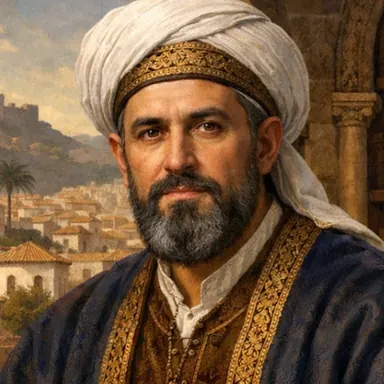
Rabbi Yitzchak ibn Ghiyyat
14 min read2,705 words
Summary
This source surveys the figure and influence of Rabbi Yitzchak ibn Ghiyyat (the Ritz Ghiyyat), who served as the architect of the Torah transition between the yeshivot of Babylonia and the emerging center in Spain in the 11th century. The text presents his work as head of the yeshiva in Lucena, where he combined the preservation of the tradition of the Geonim with an intellectual flowering that included philosophy and poetry. His monumental halakhic work, "Halakhot Kelulot," is described as a vital codificatory bridge that gathered the rulings of Babylonia and deeply influenced the great Rishonim such as Nahmanides (Ramban) and the Tur. In addition, the source emphasizes his contribution as a pioneer of Spanish religious poetry, developing the genre of the "bakkashah" (supplication), which combines linguistic precision with conceptual depth. In sum, the work sketches the figure of a multidimensional leader who succeeded in creating a creative continuity, and thereby laid the foundations for the "Golden Age" of Spanish Jewry.
Continuity and Innovation in the Torah of Spain: The Halakhic, Poetic and Exegetical Teaching of Rabbi Yitzchak ibn Ghiyyat
The historical passage of the centers of Torah from the yeshivot of Babylonia to the Iberian Peninsula in the 11th century represents one of the most significant transformations in the history of Jewish culture. At the heart of this process stands the many-sided figure of Rabbi Yitzchak ben Yehuda ibn Ghiyyat, known by his epithet the Ritz Ghiyyat. He was active in a period in which the authority of the Geonim began to wane, and the local communities in Spain and the Maghreb began to consolidate an independent Torah identity. The Ritz Ghiyyat was not merely a witness to these changes, but served as a central architect of the new Torah structure, preserving the tradition of Babylonia and blending it with the intellectual and poetic flowering of Andalusia.[1, 2] As head of the yeshiva in the city of Lucena, he raised a generation of disciples who shaped the "Golden Age," and his halakhic and liturgical work continues to resonate to this day in the prayer and legal traditions of Spanish and Eastern Jewry.[2]
Chapter 1: Lucena as a Torah Center and a Biography of Leadership
Lucena, called "Alisana" in Hebrew sources, was a unique city in the landscape of Muslim Spain. It was known as the "city of the Jews" because the majority of its population was Jewish, and it enjoyed broad cultural and religious autonomy. In this environment grew Rabbi Yitzchak ibn Ghiyyat, the son of a wealthy and respected family that filled leadership roles in the community.[1] His father, Rabbi Yehuda, was one of the sages of the generation, and the Ritz Ghiyyat continued the line when he served as head of the yeshiva and rabbi of the community, a role in which he served as the supreme authority not only for the people of his city but for sages from all over Spain and North Africa, who sent him questions in halakha.[1]
The life of the Ritz Ghiyyat reached its peak in the second half of the 11th century, a period in which Spain was divided into the "taifa" kingdoms after the disintegration of the Caliphate of Córdoba. The decentralized political reality allowed centers such as Lucena to flourish as islands of Torah stability. In the year 4849 (1089), following a severe illness, the Ritz Ghiyyat moved to Córdoba in the hope of finding relief and healing there, but there he returned his soul to his Creator. His loyalty to the city of his activity was evident even after his death, when he was brought for burial in Lucena beside the graves of his forefathers.[1]
The influence of the Ritz Ghiyyat on his disciples exemplifies the character of the center in Lucena under his leadership. It was not an institution limited to the study of Gemara alone; under his patronage grew poets such as R. Moshe ibn Ezra and philosophers such as R. Yosef ibn Tzaddik.[1] The combination of profound Talmudic scholarship with linguistic and philosophical sensitivity characterized the Ritz Ghiyyat himself and became a model for imitation for the generations that followed.
Chapter 2: "Halakhot Kelulot" – The Bridge between the Geonim and the Rishonim
The monumental halakhic enterprise of the Ritz Ghiyyat is called "Halakhot Kelulot," a work intended to encompass all the laws in force in the present time.[3] This book represents a first systematic attempt of its kind in Spain to summarize the Talmudic discussion in light of the legal tradition of the Geonim of Babylonia. The unique importance of "Halakhot Kelulot" lies in the fact that the Ritz Ghiyyat saw himself as loyal to the tradition of the Geonim, and in his book he incorporates hundreds of responsa and rulings of the Geonim of Sura and Pumbedita, some of which have not survived in any other source.[3]
The name "Halakhot Kelulot" (comprehensive laws) attests to the aspiration to halakhic harmony – the inclusion of the words of the Talmud together with the interpretations of the Geonim and the customs of the yeshivot into a single clear tractate. Over the generations, parts of the book were published under the name "Sha'arei Simcha," mainly those dealing with the subjects of the Sabbath, the festivals and mourning.[1, 4] The choice to focus on these areas attests to the communal need for a practical book of laws that would guide the public in everyday life and in the high and low moments of Jewish life.
The Structure of the Book and Its Main Contents
The surviving parts of "Halakhot Kelulot" reveal a methodology of halakhic summary based on the order of the Talmud but with an eye that examines actual practice.
- Laws of the Sabbath and festivals: The Ritz Ghiyyat discusses the details of the forbidden labors, the laws of kiddush and prayer, and the distinctiveness of each and every festival. He takes care to bring the opinions of the Geonim, at times deciding between contradictory traditions, and thereby creates a synchronization between the old Babylonian center and the emerging Spanish center.[3]
- Laws of mourning: This part is considered one of the most fundamental and important sources on the laws of mourning. Later decisors such as Nahmanides (Ramban) and the Tur relied on it almost exclusively in parts of the discussion, since it is a comprehensive repository of the responsa of the Geonim on matters of burial, shiva and mourning customs.[3]
A source for the teaching of the Geonim: The Ritz Ghiyyat was not content with quoting the bottom line; he brought the reasoning and the ways of thinking of the Geonim. For the modern scholar and for the learner throughout the generations, his book is a "time capsule" that allows a glimpse into the discussions that took place in Babylonia hundreds of years earlier.[3]
Commentaries and Later Editions
Although a large part of the work was lost, the parts that remained received extensive commentary in the 19th century, which attests to the vitality of his teaching. Rabbi Yitzchak Dov ha-Levi Bamberger, rabbi of Würzburg, wrote the commentary "Yitzchak Yeranen" on the book, thereby returning the Ritz Ghiyyat to the center of halakhic discourse.[3] Likewise, the commentary "Davar Halakha" on the laws of Passover and the Counting of the Omer was written by Rabbi Dov Ber Tzamber.[3]
Chapter 3: The Methodology of the Ritz Ghiyyat Compared with the Rif and the Rambam
To understand the work of the Ritz Ghiyyat, one must examine him against the giants of his generation, foremost among them the Rif (Rabbi Yitzchak Alfasi). The Rif aspired to create a "little Talmud," omitting the Talmudic give-and-take and focusing on the halakhic conclusion.[5] The Ritz Ghiyyat, by contrast, took a broader approach in "Halakhot Kelulot." He sought to preserve the Geonic heritage in all its splendor, including the discussions and the reasoning, and thereby created a book that is a kind of halakhic encyclopedia.[3]
The relations between the Ritz Ghiyyat and the Rif were complex and full of mutual respect. The Rif came to Spain from North Africa and settled in Lucena, where the Ritz Ghiyyat was active. Although they had deep halakhic disagreements – the Ritz Ghiyyat represented the conservative Babylonian tradition, whereas the Rif inclined to independent analysis of the Talmudic passages – great esteem prevailed between them. It is told that before his death, the Ritz Ghiyyat entrusted his son to the Rif so that he would continue his Torah education.[1]
Maimonides (Rambam), who was active about a hundred years later, saw in the Ritz Ghiyyat one of the important sources for the formation of the "Mishneh Torah." In his introduction to the Mishnah and in his responsa, he mentions the Ritz Ghiyyat with reverence. Nevertheless, the Rambam went one step further toward absolute codification without sources, whereas the Ritz Ghiyyat remained loyal to a structure in which source and ruling are interwoven.[3, 5]
Chapter 4: His Liturgical Poetry and Poetic Teaching – A Pioneer of Spanish Religious Poetry
Beyond his standing as a halakhic decisor, the Ritz Ghiyyat is considered the founder of the style of Spanish religious liturgical poetry. Hundreds of his liturgical poems have survived and have become an inseparable part of the festival prayer books.[2] His importance in this field stems from his being the first to apply the rules of pure Hebrew grammar and complex philosophical content within communal prayer.
The Genre of the "Bakkashah" and Philosophical Depth
One of the significant contributions of the Ritz Ghiyyat is the development of the genre of the "bakkashah." The bakkashah is a wide-ranging poetic work, usually in rhymed prose, dealing with abstract philosophical subjects such as the creation of the world, the essence of the soul, sin and confession.[6] Unlike the usual strophic liturgical poems, the bakkashah was meant to be recited by the individual and not only by the prayer leader, which points to a new emphasis on the personal and inner bond of the believer with his Creator.[6]
The style of the Ritz Ghiyyat in liturgical poetry is characterized by:
- Linguistic precision: the use of a sublime biblical Hebrew while avoiding the convoluted and riddling language that characterized the early liturgical poetry of the Land of Israel.[2]
- Philosophical content: the integration of concepts from the fields of astronomy, biology and Neoplatonic philosophy, out of the conception that knowledge of the Creator passes through an understanding of creation.[6]
- Broad structure: his works sometimes encompass the entire history of the world, from the first burst of creation to the future redemption.
The Spread of His Liturgical Poems in the Communities of Israel
The liturgical poems of the Ritz Ghiyyat were greatly cherished and were accepted into many festival prayer books. An especially prominent influence is evident in the prayer book "Siftei Renanot" of the community of Tripoli, where the Ritz Ghiyyat occupies a central place.[2] It is interesting to note that in the Eastern Ashkenazi rite as well there are liturgical poems signed "Yitzchak," which some scholars of poetry attribute to the Ritz Ghiyyat, which attests to the penetration of his influence beyond the cultural borders of Spain as well.[2]
Chapter 5: Commentary on the Bible and the Talmud – Remnants of a Giant
Although most of the exegetical writings of the Ritz Ghiyyat have not reached us in complete form, the existing evidence indicates that he was a prolific and innovative commentator. He wrote many commentaries on the Bible and the Talmud, which were characterized by a rationalist approach and by the use of the tools of grammar.[3]
Biblical Commentary
The Ritz Ghiyyat dealt extensively with the interpretation of the Five Scrolls. His commentary on the book of Ecclesiastes, for example, is mentioned by later commentators as an attempt to reconcile the contradictions in the book by way of reason and philosophy.[3] His approach was to understand the plain meaning within the broad conceptual context, and thereby he was among the first in Spain to pave the way for the plain-sense exegesis of Rabbi Avraham ibn Ezra and Radak.
Talmudic Commentary
In the field of the Talmud, the Ritz Ghiyyat was not content with ruling alone but dealt with explaining the Talmudic passages. A collection of his commentaries on tractate Bava Metzia survived and was printed in "Sefer ha-Ner" by Rabbi Zechariah Agamati and in the volumes of "Shitat ha-Kadmonim."[3] These fragments show that he focused on establishing the text of the Gemara and on explaining difficult words, relying on the tradition of the Geonim. He is considered one of the most authoritative sources for understanding the original readings of the Talmud as they were studied in the yeshivot of Babylonia.[3]
Chapter 6: Spiritual Leadership and Social Ties
The leadership of the Ritz Ghiyyat in Lucena was an example of multidimensional leadership. He not only taught Torah but also attended to the needs of the community and was involved in the lives of his disciples. His connection with R. Moshe ibn Ezra, for example, was especially deep; Ibn Ezra saw him as a spiritual teacher and literary mentor, and the influence of the Ritz Ghiyyat is evident in Ibn Ezra's sacred poems, which are characterized by the same devotion and the same grammatical precision.[1]
The Ritz Ghiyyat was active in a period in which the figure of the "sage" in Spain began to include knowledge of the sciences and philosophy as well. He saw no contradiction between scholarly Torah study and understanding the laws of nature, but saw them as complementary tools. This conception was passed on to his disciples, who became the spearhead of the Jewish intelligentsia in Andalusia.
Chapter 7: The Influence of the Ritz Ghiyyat in the Mirror of the Generations
Although a large part of the work of the Ritz Ghiyyat was lost, his influence did not fade. His rulings in "Halakhot Kelulot" continued to serve as a basis for halakhic discussions among the Rishonim in Spain and in Provence.
- Influence on Nahmanides: Nahmanides (Ramban), in his struggle to preserve the tradition of Spain, saw in the Ritz Ghiyyat a supreme authority. In his work "Torat ha-Adam," devoted to the laws of mourning, the Ritz Ghiyyat is one of the most frequently quoted sources.[3]
- Influence on the Tur: Rabbi Yaakov ben Asher (the Tur), author of the "Arba'ah Turim," uses the rulings of the Ritz Ghiyyat as part of the foundation on which the halakhic code of the people of Israel was built.
- Influence on the liturgy: His contribution to prayer is perhaps the most tangible part of his legacy today. In many communities, his liturgical poems are recited on the High Holidays and on the festivals, carrying the same philosophical power and linguistic precision that the Ritz Ghiyyat established some thousand years ago.[2]
Summary and Conclusions
Rabbi Yitzchak ibn Ghiyyat stands at the crossroads between Babylonia and Spain, between the period of the Geonim and the period of the Rishonim, and between halakha and poetry. His work in Lucena turned the city into a Torah lighthouse that drew to it the finest minds of the period.[1] In "Halakhot Kelulot" he saved large parts of the teaching of the Geonim from destruction and made them accessible to the new world of Spain.[3] As a poet, he laid the foundations of Spanish religious poetry, integrating into it philosophical depth and linguistic precision.[2, 6]
The figure of the Ritz Ghiyyat teaches about the power of creative continuity. He not only preserved the past, but poured it into new vessels suited to his time and place. In this way, he ensured that the Talmudic and Geonic heritage would continue to beat in the heart of the Jewish people, clothed in the finery of poetic beauty and conceptual precision. The legacy of the Ritz Ghiyyat is a living testimony to the ability of the Torah to renew itself without losing its roots, and his work remains a cornerstone in the spiritual edifice of the people of Israel to this very day.
Sources6
- 1.רבי יצחק אבן גיאת - ריצ"ג - MyTzadik, mytzadik.com/m/tzadik.aspx?id=748
- 2.יצחק אבן גיאת – ויקיפדיה, he.wikipedia.org/wiki/יצחק_אבן_גיאת
- 3.רבי יצחק אבן גיאת – ויקישיבה, yeshiva.org.il/wiki/index.php/רבי_יצחק_אבן_גיאת
- 4.שערי שמחה-מהרי"ץ גיאות ב"כ - ספרי אור החיים, sifreiorhachaim.co.il/product/שערי-שמחה-מהריץ-גיאות-בכ/
- 5.הספר ששינה ללא הכר את הפסיקה ההלכתית: הכירו את הרי"ף - BeitChabad.com - בית חבד, he.chabad.org/library/article_cdo/aid/3138271
- 6.לקסיקון אתר הפיוט והתפילה - הספרייה הלאומית, nli.org.il/he/discover/music/jewish-music/piyut/lexicon