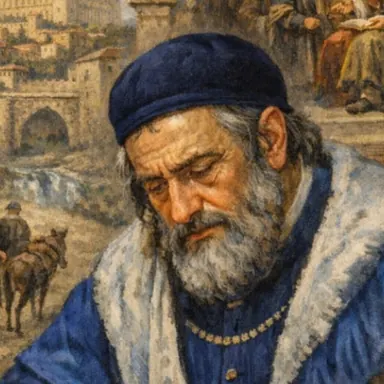
Rabbi Yehuda ben HaRosh: A Comprehensive Historical and Halakhic Examination
15 min read2,917 words
Summary
The text surveys the highly influential figure of Rabbi Yehuda ben HaRosh, a spiritual leader who was active in the 14th century and led the historic Torah transition from the Ashkenazi tradition to a center in Spain. The survey presents his firm public leadership in Toledo, which included broad judicial powers granted by the crown, alongside his extensive halakhic output in the work "Zikhron Yehuda," which combines Ashkenazi scholarship with the Spanish legal structure. Special emphasis is placed on the "Iggeret HaTokhachat" (Letter of Admonition), his ethical testament, which sketches a code of values of order, humility and devotion to study, and on his decisive role as a halakhic intermediary whose words became cornerstones for later authorities such as the author of the "Beit Yosef." In sum, the source illuminates his work as an intercultural bridge that succeeded in preserving the family heritage while adapting it to the complex political and social conditions of his generation.
The Work, Leadership and Torah Teaching of Rabbi Yehuda ben HaRosh: A Comprehensive Historical and Halakhic Examination
The history of Jewish halakha in the 14th century is marked by a dramatic transformation, a shift of the Torah center of gravity from the bleeding regions of Ashkenaz to the Iberian Peninsula. At the heart of this process stands the monumental figure of Rabbi Yehuda ben HaRosh, a halakhic authority, leader and man of the spirit who embodied in his personality and writing the complex synthesis between Ashkenazi Tosafist scholarship and the communal and legal structure of Sephardi Jewry.[1, 2, 3] Rabbi Yehuda, son and successor of the Rosh (Rabbi Asher ben Yechiel), was not merely a continuer of the path of his giant father, but an independent thinker and halakhic authority who shaped the face of the Jewish community in Toledo in a period of spiritual flourishing on the one hand and severe political and physical crises on the other.[1, 4, 5]
Family and Geographic Background: From a Cradle in Ashkenaz to the Rabbinic Seat in Toledo
Rabbi Yehuda's birth took place on a day laden with symbolism in Jewish history—the Ninth of Av 5050 (1290), in the city of Colonia (Cologne) in Germany.[1] A birth on this date, which is identified with destruction and exile but also with the hope of consolation, is almost a harbinger of the course of his life: uprooting from the Ashkenazi homeland and rebuilding a spiritual center in a distant land.[1] The Rosh's family was one of the most distinguished and important families in Ashkenaz; his father, Rabbi Asher, was the foremost disciple of the Maharam of Rothenburg, the last of the Tosafists and the undisputed leader of German Jewry.[1, 6]
The Move to Spain: The Trauma of Imprisonment and Emigration as Rescue
The decisive factor that led the family to leave Ashkenaz was the prolonged imprisonment and death in prison of the Maharam of Rothenburg. The Rosh, who feared that his fate would be like that of his teacher—imprisonment for the purpose of ransom and financial exploitation of the community by the authorities—decided in 1303 to leave Germany with his entire family.[1] Rabbi Yehuda was then about 13, an age of transition to maturity, and the experiences of flight and wandering left a deep mark on him, as is reflected in his famous testament.[7, 8]
The family passed through France and Italy until it reached Spain. In 1305, when Yehuda was only 15, his father sent him ahead to Toledo (Toletula) to examine the living conditions, the level of study and the communal structure in the city.[1] This mission attests to the early maturity and to the complete trust that the Rosh had in his son Yehuda already in his youth. Toledo at that time was a central city in the Kingdom of Castile, and its Jewry enjoyed a firm political and economic standing, although it was in need of spiritual renewal and of a halakhic authority that would unite the ranks.[2, 5]
Milestones in the Biography of Rabbi Yehuda ben HaRosh
Public Leadership: A Rabbinate Under the Patronage of the Crown
After the death of the Rosh in 1327, Rabbi Yehuda became the dominant spiritual leader of Toledo and of the entire Kingdom of Castile.[1, 2] His standing was fundamentally different from that of the rabbis of Ashkenaz; he was recognized by the crown as "chief of the rabbis," a position that carried with it broad judicial and executive powers.[1, 5]
Judicial Authority and Capital Cases
One of the most distinctive features of Rabbi Yehuda's rabbinate was the use of the authority to adjudicate capital cases, something that was extremely rare in the Diaspora.[1, 7] Under Castilian rule, the Jewish community was granted a certain legal autonomy that enabled it to punish criminals, informers (mesorim) and heretics (minim) severely. In his responsa (for example, no. 75), Rabbi Yehuda discusses the laws of death for heretics and apikorsim, analyzing the position of Maimonides (Rambam) and applying it to the complex reality of Spain.[7]
In another famous case documented in responsum 79, a case is discussed of a violent man who attacked a judge in the beit din and even tore out his beard in revenge for a ruling that did not please him.[7] Rabbi Yehuda wrote that had the case occurred in Toledo, the beit din would have decreed amputation of the attacker's hands, a deterrent punishment intended to preserve the honor of the legal system and the ability of judges to rule without fear.[1] This approach reflects the need of the community leadership in Spain to cope with violent internal elements who showed contempt for Torah authority.[5]
His Relations with His Brother and the Author of the Turim
The relationship between Rabbi Yehuda and his brother, Rabbi Yaakov ben Asher (the author of the Turim), provides deep insight into the family and spiritual dynamics of the House of the Rosh. Whereas Rabbi Yehuda held an official post, enjoyed governmental powers and ran the community with a strong hand, Rabbi Yaakov chose a life of extreme simplicity and poverty.[6, 9] Rabbi Yaakov refused to accept any payment from the community and devoted his life to writing the "Arba'ah Turim," the halakhic codex that would reshape halakha.[9]
Despite the difference in way of life, the cooperation between them was close. Their father, the Rosh, appointed the two of them together to serve as charity wardens, a task that demanded complete integrity and familiarity with the hardships of the community.[6] In addition, the ties were also familial: Rabbi Yehuda was married to the daughter of Rabbi Yaakov (or Rabbi Yaakov was Yehuda's son-in-law; there are different versions that point to marriage ties within the family in order to preserve the Ashkenazi tradition).[1] This family unity enabled the House of the Rosh to exert influence on two planes at once: the leadership-political plane (Rabbi Yehuda) and the literary-halakhic plane (Rabbi Yaakov).[9]
His Halakhic Teaching: The Responsa "Zikhron Yehuda"
The book "Zikhron Yehuda" is the central work that has remained from Rabbi Yehuda, and it constitutes the backbone of his Torah teaching.[3, 7] The book contains 91 sections (in the original editions) that cover all areas of life—from the laws of prayer and the synagogue to the laws of marriage, criminal law and matters of thought.[7, 10]
The Methodology of Ruling: A Synthesis of Ashkenaz and Sepharad
Rabbi Yehuda faced an immense challenge: to implant the Ashkenazi tradition of ruling, which rests on a dynamic analysis of the Talmud (in the style of the Tosafists), into a Sephardi world accustomed to the absolute authority of the Rif and Maimonides (Rambam).[3, 11] In his responsa he displays splendid mastery of both traditions. He cites the "great luminaries" of Spain with great respect, but did not shrink from deciding according to the view of his father the Rosh when he held that the scholarly truth lay with him.[3]
His rulings are characterized by systematic method and clarity. He is not content merely with providing the bottom line, but lays out before the questioner the development of the halakha from the Gemara, through the various commentaries, to the practical application in the local reality of Toledo.[5] This approach made him one of the preferred sources of Rabbi Yosef Karo when he came to write the "Beit Yosef," where he uses Rabbi Yehuda's words to understand the depth of the Rosh's intention.[1, 12]
Key Topics in "Zikhron Yehuda"
"Iggeret HaTokhachat": The Ethical and Biographical Testament
Rabbi Yehuda's most famous and influential composition among the general public is without doubt his testament, known as "Iggeret HaTokhachat" (Letter of Admonition).[1, 13] This document goes beyond the definition of a legal "testament" dealing with the division of property; it is a literary-ethical work intended to give his sons and the coming generations a spiritual and moral compass.[13, 14]
The Historical Importance of the Testament
Unlike many of the sages of his generation whose personal lives remained shrouded in fog, Rabbi Yehuda shares in his testament intimate biographical details that make it possible to reconstruct the history of his family.[7, 8] He describes the severe eye disease from which he suffered from childhood, an illness that greatly limited his ability to read and write and made every page of Gemara he studied an act of supreme devotion.[7] He attributes his success in study to an open miracle and to his father's blessing, and in this he tries to instill in his sons the faith that no physical obstacle can stand in the way of the desire to cleave to the Torah.[7, 14]
Ethical Principles and the Conduct of the Household
In the testament he outlines a way of life based on order, self-discipline and humility. He stresses that the key to the World to Come is not only the outward deed but the intention in the heart: "It is not by the gravity of the punishment that you can know the commandments... but only what the Torah obligated... and in any case, for the World to Come they go only after the inclination of the thoughts of hearts."[15] In this he continues the Ashkenazi line of the "Ashkenazi Pietists," which attributes great weight to a person's inner world.
He instructs his sons on very practical matters:
- Financial management: He warns them against debts ("Do not profane the honor of your face through a loan") and stresses that proper management of expenses is half of the income ("an orderly expenditure is half a livelihood").[16]
- Daily routine: He demands that they rise at dawn ("at the song of the birds") and hasten to the service of the Creator without being "lazy."[16]
- Attitude to books: One of the moving passages in the testament deals with his library. He commands them to regard books as their best friends ("make your books your companions"), to keep them clean, to arrange them on orderly shelves, and to lend them to others generously but under supervision, so that Torah not be forgotten from Israel.[13, 14]
His Literary Work and Lost Writings
Rabbi Yehuda was a prolific writer who turned his hand to many genres, some of which survived and some of which were lost in the wanderings of the exiles.
Chukkat HaTorah and the Commentaries on the Talmud
Sources mention a book called "Chukkat HaTorah" that Rabbi Yehuda composed.[1, 4] This book was apparently a collection of ordinances and practices for the community and for the study of Torah. Although the book has not reached us in its entirety, remnants of it have been found in manuscripts from the Cairo Genizah and in quotations by other Rishonim, and they were printed in the new editions of "Zikhron Yehuda."[3] In addition, he composed a commentary on tractate Shabbat and possibly on additional tractates, but these were lost during the expulsion from Spain or in the pogroms of the 14th century.[1]
Poetry and Piyyut
The influence of the Spanish environment is evident in Rabbi Yehuda's inclination toward poetry. Unlike his father the Rosh, who wrote mainly dry halakhic prose, Rabbi Yehuda wrote poems and piyyutim that adorn his books and his testament.[7, 13] Poetry served him as a tool of religious and emotional expression, and it reflects the high level of culture of the Jews of Toledo, who regarded poetry as an intellectual and spiritual value complementing Torah scholarship.[7]
His Influence Across the Generations: From the Author of the Turim to the Shulchan Arukh
Rabbi Yehuda's standing in the hierarchy of the halakhic world was determined to a large extent thanks to the role he played as an intermediary of his father's teaching.[1, 3] The Rosh is considered one of the three "pillars of halakhic instruction" on which the Shulchan Arukh rests, and Rabbi Yehuda was the most authoritative interpreter for understanding the Rosh's rulings in a changing reality.[11, 12]
The Connection with the "Beit Yosef"
Rabbi Yosef Karo cites "Zikhron Yehuda" dozens of times in his work "Beit Yosef."[1, 12] For Maran, the author of the Beit Yosef, Rabbi Yehuda is not merely "the son of," but a halakhic authority of independent weight whose opinion can decide difficult disputes. Rabbi Yehuda's ability to take the Ashkenazi Tosafist principles and clothe them in a systematic Sephardi garb made his words especially accessible and influential on the development of Sephardi halakha in the centuries that followed.[11]
Disciples and Continuity
Rabbi Yehuda raised up many disciples who continued his path in Toledo and in other cities of Spain. The most prominent among them was Rabbi Menachem ben Zerach, author of the book "Tzedah la-Derekh."[1] In this book, Rabbi Menachem preserves many of the practices and rulings that he heard from his teacher in Toledo, and thereby constitutes a further link between the generation of transition and the later Jewry of Spain. Another disciple was Rabbi Machir, author of "Avkat Rokhel," who was also deeply influenced by the method of study and ruling of the House of the Rosh.[1]
His Death and the Legacy of the Golden Generation in Toledo
The end of Rabbi Yehuda was both tragic and symbolic. In the year 5109 (1349), the Great Plague—the "Black Death"—struck Europe and the Iberian Peninsula.[1] The plague killed a considerable percentage of the Jewish community of Toledo, and did not spare the rabbi's family. Rabbi Yehuda died on the 17th of Tammuz 5109, the date that marks the breaching of the walls of Jerusalem, and thus a glorious chapter of Torah leadership in Spain was sealed.[1]
Together with him, many members of his family died, a fact that caused deep shock in the community.[1] He was brought to burial in the Jewish cemetery in Toledo, and his gravestone, alongside his testament, became sources of inspiration for Spanish Jewry even in its difficult days before the expulsion.
Conclusions and Insights on His Work
The figure of Rabbi Yehuda ben HaRosh teaches about the power of spiritual leadership in times of crisis. He succeeded in carrying out a cultural and geographic transition without losing his original identity, and in the process enriched the world to which he came.
- Synthetic leadership: He created a model of a rabbinate that combines state-granted legal authority with uncompromising spiritual authority. This model enabled the Jewish community to maintain strong internal autonomy in the face of external pressures.[1, 5]
- Halakha and life: His halakhic teaching in "Zikhron Yehuda" shows how halakha confronts burning social questions (violence, heresy, local customs) while preserving traditional continuity.[3, 7]
- Education and ethics: In his testament he laid the foundation for a Jewish education based on the "Duties of the Heart" and not only on mechanical observance of the commandments. His emphasis on intention, order and the attitude to books became an inalienable asset of Jewish thought.[13, 14, 15]
- Preservation and dissemination: The fact that his works were printed and disseminated hundreds of years after his death (in Berlin, Jerusalem and throughout the Jewish world) attests to the eternal relevance of his words. The new editions of "Zikhron Yehuda" published by Machon Yerushalayim and the Shlomo Aumann Institute in the Hebrew year 5765 continue to make his teaching accessible to the present generation, while correcting corruptions on the basis of ancient manuscripts from the Genizah.[3, 7]
Rabbi Yehuda ben HaRosh remains to this day a symbol of a rabbi who combines the dignity of a community leader with personal humility and a profound life of the spirit. His contribution to the shaping of halakha, together with his influence on his brother the author of the Turim and on Rabbi Yosef Karo, places him as one of the great Rishonim who shaped the face of the Jewish world as we know it today.[1, 11, 12]
Sources16
- 1.יהודה בן הרא"ש – ויקיפדיה, he.wikipedia.org/wiki/יהודה_בן_הרא"ש
- 2.יהדות טולדו - ויקיפדיה, he.wikipedia.org/wiki/יהדות_טולדו
- 3.שו"ת זכרון יהודה - ר"י בן הרא"ש - מכון שלמה אומן, machonso.org/publications/item.asp?id=1261
- 4.טולדו - מידע היסטורי | Toledoexperience ס - סיורים בטולדו, toledoexperience.com/about-1-1
- 5.Legal Decision-Making in Fourteenth-Century Toledo: The Responsa of Rabbi Judah ben Asher (Chapter 2) - Leadership and Conflict, cambridge.org/core/books/leadership-and-conflict/legal-decisionmaking-in-fourteenthcentury-toledo-the-responsa-of-rabbi-judah-ben-asher/C7E2F8A7F38EB969D5C01DDE075DB49B
- 6.בעל הטורים - הרב יעקב בן אשר | הילולה ב- י"ב תמוז - המאיר לארץ, hameir-laarets.org.il/hilulots/הרב-יעקב-בן-אשר-הכט-1269-הקג-1343/
- 7.זכרון יהודה – ויקיפדיה, he.wikipedia.org/wiki/זכרון_יהודה
- 8.יהודה בן הרא"ש – ויקיפדיה, he.wikipedia.org/wiki/יהודה_בן_הרא"ש#צוואתו
- 9.Jacob Ben Asher | Encyclopedia.com, encyclopedia.com/people/philosophy-and-religion/judaism-biographies/jacob-ben-asher
- 10.זכרון יהודה -- יהודה בן אשר - HebrewBooks.org Sefer Detail, hebrewbooks.org/762
- 11.שיחה:רא"ש - חב"דפדיה, chabadpedia.co.il/index.php?title=שיחה:רא"ש&mobileaction=toggle_view_desktop
- 12.הרא"ש: החכם האשכנזי שברח לספרד - BeitChabad.com - בית חבד, he.chabad.org/library/article_cdo/aid/3327269
- 13.Ethical Wills - Jewish Virtual Library, jewishvirtuallibrary.org/ethical-wills
- 14.Ethical will - Wikipedia, en.wikipedia.org/wiki/Ethical_will
- 15.רבי יהודה החסיד: על ספר חסידים וצוואה מסתורית - BeitChabad.com - בית חבד, he.chabad.org/library/article_cdo/aid/3255578
- 16.Examples of ethical wills - Personal Legacy Advisors, personallegacyadvisors.com/examples-of-ethical-wills/