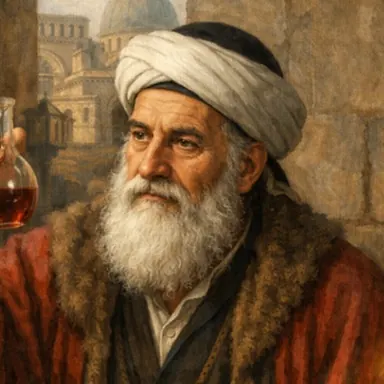
The Work, Torah Teaching and Historical Influence of Rabbi Yehuda ben Binyamin ha-Anav (the Rivevan)
15 min read3,049 words
Summary
The article surveys the figure and influence of Rabbi Yehuda ben Binyamin ha-Anav (the Rivevan), who served as the chief architect of halakha and tradition in Italian Jewry during the thirteenth century. The text highlights how the Rivevan, who combined in his personality deep Torah scholarship with the profession of medicine, established a flourishing family study hall that gave rise to foundational works such as "Shibbolei ha-Leket" and "Tanya Rabbati." The author explains that a considerable part of his commentaries on the Talmud were mistakenly absorbed under the name of Rashi, but that in fact they constitute a unique interpretive bridge between the sages of Babylonia and Spain and the ancient Italian custom. Ultimately, the work presents the Rivevan as an exemplary rationalist figure who succeeded in preserving the spiritual identity of the "Benei Roma" in the face of the competing centers in Europe, while leaving an indelible mark on the world of halakhic ruling and liturgy.
The Spiritual Crossroads of Italian Jewry in the Thirteenth Century
The thirteenth century in Rome and its surroundings represents one of the most decisive and formative periods in the history of Italian Jewry, a period in which the local halakhic identity took shape in the face of the great centers of Torah in Spain, Ashkenaz and France. At the heart of this development stands the mighty figure of Rabbi Yehuda ben Binyamin ha-Anav, known by the acronym Rivevan, and at times by the poetic epithet "Rabbi Ya'aleh" (Yehuda Anav le-Beit ha-Anavim). The Rivevan was active in Rome at a time when the city was not only the world center of Christianity, but also a living laboratory for the fusion of ancient Jewish traditions with innovative methods of study.[1] The Anavim family (Degli Mansi), to which he belonged, was considered one of the four distinguished families brought by Titus from Jerusalem to Rome, and it produced a long line of sages who were entrusted with preserving the tradition of the Land of Israel while remaining open to the influences of the Geonim of Babylonia and the Western decisors.[2]
The Rivevan's work extends along several main axes: wide-ranging commentary on the Babylonian Talmud and on the Book of Laws (Sefer ha-Halakhot) of the Rif, halakhic ruling based on the ancient Italian custom, and the establishment of a study hall that became a hothouse for the great figures of the next generation, among them the author of "Shibbolei ha-Leket" and the author of "Tanya Rabbati."[1, 3] Understanding his figure requires a dive into the socio-religious fabric of Roman Jewry, in which the sage was not merely a detached decisor, but often also a physician, a man of science involved in the life of the community and in its relations with the authorities.[2, 4] The Rivevan embodied in his personality the figure of the Italian "sage-physician," a combination that made possible a deep understanding of the physiology of the commandments and a rational analysis of the Talmudic text.
The Genealogy and Structure of the Anavim Family in Rome
The Anavim family was a kind of spiritual aristocracy, and the family ties within it formed the infrastructure for the transmission of the tradition. The Rivevan worked alongside his brothers and cousins, each of them contributing a different layer to the edifice of Italian halakha. Understanding these ties is essential for identifying the sources of the later halakhic literature.
This family structure created a "family study hall" in which the Rivevan served as the supreme authority. In the works of his students he is called "mori achi sheni" ("my teacher, my second brother"), an expression combining family closeness (a cousin) with intellectual admiration.[3]
His Interpretive Teaching: The Rivevan on the Rif and the Talmud
The Rivevan's fame in the modern yeshiva world stems mainly from his commentary on the Book of Laws of Rabbi Yitzchak Alfasi (the Rif). The Rivevan's choice to focus on the Rif is no accident; the Rif is considered a "little Talmud" and the backbone of halakhic ruling. However, the Rif's brevity and his omission of the Talmudic give-and-take created a need for an explanation that would connect the halakhic conclusions back to their sources in the Gemara.[5] The Rivevan filled this gap with remarkable systematicity.
The Methodology of the "Commentary of the Rivevan"
The Rivevan adopted an interpretive style combining the clarity and conciseness of Rashi with the structural analysis of the sages of Spain. In his commentary he not only explains difficult words, but strives to understand the "method" of the Rif: why the Rif chose to omit a certain passage and why he ruled according to one opinion and not another.[5]
One of the prominent characteristics of his work is the extensive use of accurate manuscripts. The Rivevan lived at a time when the text of the Talmud was subject to changes and corruptions, and he devoted great effort to establishing the original text, comparing the traditions of Italy with traditions that had arrived from northern Europe.[8] His influence was so great that extensive parts of his commentary were absorbed into the printed editions of the Rif under the name "Rashi," but studies and internal examinations of the text reveal his true identity.[8] In these texts one can find expressions such as "and according to Rashi's interpretation one must say," which proves that the writer is a later sage who interprets Rashi and criticizes him, namely the Rivevan or one of his close students.[8]
A Thematic Survey of His Commentaries on the Tractates of the Talmud
The Rivevan did not write a continuous commentary on the entire Talmud, but focused on the tractates that formed the heart of halakhic and communal activity. His commentaries on the tractates of the Order of Moed are the most detailed, since they deal with the laws of the festivals and fasts that are central to the life of the people.[9]
- Tractate Taanit: in this commentary the Rivevan reveals himself as one versed not only in the settled halakha, but also in the conceptual and liturgical meaning of the prayers for rain. He discusses at length the difference between "mentioning rain" and "requesting rain," and the connection between the judgment by which the world is judged on the festival of Sukkot and the climatic reality.[9]
- Tractate Sukkah: the Rivevan deals with complex topics such as the "water libation": whether it is an obligation of the day or an obligation of the sacrifice. He cites the words of Nahmanides (Ramban) and confronts them with other traditions, which attests to his being up to date with the novel insights of his generation in Spain.[9]
- Tractate Moed Katan: this commentary, sometimes printed under the name of Rashi on the Rif, deals with the laws of mourning. The Rivevan stresses here the practical laws arising from the Talmudic stories, such as the removal of shoes and the laws of "distant news."[5]
The Connection between the Rivevan and "Shibbolei ha-Leket" and "Tanya Rabbati"
An understanding of the Rivevan's work is incomplete without examining the deep connection between his study hall and the two central halakhic works of Italy in the 13th century. The book "Shibbolei ha-Leket" by Rabbi Tzidkiyah the Physician and the book "Tanya Rabbati" (the Italian Book of the Tanya) are not merely books of halakha, but in effect constitute a summary of the Rivevan's teaching as it was transmitted to his students.[3]
The Common-Source Theory of Rabbi Yisrael Braun
An old bibliographical question concerns the surprising similarity, amounting to textual identity, between extensive passages in "Shibbolei ha-Leket" and "Tanya Rabbati." Whereas early scholars held that one of the books is an abridgment of the other, Rabbi Yisrael Braun, in his introduction to the Mossad HaRav Kook edition of "Tanya Rabbati," offers a deeper insight.[3, 6] In his view, the two books were written independently by two students who sat before the Rivevan.
The Rivevan, as head of the yeshiva, delivered lessons and halakhic instructions. Rabbi Tzidkiyah recorded the material in a broad and systematic form in "Shibbolei ha-Leket," while another student (apparently Rabbi Yechiel ben Yekutiel) recorded it in the format of a book of customs and concise laws, which in time became the "Tanya Rabbati."[3, 6] The similarity of content stems from the fact that both authors draw from the same living source: the oral teaching of the Rivevan. This explains why both cite the Rivevan as the supreme authority and why both bring identical traditions in the name of "the grandfather, Rabbi Binyamin."[3, 7]
Structure and Hierarchy in the Works Influenced by the Rivevan
The Rivevan's influence on "Shibbolei ha-Leket" is so decisive that this book can be seen as the encyclopedia of the Rivevan's teaching. Rabbi Tzidkiyah does not content himself with bringing the halakhic ruling, but brings the discussion that took place in the study hall, the difficulties the Rivevan raised against the Rishonim and his original resolutions.[3]
Halakhic Ruling and Communal Leadership: Between Tradition and Innovation
The Rivevan acted as a spiritual leader (Mara D'Atra) in Rome, and his teaching reflects the effort to preserve the local custom in the face of the pressures of the Torah of Ashkenaz and Spain. While the sages of Italy admired Rashi and the Rif, they saw themselves as the continuers of an ancient and independent tradition.[3, 10]
The Centrality of the Italian Custom (Minhag Benei Roma)
In the Rivevan's teaching, custom is not merely "ritual," but a halakhic source of great weight. In "Shibbolei ha-Leket" many rulings are brought in which the Rivevan decides against the opinion of the Geonim or of the Rif, on the grounds that "this is how our fathers practiced."[3] The Italian custom, represented in the "Machzor Benei Roma," includes unique prayer texts and liturgical poems (piyyutim), and the Rivevan devoted great effort to interpreting them and justifying them halakhically.[11]
He dealt with topical questions such as:
- The order of prayer in days of distress and drought, a subject that was critical for a semi-agricultural community.[9]
- The laws of blessings over enjoyment and blessings over commandments, with precision in the wording accepted in Italy.
- The laws of Passover and the order of the Seder night, as they appear in his long commentary on the Haggadah incorporated in "Shibbolei ha-Leket."[3]
The Rivevan and Nahmanides (Ramban): A Comparison between Centers of Torah
There is a fascinating similarity between the figure of the Rivevan in Rome and the figure of Nahmanides (Ramban) in Catalonia. Both were active in the same period (the 13th century), and both were responsible for creating a synthesis between opposing halakhic worlds. Nahmanides wedded the Torah of Spain to the method of the Tosafists, and the Rivevan did something similar in Italy.[10]
However, whereas Nahmanides tended to integrate kabbalistic and philosophical elements into his commentaries, the Rivevan remained faithful to the "classical" interpretive-halakhic line.[12] In his novellae on the Talmud he does not bring "secrets," but focuses on clarifying the passage and on the practical conclusion. Like Nahmanides, the Rivevan too developed a genre of "likkutot" (collections) or "shitot" (methods) on the Rif, which are a transitional stage between running commentary and final halakhic ruling.[10]
The Figure of the Sage-Physician and Its Connection to the Rivevan's Teaching
The title "the Physician" attached to the names of the Rivevan, Rabbi Tzidkiyah and Rabbi Yechiel is not merely an honorific, but reflects a professional and intellectual reality.[2, 4, 6] In medieval Italy, medicine was the domain of many Jewish scholars, and it influenced their way of halakhic thinking.
The Rivevan, as a physician, brought to the table of halakhic ruling a rational and precise approach. One can identify in his commentaries attention to physiological and real-world details, especially in the laws of terefot, of the menstruant (niddah) and of the body.[2] The combination of science and religion enabled him to lead the community in Rome vis-à-vis the authorities and to defend Jewish customs from a position of respect and broad learning. His student, Rabbi Yechiel ben Yekutiel, continued this tradition and even copied the only complete manuscript of the Jerusalem Talmud (Leiden), which attests to an understanding of the historical and scientific value of preserving texts.[2]
The Transformations of the Names of the Books and the Preservation of the Rivevan's Teaching
One of the fascinating aspects of research on the Rivevan is the way in which his name and his works "hid" within other books or received new names over the generations.
From the "Book of the Tanya" to the "Tanya Rabbati"
The book of his student, Rabbi Yechiel, was originally called the "Book of Custom" (Sefer ha-Minhag) or simply "Tanya" (after the word that opens it: "Tanya, hayah Rabbi Meir omer," "It was taught: Rabbi Meir used to say").[7] The book was received with great favor and became a foundational book for the customs of Italy. However, in the 18th century, when Rabbi Shneur Zalman of Liadi composed his "Tanya," a need arose to distinguish between the two works. The ancient Italian book, containing the Rivevan's teaching, began to be called "Tanya Rabbati" or "Tanya Rabbata."[6, 7] This connection created an interesting situation in which the name of a book that came out of the Rivevan's study hall became a world brand, albeit in a context entirely different from Chabad Hasidism.[13]
The Rivevan within the Pages of the Rif
For hundreds of years Torah scholars studied "Rashi on the Rif" without knowing that they were studying the Rivevan's teaching. This discovery, corroborated by the comparison of manuscripts and by stylistic identification, restored to the Rivevan his standing as one of the great commentators on Alfasi.[8]
Theological and Halakhic Analysis: The Rivevan's Teaching in the Mirror of the Generations
Beyond his interpretive and halakhic activity, the Rivevan bequeathed a theological approach stressing the connection between man and his Maker through prayer and custom. In his commentaries on tractate Taanit he stresses that drought is not merely a meteorological event, but a call for social and religious repair.[9]
The Rivevan's Position on Public Matters and Fasts
The Rivevan sets out the order of the fasts not merely as a dry religious obligation, but as a communal ritual uniting the people in its distress. He discusses which troubles justify a fast and what is the relationship between the prayer of the individual and the prayer of the congregation.[9] His rulings in this field show great sensitivity to the hardships of the Jewish community in Rome, which lived under the watchful eye of the Church and at times suffered economic and social decrees.
His Influence on the "Machzor Benei Roma"
The Rivevan is considered one of the shapers of the Italian machzor. He not only interpreted the liturgical poems, but also determined which poem would be said and at which stage of the prayer.[11] His work in this field ensured that the Italian custom would not be swallowed up within the great customs of Ashkenaz or Spain. To this day, the few Italian communities that preserve their original custom owe the preservation of their identity to the activity of the Rivevan and his family in the 13th century.[11]
The Scholarly Legacy and the Modern Editions
In recent decades the figure of the Rivevan has enjoyed a scholarly revival. The "Mossad HaRav Kook" publishing house and Rabbi Ch. D. Chavel worked diligently on publishing the Rivevan's commentaries from manuscripts, separating them from the commentaries mistakenly attributed to Rashi.[14] These editions include footnotes cross-referencing the Rivevan's words with his citations in "Shibbolei ha-Leket," and thereby allow an almost complete reconstruction of the discussions in the study hall in Rome.
The Rivevan's importance for historical research is enormous, since he serves as a central witness to the transition of Torah from the Geonim to the Rishonim. Through his words we learn of rare readings in the Talmud and of responsa of the Geonim that were lost and have not survived anywhere else.[2, 3]
Summary and Conclusions on the Work of the Rivevan
Rabbi Yehuda ben Binyamin ha-Anav (the Rivevan) was much more than a commentator on the Talmud; he was the architect of Italian halakha in the Middle Ages. His figure represents the perfect union of halakhic depth, ancient family tradition, scientific-medical learning and courageous communal leadership.
His work can be summarized in the following key points:
- The hidden commentator on the Rif: the Rivevan provided the interpretive infrastructure for students of the Rif, and his teaching continues to be studied day after day under the cover of the name "Rashi."[5, 8]
- Founder of the Roman school: through his students, the authors of "Shibbolei ha-Leket" and "Tanya Rabbati," he bequeathed generations of halakhic ruling based on ancestral custom and rational analysis.[3]
- Keeper of the Italian flame: in a period of halakhic unification, he insisted on the uniqueness of the "Machzor Benei Roma" and gave it halakhic and conceptual validity.[11]
- The rationalist sage: as a physician and as a copyist of manuscripts (through his nephew), he promoted an approach that respects the precise text and physical reality as an inseparable part of understanding the commandment.[2]
The Rivevan's legacy lives on in every page of Gemara with the Rif, in every section of "Shibbolei ha-Leket," and in every community that continues to pray in the ancient Italian rite. He remains an exemplary figure of a sage who knows how to combine absolute loyalty to the past with the creativity required to ensure the future of the Torah in his generation and in the generations to come.
Sources14
- 1.יהודה בן בנימין ענו - ויקיפדיה, he.wikipedia.org/wiki/יהודה_בן_בנימין_ענו
- 2.רבי יחיאל בן יקותיאל הרופא | מקורות מתוך ספריית ספריא, sefaria.org.il/topics/yechiel-ben-yekutiel
- 3.שבלי הלקט – ויקיפדיה, he.wikipedia.org/wiki/שבלי_הלקט
- 4.צדקיה בן אברהם - ויקיפדיה, he.wikipedia.org/wiki/צדקיה_בן_אברהם
- 5.הספר ששינה ללא הכר את הפסיקה ההלכתית: הכירו את הרי"ף - BeitChabad.com - בית חבד, he.chabad.org/library/article_cdo/aid/3138271
- 6.תניא רבתי - ויקיפדיה, he.wikipedia.org/wiki/תניא_רבתי
- 7.תניא רבתי – ויקישיבה, yeshiva.org.il/wiki/index.php/תניא_רבתי
- 8.סתירה בפירוש רש"י ורש"י על הרי"ף - פורום מורשת מרן, forum.moreshet-maran.com/threads/סתירה-בפירוש-רש-י-ורש-י-על-הרי-ף.10636/
- 9.חברותא - תענית - תורת אמת, toratemetfreeware.com/online/f_02346.html
- 10.חידושי הרמב"ן לתלמוד - ויקיפדיה, he.wikipedia.org/wiki/חידושי_הרמב"ן_לתלמוד
- 11.מהדורה חדשה של המחזור כמנהג בני רומה / ד"ר אברהם דוד - מכון שלמה אומן, machonso.org/hamaayan/?gilayon=38&id=1167
- 12.ר"ן | מקורות מתוך ספריית ספריא, sefaria.org.il/topics/nissim-of-gerona-(ran)
- 13.ספר התניא - מהדורה מנוקדת - BeitChabad.com - בית חבד, he.chabad.org/library/article_cdo/aid/369431
- 14.פירוש הרמב"ן על התורה (2 כרכים) - מוסד הרב קוק, mosadharavkook.com/shop/פירוש-הרמבן-על-התורה/