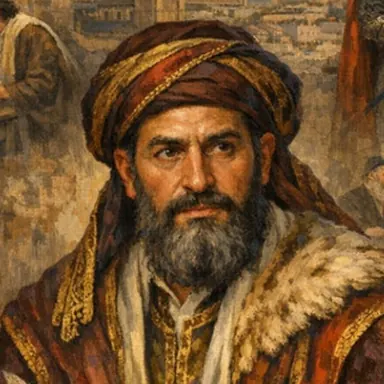
Leadership, Halakha and Masorah: The Work and Torah Teaching of Rabbi Meir HaLevi Abulafia (the Ramah) in the Transitional Period of Spanish Jewry
14 min read2,768 words
Summary
The source surveys the many-sided figure of Rabbi Meir HaLevi Abulafia (the Ramah), who served as a central axis in the transition of Spanish Jewry from the Golden Age to the late Middle Ages. The text presents the Ramah as a political and spiritual leader (nasi) in Toledo who combined profound Talmudic scholarship, in his work "Yad Ramah," with pioneering textual research for the preservation of the biblical text. A significant focus of the text is devoted to his conservative theological position in the Maimonidean controversy, in which he defended the plain meaning of the faith against extreme philosophical rationalism while preserving respect for the sages. In conclusion, the article stresses how the Ramah's halakhic and masoretic legacy serves to this day as an indispensable bridge between the tradition of the Geonim and the later halakhic rulings accepted throughout the Jewish world.
In a historical view of the Golden Age of Spanish Jewry and its decline into the late Middle Ages, the figure of Rabbi Meir ben Todros HaLevi Abulafia (the Ramah) stands out as a central pillar who shaped the face of halakha, Masorah and Jewish thought for generations. The Ramah, who was active in Toledo in the Kingdom of Castile in the first half of the 13th century, represents a rare synthesis of profound Talmudic scholarship, the authority of political leadership as "nasi," and pioneering textual research in the field of the Masorah.[1, 2] His famous work, the "Yad Ramah," became a cornerstone of the literature of commentary and halakhic ruling, while his resolute involvement in the controversy over the writings of Maimonides (Rambam) set him up as the chief spokesman of traditional conservatism against rising philosophical rationalism.[2, 3] Analysing his work requires a multidimensional understanding of the religious and social reality of Christian Spain, in which the traditions of the Geonim were combined with the new methods of study of the Sages of Provence and Ashkenaz.[4, 5]
The Historical and Social Background: Toledo as a Spiritual and Political Center
The 13th century in Spain was a period of significant geopolitical and religious change. With the decline of Muslim rule in the south and the rise of the Christian kingdoms in the north, Toledo (Toleitula) became the most important Jewish center in the Iberian Peninsula. In this context, the Abulafia family held a position of primacy as a Jewish noble family ("nesi'im") close to the Castilian royal court.[1, 4] The Ramah was born in Burgos around 1170, but did most of his work in Toledo, to which he moved with his father, Rabbi Todros HaLevi.[4, 5]
The title of "nasi," which passed by inheritance from his father to the Ramah in 1225, was not a mere honorific but the definition of a broad leadership authority that included representing the community before the authorities, administering the charitable institutions, and serving as supreme judge.[1, 2] This standing gave the Ramah the ability to lead wide-ranging public initiatives, such as the protest against the philosophical views of Maimonides, from a position of power recognized not only in Spain but also in the communities of Provence and northern France.[2]
The Dynasty of Nesi'im and the Ramah's Public Standing
The combination of Torah and worldly greatness found expression in the yeshiva the Ramah founded in Toledo, which became a magnet for Torah scholars from all over Spain.[1, 5] This yeshiva did not engage only in the theoretical study of the Gemara, but served as a laboratory for practical halakhic ruling, something clearly evident in the structure of his works, which are not content with commentary but always strive for a normative decision.[2]
The Yad Ramah: Interpretive and Halakhic Methodology
The Ramah's monumental work on the Talmud, known by its printed name "Yad Ramah," was originally called by its author "Peratei Peratin" ("Details of Details").[4] This name attests to the book's ambition: not only to present the essentials of the Talmudic discussion, but to go down to the finest details of the positions and halakhic decisions that emerge from it. The book was originally written on most of the tractates of the Babylonian Talmud, but only parts of it have survived the vicissitudes of time, chiefly on the tractates Bava Batra and Sanhedrin, and extensive sections of Kiddushin and Gittin.[2, 4]
Language and Style as a Tool for Transmitting Tradition
One of the distinctive features of the "Yad Ramah" is its extensive use of the Aramaic language, at times mixed with Judeo-Arabic for the purpose of explaining difficult terms.[4] This linguistic choice is not accidental; it reflects the Ramah's deep attachment to the tradition of the Geonim and to the work of the Rif (Rabbi Yitzchak Alfasi), which formed the backbone of classical Sephardic scholarship.[6] Unlike Rashi's commentary, which was meant to ease the understanding of the text, or the pilpul of the Tosafists, which sought harmony between distant Talmudic discussions, the Ramah focuses on building a solid halakhic storey on top of the words of the Talmud.[2, 4]
The analysis in the "Yad Ramah" is analytical and exceptionally well ordered. The Ramah's practice is to divide the Talmudic discussion into its components, to present the positions of the Rishonim who preceded him, and then to decide between them using original reasoning and close attention to the wording of the Gemara.[2] The force of his decisions was so great that Rabbi Yaakov ben Asher, author of the "Turim," based extensive parts of his book, and in particular the Tur Even ha-Ezer, on the rulings of the Ramah.[4, 6]
The Dissemination and Preservation of the "Yad Ramah"
The influence of the "Yad Ramah" extends beyond the borders of Spain. Rabbeinu Asher ben Yechiel (the Rosh), who moved from Ashkenaz to Spain one generation after the Ramah, adopted many of his conclusions and incorporated them into his rulings, thereby making the Ramah an inseparable part of the chain of halakhic ruling of the whole Jewish people.[4, 8]
The Controversy over Maimonides: Conservatism versus Rationalism
The Ramah's contribution to Jewish thought was etched into historical consciousness chiefly through his involvement in the first "Maimonidean controversy."[3] When the books of Maimonides, the "Mishneh Torah" and the "Guide of the Perplexed," reached the sages of Spain and Provence, they aroused enormous admiration alongside grave concerns. The Ramah, who was then in his thirties, was the first who dared to come out with open and reasoned criticism of certain aspects of Maimonides' teaching.[2]
The Dispute over the Resurrection of the Dead and the World to Come
The focus of the Ramah's criticism was not halakhic but theological. In the "Mishneh Torah," Maimonides described the World to Come as an absolutely spiritual world, "in which there is no body or corporeal form," and stressed that the final reward is the survival of the intellectual soul.[2, 9] The Ramah saw in this description a grave danger to the principle of belief in the resurrection of the dead in its plain sense. In his argument, if the World to Come is purely spiritual, then the bodily resurrection of the dead becomes a temporary event devoid of ultimate religious value.[9]
The exchange of letters between the Ramah and the sages of Lunel, headed by Rabbi Aharon ben Meshullam, was collected in the book "Kitab al-Rasa'il" (The Book of Letters).[2, 4] In these letters the Ramah sets out a conservative doctrine that seeks to defend the plain meaning of the biblical verses and the sayings of the Sages against what he perceived as an allegorical-philosophical interpretation that empties the commandments of their tangible content.[2] He argued that Jewish faith requires recognizing that the body and the soul, which acted together in this world in fulfilling the commandments, will together merit reward in the World to Come after the resurrection.[9]
A Complex Position of Respect and Criticism
Despite the sharpness of the controversy, the Ramah's attitude to Maimonides was far from one-dimensional. He held enormous respect for Maimonides' halakhic genius and used the "Mishneh Torah" as a basis for his discussions in the "Yad Ramah."[2, 6] When Maimonides died, the Ramah composed a moving lament for him expressing the magnitude of the loss to the people of Israel, and in the later stages of his life he refrained from joining the extreme bans of the sages of northern France against Maimonides' books, out of a desire to preserve peace in the community.[2]
The Ramah's position set out a model of "enlightened conservatism": opposition to changing the principles of faith while recognizing the value of the logical and systematic tools that Maimonides brought to the world of Torah.[2]
Masoret Seyag la-Torah: A Lifelong Textual Enterprise
Another field in which the Ramah is regarded as a supreme and irreplaceable authority is the study of the Masorah. His book "Masoret Seyag la-Torah" ("The Masorah Is a Fence for the Torah") is the fruit of decades of research, whose aim was to determine the exact text of the Torah scroll, with an emphasis on plene and defective spelling.[4, 10] In the Middle Ages, owing to repeated copying, minor corruptions had crept into Torah scrolls, and the Ramah saw this as an injury to the sanctity of the text and to the ability to fulfil the commandment of writing a Torah scroll in accordance with halakha.[10]
The Ramah's Methodology in the Study of the Masorah
The Ramah was not content with family tradition, but undertook a research journey among ancient and accurate manuscripts that were to be found in Spain and North Africa. He compared readings, examined the masoretic notes of the Tiberian Masoretes, and decided doubtful places according to clear rules of the majority of manuscripts and agreement with the Masorah Magna and Masorah Parva.[10]
Following his research, the Ramah himself wrote an exemplary Torah scroll, which became known as "the book of Rabbi Meir." This scroll became a model (prototype) for scribes of Torah scrolls, tefillin and mezuzot in Spain, and through it his textual decisions were handed down to later generations.[4] The importance of his work in this field is reflected in the fact that his studies form to this day the basis of the biblical text accepted in the communities of Ashkenaz and Sepharad alike.[4, 11]
The Book's Influence on the Shaping of the Torah Scroll
- Plene and defective spelling: an exact decision on every single letter in the Torah, which prevents a Torah scroll from being halakhically invalid.[10]
- Open and closed sections: fixing the exact spaces between the sections, a subject that was in fierce dispute between Maimonides and other Rishonim.[10]
- The form of the letters: instructions for writing unusual letters (such as the curled letters) in accordance with the tradition of the esoteric teaching and the Kabbalah.[10]
His book "Ein ha-Kore," which includes grammatical notes and an introduction to the Masorah, completes the picture of the Ramah's world as a scholar seeking to set the study of Torah on a textual foundation immune to errors.[10]
The Ramah's Kabbalistic and Poetic Teaching
Beyond being a man of halakha and Masorah, the Ramah was deeply rooted in the mysterious world of the early Kabbalah in Spain. Although this side of his work was at times played down because of his public image as a conservative, his writings attest to a profound understanding of the esoteric teaching.[1, 4]
Commentary on Sefer Yetzirah: "Lifnei ve-Lifnim"
The Ramah's certain Kabbalistic work is "Lifnei ve-Lifnim," a commentary on Sefer Yetzirah (the Book of Formation).[1, 4] In this work the Ramah explains the secrets of the ten sefirot and the thirty-two wondrous paths of wisdom. He sees the letters of the alphabet as the building blocks of the universe, and thereby links his research in the Masorah with his metaphysical outlook: precision in the letters of the Torah is not only a halakhic matter, but a cosmic necessity for preserving the connection between the material world and its spiritual sources.[4]
As for the book "Ginat Bitan," a Kabbalistic commentary on the book of Genesis that is sometimes attributed to him, modern scholarship tends to doubt this attribution and to ascribe it to later authors, but the very attribution attests to the reputation the Ramah acquired as a Kabbalist of great stature.[4]
Poetry and Liturgical Verse as an Expression of Thought
The Ramah continued the glorious tradition of the sages of Spain who combined Torah with poetry. His poems are characterized by a pure biblical language and by the use of the complex metres of Spanish Hebrew poetry.[4] His liturgical poems are not merely aesthetic creations but a vehicle for conveying ideas; his laments on the deaths of righteous men, foremost among them the lament on Maimonides, serve as historical and spiritual documents expressing the tensions of his generation.[2]
Halakhic Ruling and Public Authority: The Ramah's Responsa
As a judge in the rabbinic court of Toledo and as head of the yeshiva, the Ramah was sent questions from all over the Jewish world. His responsa, some of which were collected in the book "Or Tzaddikim," reveal a halakhic decisor who combined uncompromising fidelity to the sources of the Gemara with a profound understanding of the needs of the community.[1, 4]
Areas of Ruling and Their Influence
The Ramah dealt extensively with monetary law, a field that was critical in a strong and wealthy community such as Toledo. His decisions on the laws of partnerships, real estate ("damage caused by sight") and taxes became foundations of halakhic literature.[8] His influence is especially prominent in the field of marriage law; his rulings on marriage contracts (ketubbot), divorce and betrothal are cited hundreds of times in the Tur and in the Shulchan Arukh, often as the decisive opinion against Maimonides or the Geonim.[6, 7]
His standing as a judge was not only religious but also administrative in character. He enacted ordinances in the community of Toledo intended to regulate social life and prevent disputes, and thereby made the rabbinic court a focus of social stability in a period of political change.[1, 2]
The Legacy for Generations: The Ramah as a Bridge between Worlds
Summing up the work of Rabbi Meir HaLevi Abulafia, one can see in him the connecting link between the early period of the Rishonim and the flowering of learning in Spain in the 13th and 14th centuries. He succeeded in preserving the legacy of the Geonim and the Rif, yet did not ignore the new challenges posed by Maimonides on the one hand and the Tosafists on the other.[1, 4]
His Influence on the Generation of Nahmanides and the Rashba
Although the Ramah was older than Nahmanides (Ramban; Rabbi Moshe ben Nachman), the influence of his writings on him was evident. Nahmanides, who adopted a mediating approach in the Maimonidean controversy, drew inspiration from the Ramah's textual precision and from his combination of the revealed and the hidden.[2, 5] The Rashba (Rabbi Shlomo ben Aderet), Nahmanides' successor, also refers to the Ramah as one of the "fathers of the world" according to whom one must rule.[2]
Summary of His Historical Contribution
The Ramah's legacy lies not only in his written works but in the model of leadership he set: a nasi who acts within the royal court yet remains completely faithful to the sanctity of the tradition; a decisor who values philosophy yet sets it clear limits of faith; and a scholar who understands that the spiritual wholeness of the nation depends on the precision of every single letter in its Torah scroll.[2, 4, 10]
In the yeshiva world of today, the "Yad Ramah" continues to be one of the foundational books for the study of the tractates Sanhedrin and Bava Batra, and a living testimony to the depth of the thought and the force of the influence of "the Nasi of Toledo" on the world of Torah.[4] The Ramah's work ensures that even after hundreds of years, the voice of the classical Sephardic Talmud will continue to be heard clearly and authoritatively.[6]
Sources11
- 1.מאיר הלוי אבולעפיה | מקורות מתוך ספריית ספריא, sefaria.org.il/topics/meir-abulafia
- 2.רבי מאיר הלוי אבולעפיה – ויקישיבה, yeshiva.org.il/wiki/index.php/רבי_מאיר_הלוי_אבולעפיה
- 3.פולמוס הרמב"ם - ויקיפדיה, he.wikipedia.org/wiki/פולמוס_הרמב"ם
- 4.מאיר הלוי אבולעפיה - ויקיפדיה, he.wikipedia.org/wiki/מאיר_הלוי_אבולעפיה
- 5.תור הזהב בספרד - ישיבת הר ברכה, yhb.org.il/shiurim/ravzeev4979/
- 6.ארבעה טורים – ויקיפדיה, he.wikipedia.org/wiki/ארבעה_טורים
- 7.טור אבן העזר - ויקיטקסט, he.wikisource.org/wiki/טור_אבן_העזר
- 8.חברותא - בבא בתרא - תורת אמת, toratemetfreeware.com/online/f_02359.html
- 9.אגרות קודש - מכתב ר - Chabad.org, chabad.org/therebbe/article_cdo/aid/4666239/jewish/page.htm
- 10.בעלי המסורה - יד יצחק בן־צבי, ybz.org.il/מחקר/מאגרי-מידע-ואוספים/ארם-צובה/בעלי-המסורה/
- 11.מעיל לספר תורה אשכנזי: מסורת והמשכיות | רונית גור תשמישי קדושה, ronitgur.co.il/שמירה-על-המורשת-מעיל-לספר-תורה-אשכנזי/