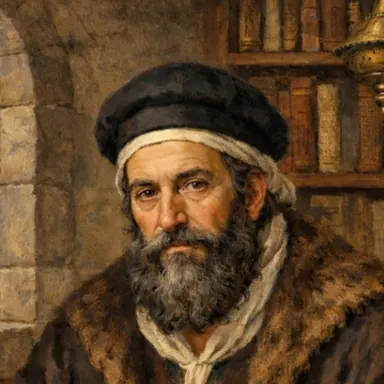
The Work and Torah Thought of Rabbenu Manoach of Narbonne: Exegesis, Codification and the Provençal Tradition
13 min read2,608 words
Summary
The text surveys the figure and Torah contribution of Rabbenu Manoach of Narbonne, a prominent sage of the region of Provence who was active at the juncture between the thirteenth and fourteenth centuries. His central work, "Sefer HaMenuchah" ("The Book of Rest"), is presented as an exegetical masterpiece on Maimonides' "Mishneh Torah," whose aim is to bridge the Maimonidean ruling and the local traditions and the critical glosses of the Raavad. The article emphasizes the unique synthesis that Rabbenu Manoach created between French scholarship and Spanish rationalism, using a methodology of uncovering sources and establishing precise textual readings. Ultimately, the source seeks to show how Rabbenu Manoach became an essential connecting link that shaped the world of halakha for generations, as reflected in his decisive influence on the rulings of the "Beit Yosef."
The history of rabbinic creativity in Provence during the Middle Ages represents one of the most fascinating and influential chapters in the history of Jewish halakha and thought. At the very heart of this period, in the late thirteenth and early fourteenth centuries, Rabbenu Manoach ben Shimon of Narbonne was active, a key figure whose monumental work, "Sefer HaMenuchah," became a cornerstone of classical exegesis on Maimonides' work, the "Mishneh Torah."[1, 2] Rabbenu Manoach was active in a critical transitional period, in which the local traditions of the sages of southern France began to be absorbed into the new codificatory framework set by Maimonides, while preserving scholarly and critical independence. Analyzing his work requires a deep understanding of the geographic and cultural space of Narbonne and Lunel, the places where his Torah personality was formed.[3]
The Geographic and Spiritual Background of Provençal Jewry
Thirteenth-century Provence was not merely an administrative unit but a spiritual center that served as a bridge between the scholarship of France and Ashkenaz and the philosophy and systematic thought of Spanish Jewry. The sages of Provence, Rabbenu Manoach among them, were endowed with a rare ability to combine seemingly contradictory methods of study. Whereas in northern France the Tosafists engaged in the deconstruction and reconstruction of talmudic sugyot, and in Spain the Rif and Maimonides focused on the ruling of pure halakha, the sages of Provence sought to create a synthesis that would give halakhic practice a broad and rational scholarly foundation.[4]
Narbonne, the main city of residence of Rabbenu Manoach, had been known as a "city of Torah" since the days of the Geonim. Its rabbinic institutions enjoyed autonomy and great prestige, and the traditions preserved there served as a counterweight to the new works arriving from Egypt and Spain. Nevertheless, Rabbenu Manoach also spent a considerable part of his time in Lunel, an intellectual center identified more than any other with the Maimonidean movement and with the translation of scientific and philosophical writings.[1, 3] This combination of the halakhic conservatism of Narbonne with the scientific openness of Lunel is the key to understanding the thought of Rabbenu Manoach, as it is expressed in "Sefer HaMenuchah."
The Biographical Identity of Rabbenu Manoach: Solving Scholarly Mysteries
The figure of Rabbenu Manoach is shrouded in a certain mystery with regard to his personal biographical details. The scholarly and Torah sources disagree about the exact name of his father and about the exact dates of his life, a matter that sometimes stems from mistaken identification with other sages of similar name or from copying errors in early manuscripts.[3]
Modern scholarship tends to adopt the identification as Rabbenu Manoach ben Shimon, since internal evidence from "Sefer HaMenuchah" cites decisions and rulings in the name of his father, Rabbi Shimon.[1] The fact that Rabbi Yosef Karo, in his monumental work "Kesef Mishneh," devotes extensive space to the commentaries of Rabbenu Manoach attests to the great authority attributed to him already in the first centuries after his death.[3] Rabbenu Manoach is not only a commentator; he is perceived as a connecting link in the chain of transmission of the Torah of Provence, lending validity to the local tradition against the global codification of Maimonides.
Education and Influence: The Teachers of Rabbenu Manoach
The shaping of Rabbenu Manoach's Torah world took place in the study halls of the great figures of the generation in Provence. His teachers were pioneers of the approach that combines talmudic scholarship with religious philosophy, an approach that marked the distinctiveness of southern France in those days.[1, 2]
Rabbi Meir ben Shimon HaMe'ili, author of "HaMe'orot" and "Milchemet Mitzvah," was one of his foremost teachers. HaMe'ili was known for his struggle for the purity of faith and for his defense of the Jewish community against the pressures of Christianity, but no less so for his scholarly method, which aspires to conceptual clarity.[3] His influence on Rabbenu Manoach is evident in the latter's tendency not to be satisfied with a superficial understanding of Maimonides' words but to seek the logical and textual root of every ruling.[1, 2]
His second teacher, Rabbi Reuven ben Chaim, author of "Sefer HaTamid," was a key figure in transmitting the teaching of the Raavad (Rabbi Abraham ben David of Posquières) to later generations.[3] The Raavad, as is well known, was the sharpest critic of Maimonides, and his glosses have accompanied the "Mishneh Torah" from the moment of its publication. Rabbenu Manoach, who was raised on the knees of the Raavad's teaching through Rabbi Reuven ben Chaim, finds himself in a unique position: he admires the structure of Maimonides but is committed to the critical tradition of the Raavad.[2] This dual position is what gave birth to "Sefer HaMenuchah," a work whose aim is to resolve the difficulties and to grant "menuchah" (rest) to the learner who is perplexed between the Maimonidean ruling and the Provençal glosses.[1]
"Sefer HaMenuchah": Structure, Scope and Methodology
The central work of Rabbenu Manoach, "Sefer HaMenuchah," is a systematic commentary on parts of Maimonides' "Mishneh Torah." The name "Menuchah" is not merely a play on his given name but a pedagogical declaration of intent: to bring the learner to rest and to a full understanding of Maimonides' words, which at times seemed obscure because of the absence of explicit sources.[1]
The Textual Scope of the Work
Whereas Maimonides divided his work into fourteen books ("Yad HaChazakah"), the commentary of Rabbenu Manoach that has reached us focuses mainly on the books dealing with the commandments of daily life and the annual cycle.[6, 7]
There is a dispute among scholars as to whether Rabbenu Manoach wrote a commentary on the entire "Mishneh Torah" and part of it was lost, or whether he chose to focus only on those areas that were more relevant to the practical life of the community in Provence.[2] The fact that additional manuscripts were discovered in the course of the twentieth century, such as the Günzburg manuscript in Moscow, which includes the laws of prayer, strengthens the hypothesis that the scope of his writing was far broader than what was printed in the early editions.[3]
The Exegetical Methodology: Bridging Maimonides and the Sources
Rabbenu Manoach does not operate as a merely "local" commentator. His method includes several central components that made "Sefer HaMenuchah" an essential working tool for later halakhic decisors:
- Uncovering the sources: In contrast to Maimonides, who sought to create a halakhic book without mentioning the names of the Tannaim and Amoraim, Rabbenu Manoach reconstructs the talmudic discussion that preceded the ruling. He makes frequent use of the Jerusalem Talmud and of rare halakhic midrashim, at times even ones known only to the sages of southern France.[3]
- Dealing with the Raavad's glosses: This is perhaps the most important aspect of his work. Rabbenu Manoach sees himself as a mediator. Where the Raavad attacks Maimonides in sharp language, Rabbenu Manoach tries to explain the internal logic of Maimonides, showing how the Maimonidean ruling can be reconciled with the sources that the Raavad raised against him.[2]
- Precision of textual readings: Because of his chronological and geographic proximity to centers that held accurate copies of Maimonides, Rabbenu Manoach devotes great attention to establishing the correct text. He often remarks that copying errors are the source of difficulties in understanding Maimonides, and in this he lays the foundations of halakhic textual criticism.[2]
- Preserving local custom: Despite his admiration for Maimonides, Rabbenu Manoach does not give up the tradition of his forefathers. In many cases he notes the custom practiced in Narbonne, even if it differs from Maimonides' ruling, and thereby grants legitimacy to a variety of customs within a world of uniform codification.[3]
His Torah and Intellectual Thought: Between Rationalism and Tradition
The spiritual world of Rabbenu Manoach reflects the struggles and achievements of the Maimonidean movement in Provence. In the thirteenth century, Maimonides' books stood at the center of a fierce controversy between supporters of philosophy and its opponents. Rabbenu Manoach, as a product of the study hall in Lunel, clearly leans toward the rationalist side, but he does so with moderation and religious responsibility.[2, 5]
Contrary to certain descriptions that attribute to him intensive engagement in mathematics or grammar as separate branches, Rabbenu Manoach's Torah scholarship integrates the sciences as an aid to understanding the commandments. For him, the study of the sciences is no contradiction to Torah but a means of deepening faith in the Creator through the laws of nature.[5] This conception is expressed especially in his commentary on the laws of the recitation of the Shema and prayer, where he emphasizes the need for mental concentration and for a philosophical understanding of the unity of God's Name.[2]
Nevertheless, one must distinguish between Rabbenu Manoach of Narbonne and other figures whose names are linked with the struggle against Hasidism or with the composition of systematic ethical books such as "Duties of the Hearts."[5] Rabbenu Manoach was first and foremost a man of halakha, whose intellectual insights derived from the legal text and not from abstract speculation. His rationalism was a "halakhic rationalism," seeking to understand the reasons for the commandments (the reasons of Scripture and of law) with logical and reasonable tools.[2]
The Role of Education and Communal Responsibility
Although Rabbenu Manoach is known mainly for his exegetical writing, his work reflects a broad conception of responsibility for educating the next generation. In his time, the discussion of a father's obligation to teach his son Torah took on added force in light of the need to preserve Jewish identity in the face of external and internal challenges.[8]
In medieval Provence, education was not limited to the memorization of texts. The model represented by Rabbenu Manoach in his commentaries assumed that the student must understand the logical structure of halakha. "Sefer HaMenuchah" in effect served as an advanced textbook, guiding the learner in how to approach the Code of Maimonides. He emphasizes that early study at the ages of six or seven is only the foundation, and that the intellectual commitment to study continues throughout a person's entire life.[8] This conception of "study for the sake of understanding" is what made Provençal Jewry such a vibrant intellectual center, in which even the broad public possessed a high level of Torah literacy.
The Influence of Rabbenu Manoach on Halakhic Ruling across the Generations
The standing of Rabbenu Manoach in the chain of halakhic transmission was established mainly thanks to the massive adoption of his words by the great Acharonim. Without his mediation, large parts of Maimonides' teaching would have remained without a satisfactory explanation in the face of the Gemara's objections.[3]
Rabbi Yosef Karo saw in Rabbenu Manoach one of the most important tools for the defense of Maimonides. In many cases, when the "Kesef Mishneh" writes "and Rabbenu Manoach answered...," he is in effect accepting the interpretation of the Provençal sage as the most authentic and binding interpretation of Maimonides' intent.[3] In this way Rabbenu Manoach became a kind of "mouth" for Maimonides, speaking in his name and reconciling his approach with the talmudic tradition.
Case Analysis: The Laws of Chametz and Matzah and the Rulings of Narbonne
One of the clearest examples of the work of Rabbenu Manoach is found in his commentary on the laws of chametz and matzah. This part of "Sefer HaMenuchah" was among the first to be printed and enjoyed wide circulation.[1, 3] In his commentary, Rabbenu Manoach is not content with a merely technical explanation of Maimonides' words but discusses questions of custom in depth.
He describes the custom in Narbonne regarding the removal of chametz and the order of the night, and shows how the local community preserved traditions from the geonic period that do not appear explicitly in Maimonides. His ability to hold both worlds, loyalty to the code and loyalty to custom, is what made his work acceptable to all streams of Jewry.[3] For the sages of later generations, "Sefer HaMenuchah" was not merely a commentary on Maimonides but a window onto the rich religious life of southern French Jewry before the period of the expulsions and the great persecutions.
Language and Style: The Transition to Polished Rabbinic Hebrew
The writing style of Rabbenu Manoach in "Sefer HaMenuchah" attests to a high level of Hebrew literacy. At a time when a large part of Torah literature in Spain was still written in Judeo-Arabic (such as the "Guide of the Perplexed"), the sages of Provence were pioneers of the transition to writing in pure Hebrew.[4]
Rabbenu Manoach uses concise, precise and clear language. He avoids the long pilpul that characterized the Tosafists, and prefers the didactic style that characterizes later Provençal exegesis (such as that of the Meiri). His linguistic analysis is not limited to understanding words but extends to descending into the depth of the syntactic structure of Maimonides, with the understanding that every word in the "Mishneh Torah" was chosen with care.[2, 3]
The Spiritual Legacy: Summary and Conclusions
Rabbenu Manoach ben Shimon of Narbonne represents the best of the spirit of Provence: deep scholarship, learned criticism, balanced rationalism and uncompromising loyalty to the tradition of the forefathers. His work in "Sefer HaMenuchah" goes beyond mere textual exegesis; he created a bridge that enabled Maimonides to become the central decisor of the entire Jewish world, while softening the initial opposition that his work had aroused.[1, 3, 7]
Through his work we have been privileged to preserve ancient halakhic traditions from Narbonne and from Lunel, traditions that without his testimony might have been forgotten. His decisive influence on the "Beit Yosef" and on later ruling ensures that the voice of the Provençal sage will continue to be heard in the study halls in every generation. Rabbenu Manoach proved that the great commentator is not one who merely explains the text but one who gives it new life within its communal and historical context.[2, 3]
The deepest insight arising from the study of his thought is the ability to create "menuchah" (rest) within a world of disputes. For Rabbenu Manoach, spiritual rest is achieved not by ignoring the difficulties but by thoroughly clarifying them and placing them within a broad framework of knowledge and Torah. In this way "Sefer HaMenuchah" remains not only a halakhic monument but also an inspiration to every learner who seeks to combine faith with reason.[1, 2]
Sources8
- 1.MANOAH B. JACOB - JewishEncyclopedia.com, jewishencyclopedia.com/articles/10374-manoah-of-lunel
- 2.מנוח מנרבונה – ויקיפדיה, he.wikipedia.org/wiki/מנוח_מנרבונה
- 3.Manoah of Narbonne - Jewish Virtual Library, jewishvirtuallibrary.org/manoah-of-narbonne
- 4.TALMUDIC STUDIES, repository.yu.edu/bitstreams/0be40cba-1991-4028-a222-7f686779193f/download
- 5.מחברים | מקורות מתוך ספריית ספריא, sefaria.org.il/topics/category/authors
- 6.הלכה, משנה תורה | ספריית ספריא, sefaria.org.il/texts/Halakhah/Mishneh Torah
- 7.משנה תורה לרמב"ם - חב"דפדיה, chabadpedia.co.il/index.php/משנה_תורה_לרמב"ם
- 8.The Duty to Educate in Jewish Law: A Right with a Purpose - Rabbi Michael J. Broyde, broydeblog.net/uploads/8/0/4/0/80408218/dutytoeducate.pdf