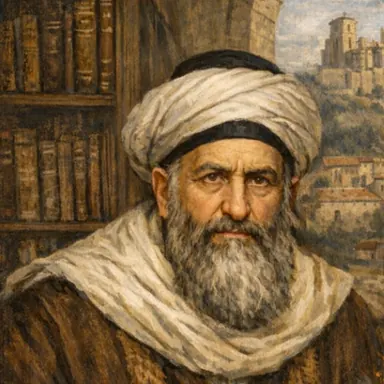
The Halakhic and Rationalist Revolution of the Sages of Provence: The Figure, Work, and Teaching of Rabbi Meshulam ben Moses of Béziers and the Dynasty of Lunel
15 min read3,030 words
Summary
The text surveys the intellectual revolution of the sages of Provence in the twelfth and thirteenth centuries, focusing on the central figure of Rabbi Meshulam ben Moses of Béziers, author of "Sefer HaHashlamah" ("The Book of Completion"). The work describes how Provence served as a cultural bridge that merged French scholarship with Spanish rationalism, and how the dynasty of the sages of Lunel led a movement of translation and scientific openness alongside halakhic decision-making. The central axis of the article examines the methodology of study in "Sefer HaHashlamah," which was intended to update and establish the rulings of the Rif, alongside the author's independent position, which was characterized on the one hand by admiration for Maimonides (Rambam) and on the other by penetrating halakhic criticism. Finally, Rabbi Meshulam's resolute opposition to mysticism and to the nascent Kabbalah is highlighted, a position that reflects his deep commitment to pure halakha and rational thought as tools for preserving Jewish identity.
The Cultural and Historical Setting of Provence in the Twelfth and Thirteenth Centuries
Understanding the work of Rabbi Meshulam ben Moses of Béziers, known as the "Ba'al HaHashlamah," requires a dive into the unique geopolitical and spiritual reality of the region of Provence in southern France in the Middle Ages. Provence was not merely a geographical region, but served as a critical intellectual bridge that connected the world of the sages of Ashkenaz and northern France (the Tosafists) with the world of the sages of Spain and the East.[1, 2] Whereas in northern France study focused on dialectical interpretation of the Talmud, and in Spain a halakhic world connected with codes and with Arabic-Jewish philosophy developed, in Provence a rare combination arose: deep Talmudic scholarship alongside openness to the natural sciences, to philosophy, and to grammar.[3, 4]
At the center of this setting stood the city of Lunel, which earned the epithet "the Tower of Lunel" because of its centrality as a Torah center. In Lunel there developed a rich and influential dynasty of sages, headed by Rabbi Meshulam ben Jacob of Lunel, the grandfather of the Ba'al HaHashlamah.[1, 5] This family not only established yeshivot, but also served as patron of the great translation movement. Under their patronage the writings of Maimonides (Rambam), of Rabbeinu Bahya ibn Paquda, and other philosophical books were translated from Arabic into Hebrew, which made possible the penetration of Spanish rationalism into the world of the yeshivot of Christian Europe.[3, 5] Rabbi Meshulam ben Moses of Béziers grew up in this hothouse, drawing both from the local halakhic tradition and from the intellectual storms brought by Maimonidean philosophy.[4, 6]
The Dynasty of Lunel: The Foundations Laid by Rabbi Meshulam the Great
To understand "Sefer HaHashlamah," one must first examine the work of the grandfather, Rabbi Meshulam ben Jacob of Lunel (died 1170), known as "Rabbi Meshulam the Great."[1, 5] He was the head of the yeshiva in Lunel and a prominent political and economic leader. The famous traveler Rabbi Benjamin of Tudela, who visited Lunel around the year 1159, describes Rabbi Meshulam as a very wealthy man who maintained a great and renowned yeshiva, and supported students and Torah scholars from all over the world.[1]
Rabbi Meshulam the Great was a key figure in the transition from pure halakha to rationalist thought. It was he who encouraged Rabbi Judah ibn Tibbon to translate "Chovot HaLevavot" ("Duties of the Heart"), thereby opening the door to ethical and philosophical literature in Provence.[3, 5] His halakhic contribution included the book "Issur Mashehu" on the laws of kashrut, and a commentary on the 613 commandments.[1] His influence was so great that the great figures of the next generation, such as the Rabad (Rabbi Abraham ben David of Posquières) and Rabbi Zerachia HaLevi (author of the Ba'al HaMaor), were regarded as his disciples or as members of his close circle.[1, 5]
The sons of Rabbi Meshulam the Great continued his path in various ways, and all of them influenced their nephew, the Ba'al HaHashlamah:
Rabbi Asher of Lunel (the Rosh of Lunel): he was called "the Ascetic" ("HaParush") because of his tendency toward asceticism. He composed "Halakhot Yom Tov" and was an exemplary figure of scholarship and abstinence.[1]
- Rabbi Aharon of Lunel: he was a sage and expert in calendar calculation and the sciences. He became famous mainly as a fervent defender of Maimonides (Rambam) in the controversy with Rabbi Meir Abulafia (the Ramah), using a polished literary style and sharp rationalist arguments.[1, 7]
- Rabbi Moses ben Rabbi Judah: the son-in-law of Rabbi Meshulam the Great and the father of the Ba'al HaHashlamah. He was among the sages of Lunel close to the Razah, and was the foremost teacher of his son.[4, 6]
This family network created for Rabbi Meshulam of Béziers a unique starting point: he was the heir of an ancient Provençal halakhic tradition, but was also exposed to sharp criticism of halakhic conventions and to the winds of philosophical change.[4]
Rabbi Meshulam ben Moses of Béziers: The Biography of the Leader in Béziers
Rabbi Meshulam was born in Lunel between 1160 and 1175.[4, 6] In his youth he studied with his father, Rabbi Moses, who was the link connecting him to the sages of the previous generation. With the move to Béziers, Rabbi Meshulam became one of the most influential figures in southern France in the thirteenth century.[6]
Béziers in that period was a stormy city, which went through the hardships of the "Albigensian Crusade" (directed against the Cathars in the region). The Jewish community there was strong and wealthy, and Rabbi Meshulam stood at its head as the supreme halakhic and public authority. His standing was so high that the sages of his generation, including Nahmanides (Ramban) of Catalonia, turned to him with complex communal problems, showering him with extravagant praise for his wisdom and leadership.[4]
His foremost disciple, Rabbi Yedaya HaPenini, left a moving description of the yeshiva that Rabbi Meshulam established in Béziers. According to Yedaya, the yeshiva was a focus of attraction for students from afar, and the study in it was characterized by exceptional theoretical depth.[4, 6] Rabbi Meshulam was not merely a teacher of Torah, but a spiritual father figure in whom his disciples saw the embodiment of wisdom and fear of Heaven. With his death in 1238 (or, according to other versions, 1250), the yeshiva closed, which illustrates the fact that the institution was based entirely on his unique personality.[4]
Sefer HaHashlamah: The Project of His Life and the Scholarly Methodology
Rabbi Meshulam's central work, "Sefer HaHashlamah," is one of the most important works in the literature of the Rishonim. To understand its importance, one must understand the standing of the Rif (Rabbi Isaac Alfasi) in the Torah world of the Middle Ages. The Rif wrote a kind of "Talmud Katan" ("Little Talmud"), in which he summarized the halakhic rulings while omitting the Talmudic discussions that are not halakhically operative and omitting halakhot that are not practiced in our times.[4]
Rabbi Meshulam saw his work not merely as a commentary, but as a tool intended to grant the Rif's composition an unchallengeable authority ("Uncontested Authority") by resolving all the problems and contradictions that were raised against it in the generations after him.[4] He did not hesitate to disagree with the great figures of his generation, including the Rabad, although he held them in immense respect and regarded them as the pillars of the Torah.[4]
The Scholarly Structure of the Book
Unlike the Tosafists, who developed a method of study based on comparing distant passages and resolving them through logical distinctions, Rabbi Meshulam inclined more to the "Spanish" approach of the Rif and Maimonides (Rambam), which concentrates on clarifying the text and drawing the final halakhic conclusion.[4] At the same time, he incorporated into his writing the textual precision of the sages of Provence, who were known for using ancient and accurate manuscripts of the Talmud.[1, 5]
Sefer HaHashlamah was written on the orders of Moed, Nashim, and Nezikin, and also on tractate Chullin. Over the generations, parts of the book circulated in manuscript, but many of them were lost or were mistakenly attributed to others.[4] A prominent example is tractate Yevamot, where "Sefer HaHashlamah" was mistakenly printed in the Vilna Talmud under the title "Tosafot Chad Mikamei" ("Tosafot of One of the Early Authorities"), since the printers did not identify the author and thought that it was a commentary in the style of the Tosafot on the Gemara, whereas in fact it is a work on the Rif.[6]
The Maimonidean Controversy: Admiration versus Independent Criticism
Rabbi Meshulam ben Moses was active at the height of the controversy surrounding the writings of Maimonides (Rambam). Rabbi Meshulam's family was identified with the Maimonidean camp. His uncle, Rabbi Aharon of Lunel, wrote a famous letter of defense in which he praised Maimonides (Rambam) and placed him above all ordinary human criticism.[7] Rabbi Meshulam himself continued this line and defended Maimonides (Rambam) and his supporters, such as Abraham ibn Chasdai, from their attackers.[6]
Nevertheless, in halakhic terms Rabbi Meshulam maintained complete independence. He composed a series of "objections" (Hassagot) on Maimonides' (Rambam's) book "Mishneh Torah."[4, 6] Studies have shown that Rabbi Meshulam most likely did not know the famous objections of the Rabad when he wrote his own objections, and he reached his critical conclusions independently.[4] His criticism focused mainly on places where Maimonides (Rambam) deviated from the Talmudic tradition as it was accepted in Provence, or on places where Maimonides' halakhic source was obscure.[4]
This combination – defense of the figure and the philosophical method alongside pointed criticism of the halakhic details – characterizes the "Provençal reason" of the thirteenth century. These sages did not regard Maimonides (Rambam) as a figure beyond challenge, but as a partner in an intellectual path whose words are to be examined with the analytical tools of the Talmud.[4]
The Struggle Against Mysticism: Rabbi Meshulam's Opposition to Kabbalah
One of the most fascinating and controversial aspects of Rabbi Meshulam's work is his resolute and sharp opposition to the teaching of Kabbalah, which began to develop in Provence in his time.[4, 6] Toward the end of the twelfth century the "Sefer HaBahir" appeared, which is regarded as the foundational book of Provençal Kabbalah. For Rabbi Meshulam, who was raised on the knees of the rationalist philosophy that denies any corporealization of God, the ideas of the "sefirot" and the mystical descriptions of the Divinity were perceived as a grave deviation from pure Judaism.[6, 8]
Rabbi Meshulam took an extreme position:
- Declaring it heresy: he declared the teaching of Kabbalah to be "heresy and denial."[6]
- Burning of books: in an extremely unusual act, he ordered the burning of Kabbalistic books that came into his hands, out of concern that they would contaminate the faith of the masses of the people.[6]
- Family backing: his nephew and disciple, Rabbi Meir ben Shimon HaMe'ili, continued this line and wrote sharp works against the first "Kabbalists," relying on the teaching of his uncle.[4]
This opposition did not stem only from conservatism, but from a deep rationalist conception that saw in Kabbalah a return to pagan or Gnostic beliefs under the guise of an ancient tradition.[6] It is interesting to note that despite his militant position, he enjoyed immense esteem from Nahmanides (Ramban), who was himself a Kabbalist, which attests that his Torah standing was higher than any ideological dispute.[4]
The Yeshiva of Béziers: An Educational Model of Torah and Wisdom
Rabbi Yedaya HaPenini's description of the study at the Béziers yeshiva reveals a sophisticated Jewish educational system.[4] Yedaya, who came to study at the yeshiva at the age of 15, describes an institution in which study was not merely the accumulation of halakhic data, but a comprehensive intellectual experience.[4]
At the center of study stood the Gemara, but it was studied through the prism of "Sefer HaHashlamah." The students learned how to analyze the words of the Rif, to understand the criticism of the Ba'al HaMaor, and to see how Rabbi Meshulam resolves the matters.[4] This method gave the students the ability to analyze the halakhic text phenomenologically. In addition, Rabbi Meshulam incorporated into the yeshiva studies of ethics and philosophy, as part of the legacy of his grandfather, who wrote ethical works divided into gates.[1, 3]
The yeshiva was an elitist institution that attracted the sons of the distinguished and learned families of Provence and Spain. With the death of Rabbi Meshulam, Yedaya HaPenini mourns the closing of the institution, and describes it as the destruction of the world of wisdom in the region.[4]
The Influence of "Sefer HaHashlamah" on the Meiri and on Halakhic Decision-Making
The importance of Rabbi Meshulam of Béziers is evident perhaps more than anywhere else in the work of Rabbi Menachem HaMeiri, "Beit HaBechirah." The Meiri, who was active about fifty years after the death of Rabbi Meshulam, regarded the Ba'al HaHashlamah as one of his principal sources.[4, 9]
The Meiri not only quoted Rabbi Meshulam, but adopted his methodology. In many cities in Provence, "Sefer HaHashlamah" became the standard text through which the Rif was studied.[4] The Meiri mentions the Rif and Sefer HaHashlamah "in one breath," which shows that in the eyes of the sages of later generations, Rabbi Meshulam's "Completion" became an inseparable part of the body of the original work.[4]
The connection between the Meiri and the Ba'al HaHashlamah was so strong that confusions arose in the genealogy. In the novellae on tractate Eruvin that were attributed to the Meiri, it is written that Rabbi Meshulam was among the ancestors of the author. However, modern scholars note that this work is most likely not by the Meiri, and in his authentic works the Meiri cites Rabbi Meshulam without noting any family relationship, which refutes the supposition that he was among his descendants, but confirms the deep spiritual kinship.[9]
Preservation of the Work: From the Nineteenth Century to Our Time
The fate of "Sefer HaHashlamah" through the generations was complex. Whereas in Provence it was a foundational book, with the expulsion of the Jews from France and the weakening of the centers in the south, the book gradually fell into oblivion.[4] The manuscripts were scattered in various libraries in Europe, and many of them were lost.
In the nineteenth century a process of "redemption" of the book began, by scholars and halakhists:
- Judah Lubetzky: he was the first to publish a scholarly and annotated edition of Seder Nezikin at the end of the nineteenth century and the beginning of the twentieth.[4] Lubetzky added an extensive commentary called "Torat HaHashlamah," in which he analyzed Rabbi Meshulam's sources and his relation to other Rishonim.
- Moshe Hershler: he published additional parts within the series "Ginzei Rishonim," using new manuscripts that were discovered.[4]
- Avraham Chaputa: in the second half of the twentieth century he published a comprehensive edition of the book with the commentary "Reshit HaHashlamah," which made the book accessible to modern students of Torah.[4]
The Family of Lunel and the Continuity of the Legacy
Rabbi Meshulam ben Moses was not an isolated island. He was part of an extensive family network that continued to influence the Torah world for generations. His sons, as described by Benjamin of Tudela, were sages and wealthy men, and some of them continued his path in leading the communities.[1]
The grandson of the son of Rabbi Meshulam the Great (through Rabbi Joseph) was Abba Mari HaYarchi, a central figure in the second Maimonidean controversy, who was connected by family and spiritual ties to the Ba'al HaHashlamah.[1, 10] In addition, the descendants of Rabbi Meshulam became integrated into the famous Lattes family, which produced prominent Talmudists and scholars in the fourteenth century.[4]
This continuity attests that Rabbi Meshulam's teaching was not only a literary theory, but a way of life of a Jewish elite family that combined economic power, social prestige, and an uncompromising commitment to halakha and to wisdom.[1, 4]
Summary and Conclusions on His Work and Teaching
Rabbi Meshulam ben Moses of Béziers represents the pinnacle of spiritual creativity in Provence in the period of the Rishonim. His figure is a synthesis of opposites: he was a conservative who fought to the bitter end against Kabbalah and heresy, yet an open rationalist who admired Maimonides (Rambam) and science; he was committed to the Rif as a supreme authority, yet did not hesitate to "complete" and correct his words out of self-confidence in his scholarship.[4, 6]
His Torah teaching, as reflected in "Sefer HaHashlamah," is a model of order and clarity. He succeeded in taking the sea of the Talmud and the stormy disputes of the sages of his generation, and distilling from them a halakhic code that served as a backbone for entire communities.[4] His contribution to the preservation of the Provençal tradition is decisive; without "Sefer HaHashlamah," large parts of the teaching of the Rabad, the Razah, and the sages of Lunel would have been lost to us.[4]
From a historical perspective, Rabbi Meshulam stands at the crossroads where European Jewry had to decide on its path: whether to turn to mysticism or to remain faithful to rationalism and the halakhic text. Rabbi Meshulam chose the second path with all his strength. Although in the later Jewish world Kabbalah gained great influence, in the world of Talmudic study Rabbi Meshulam's method remained a cornerstone for anyone who seeks to descend to the depths of a topic and to clarify the halakha in its truth.[4, 6]
Sources10
- 1.משולם בן יעקב מלוניל – ויקיפדיה, he.wikipedia.org/wiki/משולם_בן_יעקב_מלוניל
- 2.Talmudic Studies (Chapter 22) - The Cambridge History of Judaism, cambridge.org/core/books/cambridge-history-of-judaism/talmudic-studies/3553FEB85B46AE01A01321F1F5C3E364
- 3.MESHULLAM BEN JACOB OF LUNEL - JewishEncyclopedia.com, jewishencyclopedia.com/articles/10713-meshullam-ben-jacob-of-lunel
- 4.Meshullam ben Moses | Encyclopedia.com, encyclopedia.com/religion/encyclopedias-almanacs-transcripts-and-maps/meshullam-ben-moses
- 5.Meshullam ben Jacob - Wikipedia, en.wikipedia.org/wiki/Meshullam_ben_Jacob
- 6.משולם בן משה מבדרש - ויקיפדיה, he.wikipedia.org/wiki/משולם_בן_משה_מבדרש
- 7.Aaron ben Meshullam ben Jacob of Lunel - Wikipedia, en.wikipedia.org/wiki/Aaron_ben_Meshullam_ben_Jacob_of_Lunel
- 8.קבלה - ויקיפדיה, he.wikipedia.org/wiki/קבלה
- 9.מנחם המאירי - ויקיפדיה, he.wikipedia.org/wiki/מנחם_המאירי
- 10.מחברים | מקורות מתוך ספריית ספריא, sefaria.org.il/topics/category/authors