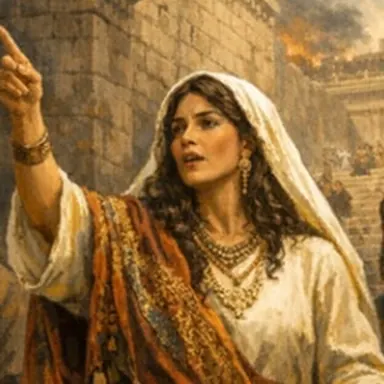
The Work and Torah Teaching of Huldah the Prophetess: A Comprehensive Study of Authority, Gender and Canonization in the Late Kingdom of Judah
16 min read3,258 words
Summary
This article surveys the complex figure of Huldah the Prophetess as a central juncture combining religious authority, female leadership and the establishment of the biblical canon in the days of King Josiah. The text analyzes how Huldah, who was active in the "Mishneh" quarter of Jerusalem, gave prophetic validity to the Torah scroll found in the Temple and thereby set in motion a far-reaching political and spiritual reform. Through an examination of the sources of the Sages and of modern scholarship, the article highlights her unique role as a connecting link between oral prophecy and written religion, as she challenges gender conventions and leaves a physical imprint on the topography of Jerusalem through the Huldah Gates. In sum, the source presents her teaching as a foundation of Jewish national identity, combining loyalty to the sacred text with living and dynamic interpretation.
Historical and theological research on the First Temple period finds in the story of Huldah the Prophetess a decisive juncture combining religious leadership, political reform and the beginning of the crystallization of the biblical canon. Huldah, who was active in the days of King Josiah (around 622 BCE), is not merely a prophetess conveying a divine message, but a key figure whose role has been defined in modern scholarship as the "chief strategist" of the Deuteronomistic reform.[1] Her single but powerful appearance in the Second Book of Kings and the Second Book of Chronicles sketches the figure of a woman of unprecedented authority, who confirms the authenticity of the Torah scroll found in the Temple and thereby changes the face of Judaism for generations.[2, 3, 4] Huldah's work and Torah teaching are woven into deep processes of transition from oral prophecy to a religion based on scripture, as she challenges gender conventions and sets up a model of "women's wisdom" that has found wide resonance in the tradition of the Sages and in modern interpretation.[5, 6, 7]
The Historical and Political Background: The Kingdom of Judah in the Days of Josiah
To understand the depth of Huldah's work, one must examine the political and spiritual reality of the seventh century BCE. After decades of heavy Assyrian influence under the kings Manasseh and Amon, during which foreign cults penetrated the Temple, Josiah came to power at the age of eight.[2, 4] Josiah began a process of "repairing the house" and purifying the cult, but the dramatic turning point came in the eighteenth year of his reign, when Hilkiah the high priest found the "book of the Torah" during renovations in the Temple.[2, 4, 8] This discovery led to a deep theological crisis for the king, who understood that the people had strayed radically from the laws of the covenant appearing in the book, identified in scholarship as a version of the Book of Deuteronomy.[2, 3, 8]
At this point Huldah enters the picture. Josiah does not turn to Jeremiah or to Zephaniah, the prominent prophets of rebuke of his generation, but sends a high-ranking delegation to Huldah.[9, 10, 11] The delegation included the top leadership of the kingdom of Judah, which attests to the prophetess's high standing in the social and religious hierarchy.
The Royal Delegation to Huldah the Prophetess
The decision to turn to Huldah is explained in the tradition of the Sages in several ways. The school of Rabbi Shila argues that Josiah chose her "because women are compassionate," in the hope that she could soften the harsh decree appearing in the book.[1, 10] By contrast, Rav argues that Huldah was a relative of Jeremiah, and therefore he did not object to her prophesying in his place or in his presence.[9, 10] Modern scholarship suggests that Huldah may have held an official position in the Temple or in the palace, perhaps as a "keeper of the archive" or as a figure with a specific legal-textual expertise in the "Mishneh" quarter.[1, 11, 13]
Her Torah Teaching and Her Location in the "Mishneh": Between Geography and Pedagogy
The identification of Huldah's place of residence in the "Mishneh" (2 Kings 22:14) is a cornerstone for understanding her Torah teaching. The word "mishneh" has received many interpretations in the sources of the Sages and the Rishonim, and they divide into three main directions: geographical, linguistic and educational.[9, 10, 14]
The geographical interpretation, accepted by the Radak and the Metzudot, holds that the "Mishneh" was a new quarter in Jerusalem, "outside the wall, between the two walls," which was a second city alongside the old city.[9, 14] This interpretation is supported by archaeological research identifying the expansion of Jerusalem in the First Temple period toward the Western Hill, an area settled by refugees from the northern kingdom of Israel after the destruction of Samaria.[8] Huldah, then, lived at the heart of the new and bustling urban center of Jerusalem.
The educational-Torah interpretation, brought by Rashi and in Tannaitic sources, sees in the "Mishneh" an expression of her role as a teacher of Torah. According to this approach, Huldah sat in a "beit ulpana," a place of repetition and study.[4, 9, 10, 14] Rashi goes further and states that Huldah "would teach the Oral Torah to the elders of the generation."[9, 10] This insight places Huldah as a critical connecting link in the transmission of the oral tradition, even before the crystallization of the Mishnah as a halakhic collection. She not only received prophecy but engaged in repetition (from the word mishneh) and in the interpretation of the laws of the Torah for the spiritual leadership of the people.[10, 14]
Interpretations of the Term "in the Mishneh" and Their Significance
Combining the interpretations yields a picture of a spiritual leader whose authority derived both from prophetic inspiration and from deep scholarly knowledge. Huldah was the most qualified personality to confirm that the Torah scroll that had been found was indeed "the word of the LORD," since she engaged regularly in its repetition and study.[1, 7, 13]
Her Prophetic Work: Confirming the Scripture and Determining the Fate of the Kingdom
Huldah's central work takes place at the moment when the delegation presents to her the findings of the "repair of the house." Her prophetic response is sharp, resolute and uncompromising. She opens with the words: "Thus says the LORD, the God of Israel: Tell the man who sent you to me."[4, 9] This formulation, called in scholarship a "Validation Prophecy," is a founding moment in the history of biblical religion.[1, 13]
Huldah does not create a new text, but gives divine validity to an existing text. She is the first prophet in biblical history whose authority serves to determine the canonicity of the holy scriptures.[1] By this action, she lays the foundations for later rabbinic Judaism, in which the interpretation and validation of the text become the center of religious life. Her prophecy consists of two layers:
- The national layer: confirmation that all the words of the book, including the curses and the calamities, will indeed be fulfilled upon Judah and Jerusalem because of the forsaking of the LORD and the worship of other gods.[4, 8, 9] Huldah makes clear that the accumulated sins, especially those of the days of Manasseh, created a spiritual debt that could not be erased without destruction.[2, 8]
- The personal-royal layer: a promise to Josiah that because of his "tender heart" and his humbling himself before the LORD, he would not see with his own eyes the evil that would come upon the place.[4, 9, 13] Huldah announces to him: "Behold, I will gather you to your fathers, and you shall be gathered to your grave in peace."[4, 9]
The expression "in peace" has raised many interpretive difficulties, since Josiah was killed in battle at Megiddo at the hands of Pharaoh Necho.[13] However, Huldah's teaching explains that the "peace" is the absence of national destruction in his days. His death on the battlefield is regarded as a divine kindness preventing him from seeing the destruction of Jerusalem and the Temple, and thus her prophecy is perceived as reliable and precise.[4, 8, 9, 13]
"Tell the Man": The Struggle of Powers between Prophecy and Kingship
One of the fascinating points in the discussion of Huldah among the Sages is her manner of speech. The Gemara in tractate Megillah 14b criticizes Huldah for using the expression "tell the man" (imru la-ish) instead of "tell the king" (imru la-melekh).[9, 10, 15] Rav Nachman states that "arrogance does not befit women," and counts Huldah as one of two arrogant women (together with Deborah), whose names are "repulsive": Huldah as an animal (a weasel) and Deborah as an insect (a bee).[9, 10]
However, a deeper look reveals that Huldah's "arrogance" is nothing but an expression of her absolute prophetic authority. Within the realm of the word of the LORD, King Josiah is a "man" subject to the covenant and to the very laws that Huldah is charged with confirming.[1, 6, 7] Huldah does not speak to the king as a subject, but as the representative of the true Sovereign. The fact that her name derives from the name of an animal that digs in burrows (huldah / karkushta) was interpreted in the Midrash as a symbol of her modesty and her dwelling in concealment, but her public work was open and powerful.[1, 9, 11, 15]
Comparison between Deborah and Huldah in the Tradition of the Sages
Her Lineage: From Joshua and Rahab to Jeremiah
Huldah's lineage is not merely a genealogical detail, but a key to understanding her Torah teaching and her connection to the history of the people of Israel. According to the opinion of Rabbi Yehuda in the Babylonian Talmud, Huldah was a descendant of Joshua son of Nun and Rahab the harlot.[9, 15, 17] This lineage has deep symbolic significance:
- Joshua son of Nun: represents the initial conquest of the Land and the fulfillment of the original covenant. Huldah, as his descendant, acts to close a circle: she confirms the Torah that Joshua bequeathed to the people, at a time when the hold on the Land is in danger.[15, 17]
- Rahab the harlot: represents the power of repentance and conversion. The Sages relate that Rahab converted and married Joshua, and from her came eight prophets who were priests, among them Huldah.[9, 17] The connection to Rahab highlights Huldah's teaching about the ability to change and to be saved through devotion to the word of the LORD, exactly as Josiah tries to do through the reform.[17]
- Jeremiah the prophet: the Sages note that Huldah was a relative of Jeremiah (according to one opinion, both were descendants of Rahab).[9, 10, 17] This connection explains the division of labor between them: Jeremiah worked in the streets of the city and called for social and political repair, while Huldah worked in the religious and scholarly center (in the Mishneh) and gave the textual seal of approval to the reform.[9, 11, 13]
Physical Legacy in Jerusalem: The Huldah Gates and the Prophetess's Tomb
Huldah's work was commemorated in the topography of Jerusalem in a way that attests to her unprecedented importance. Two main sites are identified with her name: the Huldah Gates on the Temple Mount and her tomb within the city (or on the Mount of Olives).
The Huldah Gates
The Mishnah in tractate Middot (1:3) describes five gates of the Temple Mount, among them "the two Huldah Gates on the south, serving for entrance and exit."[10, 14, 18, 19] The southern gates were the main gates through which the masses of pilgrims entered, since the city extended mainly toward the south.[14] There are several reasons for calling the gates by her name:
- The place of her prophecy: Huldah would sit between these two gates in the First Temple period and deliver there her prophecies and the judgments of the Torah to the people.[9, 14] The link between the "Mishneh" and the physical place between the gates makes the gates a focus of instruction and Torah.
- The symbolism of the weasel (huldah): some have explained that the gates were so called because of the multitude of people entering and leaving, recalling a weasel in its burrow, but the tradition identifying the gates with the prophetess is the strongest.[14]
The Tomb of Huldah the Prophetess
The identification of Huldah's tomb is a charged subject in scholarship and tradition. The earliest sources (Tosefta Bava Batra 1:11) state that "the tombs of the House of David and the tomb of Huldah the prophetess were in Jerusalem, and no one ever touched them."[10, 12] According to halakha, tombs may not be left inside Jerusalem because of impurity, but a special exception was made for the royal tombs and for Huldah's tomb. The Tosefta explains that there was an underground "burrow" (a tunnel) that carried the impurity directly out to the Kidron Valley.[10, 12]
In contrast to the early tradition that locates the tomb in the City of David, a later tradition from the 14th century (Estori HaParchi) identifies the tomb at the top of the Mount of Olives.[9, 12] This site, located near the Church of the Ascension, is holy to the three religions:
- In Judaism: attributed to Huldah the Prophetess. There is a belief that whoever circles the narrow tomb seven times merits atonement for sins.[12]
- In Christianity: attributed to Saint Pelagia (Margarita), an actress from Antioch who repented and lived as a nun at the site.[12]
- In Islam: attributed to the Sufi saint Rabia al-Adawiyya (or Mary of Egypt), who engaged in contemplation and poetry in the ninth century.[12]
The scholar Yehosef Schwarz (19th century) sharply criticized the identification on the Mount of Olives, arguing that it was an error arising from the fact that the Muslims called the place "prophetess" (because of the sanctity of Pelagia or Rabia), and the Jews assumed that it was Huldah, the only prophetess they knew of from Jerusalem.[12] In his view, Huldah's original tomb was and remains in the City of David, within the bounds of the ancient wall.
The Significance of Josiah's Reform under Huldah's Guidance
Huldah's work did not amount to words alone; her prophecy set in motion one of the greatest religious reforms in the history of Israel. Josiah, after receiving Huldah's confirmation, carried out a series of dramatic actions:
- Purification of the cult: removal of all the vessels of Baal and of the Asherah from the Temple and burning them in the Kidron Valley.[2, 6, 11] It is interesting to note that modern scholarship sees Huldah, as a woman, as a figure who validated the removal of the Asherah (a female deity) and thereby strengthened pure male monotheism.[6]
- Centralization of the cult: abolition of all the high places outside Jerusalem and defilement of the cult centers at Bethel.[2, 3, 4] This action made the Temple in Jerusalem the exclusive place for the service of the LORD.
- Renewal of the covenant: the making of a renewed covenant between the people and their God, based on obedience to the laws of the book that had been found.[4, 8] Josiah read the book in the hearing of "all the men of Judah and all the inhabitants of Jerusalem," in a step that made the Torah a founding document of national identity.[4]
- Celebration of the great Passover: Josiah held a Passover of unprecedented scope, the like of which had not been held since the days of the Judges, as instructed by the book confirmed by Huldah.[8]
Huldah served as the spiritual engine behind these actions. Without her confirmation, the book might have remained an archaeological curiosity. It was her prophetic authority that gave the king the moral and religious backing to carry out such radical changes in the social and religious structure of Judah.[1, 7, 20]
Huldah in a Modern Perspective: Female Leadership and Religious Justice
The modern discussion of Huldah the Prophetess highlights her role as a trailblazer in female leadership. Huldah is described as a woman who "stood in the breach" between the king and the people, and between the glorious past and the impending destruction.[1, 7, 20] She emerges as a figure of political daring, who does not hesitate to speak the "hard truth" to decision-makers.[20, 21]
In contrast to ecclesiastical or traditional narratives that pushed women to the margins, Huldah is presented in scholarship as one who "guided men in the way of God."[7, 20] Her authority did not derive from family status alone (although she was the wife of the keeper of the wardrobe), but from her direct calling by God. Academic research sees her as a "Court Prophet" with deep professional knowledge, capable of interpreting national destinies like the prophetesses in parallel micro-cultures of the ancient Near East (such as at Mari or in Assyria).[11, 13]
There is also an interesting comparison between Huldah and prophetic figures in other traditions (such as Lehi in the Mormon tradition), which highlights the importance of prophetic confirmation of the destruction of Jerusalem as a means of motivating change and repentance.[8] Huldah is the model of a prophet who not only foretells the future, but uses prophecy to shape the present.[1, 21]
Summary and Conclusions of the Study
The work and Torah teaching of Huldah the Prophetess are a critical layer in understanding the development of Judaism. Huldah stands at the point of transition from an oral religion to a textual religion, and serves as the "godmother" of the biblical canon.
Huldah the Prophetess proved that the holy spirit and Torah knowledge are not limited by gender or by political status. Her teaching, which stresses the need for absolute loyalty to the written covenant together with living and dynamic interpretation (mishneh), became the foundation on which Judaism was built after the destruction of the Temple. Her physical memory, preserved in the gates of the Temple Mount and in the tunnels of Jerusalem, continues to bear witness to a time when one prophetess succeeded in turning the course of an entire nation through words of truth, wisdom and compassion.[1, 5, 20]
Sources21
- 1.prophetess huldah as a principal strategist of josiah's reforms (2 kings 22): lessons for women in political and religious leadership in africa - Academia.edu, academia.edu/32023586/PROPHETESS_HULDAH_AS_A_PRINCIPAL_STRATEGIST_OF_JOSIAHS_REFORMS_2_KINGS_22_LESSONS_FOR_WOMEN_IN_POLITICAL_AND_RELIGIOUS_LEADERSHIP_IN_AFRICA
- 2.מלכים ב כ"ג 4-14: רפורמת יאשיהו | ספריית ספריא, sefaria.org.il/Sheet.106583
- 3.רפורמת יאשיהו - ויקיפדיה, he.wikipedia.org/wiki/רפורמת_יאשיהו
- 4.ביאור:מלכים ב כב - ויקיטקסט, he.wikisource.org/wiki/ביאור:מלכים_ב_כב
- 5.חולדה הנביאה - חכמת נשים - בני ציון - בונים קומה בתנ"ך, bneyzion.co.il/מאגר-השיעורים-והמאמרים/נביאים/מלכים-ב/תשובת-יאשיהו-פרקים-כב-כג/חולדה-הנביאה-חכמת-נשים
- 6.Gazing at Huldah - The Bible and Critical Theory, bibleandcriticaltheory.com/wp-content/uploads/2018/04/vol1-no3-2005-gazing-at-huldah-mckinlay-40-148-1-PB-2nyzs16.pdf
- 7.A Woman's Work: How God used Huldah to change the heart of a king and a nation, academia.edu/35109480/A_Womans_Work_How_God_used_Huldah_to_change_the_heart_of_a_king_and_a_nation
- 8.Huldah's Long Shadow - BYU ScholarsArchive, scholarsarchive.byu.edu/cgi/viewcontent.cgi?filename=3&article=1001&context=mi&type=additional
- 9.חולדה הנביאה - ויקיפדיה, he.wikipedia.org/wiki/חולדה_הנביאה
- 10.חולדה | Voices on Sefaria - ספריא, sefaria.org.il/sheets/181625
- 11.At the Service of the Word of God – Understanding Huldah's Ministry in 2 Kings 22:14, cabanalive.org/?sdm_process_download=1&download_id=2573
- 12.קבר חולדה הנביאה בירושלים, לימודי ירושלים, סיורים בירושלים, הרצאות בירושלים, jerusalem-love.co.il/?page_id=725
- 13.The Role and Function of Huldah as a Royal Prophet - Korea Journal Central, journal.kci.go.kr/ksots/archive/articleView?artiId=ART002884017
- 14.שערי חולדה – ויקימקדש, wiki.temple.org.il/wt/שערי_חולדה
- 15.מגילה יד ב - ויקיטקסט, he.wikisource.org/wiki/מגילה_יד_ב
- 16.7 הנביאות של עם ישראל - BeitChabad.com - בית חבד - Chabad.org, he.chabad.org/library/article_cdo/aid/7109791/jewish/7.htm
- 17.רחב - ויקיפדיה, he.wikipedia.org/wiki/רחב
- 18.שערי חולדה - הר הבית - אתרים היסטוריים בישראל, historicalsitesinisrael.com/שערי-חולדה/
- 19.שערי חולדה - הר הבית - YouTube, youtube.com/watch?v=-a15PfcGa9A
- 20.Huldah: A Trustworthy Prophet - Center for Action and Contemplation, cac.org/daily-meditations/huldah-a-trustworthy-prophet-2023-02-15/
- 21.Prophecy and Politics in Ancient Israel: An Exploration of the Role of Prophetess Huldah in Josiah's Reformation - Academic Journals Online (ACJOL), acjol.org/index.php/jorahr/article/download/5383/5220