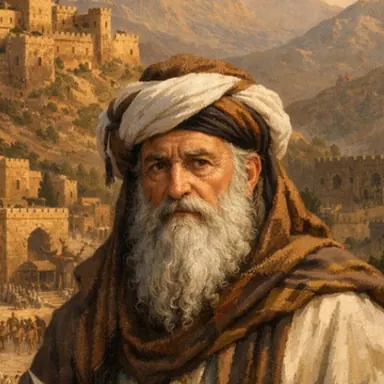
The Work and Torah Teaching of Rabbi Ephraim of Qal'at Hammad: A Comprehensive Historical and Halakhic Study
13 min read2,618 words
Summary
The text surveys the highly influential figure of Rabbi Ephraim of Qal'at Hammad, an 11th-century North African sage who served as a vital link between the period of the Geonim and the Rishonim of Spain and Europe. The article emphasises his unique standing as the "talmid-chaver" (disciple-colleague) of the Rif, a standing that allowed him to preserve intellectual independence, to criticise his teacher's readings and even to embed his glosses in the text of the Rif itself. Beyond halakhic ruling, the source highlights his exceptional expertise in grammar and philology, tools he used to distil the "plain sense" (peshat) of the Talmud and to correct textual corruptions in the manuscripts. Although most of his work was lost with the destruction of Qal'at Hammad by the Almohads, the text explains how his teaching has been reconstructed in modern scholarship from quotations in the writings of the sages of Provence, and thereby commemorates his legacy as an intellectual bridge between cultures and as a symbol of textual and scientific precision in the world of halakha.
Introduction: The Figure of Rabbi Ephraim in the Mirror of His Time and Place
The history of North African Jewry in the period of transition between the end of the era of the Geonim in Babylonia and the rise of the Torah centres in Spain and Europe is filled with spiritual giants who served as connecting links in the history of halakhic transmission. One of the most prominent and mysterious of them is Rabbi Ephraim of Qal'at Hammad, also known as Rabbi Ephraim the disciple of the Rif or Rabbi Ephraim Qal'i.[1, 2] The figure of Rabbi Ephraim represents a unique synthesis of profound Talmudic learning, rigorous textual criticism and linguistic expertise, all in a period of dramatic geopolitical and religious upheavals in the Islamic Maghreb.[1, 2]
Rabbi Ephraim was active in the second half of the 11th century and the first half of the 12th, a period defined as the golden age of the yeshivot of North Africa before the great destruction brought by the Almohads.[1, 3] He was not only the leading disciple of Rabbeinu Yitzhak Alfasi (the Rif), but was considered a "talmid-chaver" (disciple-colleague), a standing that attests to intellectual independence and to the ability to dispute with his principal teacher as an equal among equals.[1, 4] This standing found expression in the fact that his glosses and readings entered the text of the Book of the Rif itself, which makes understanding his teaching essential for anyone engaged in the study of the "great decisor" of that period.[1]
The place where he grew up and worked, Qal'at Hammad, was then a flourishing metropolis and a cultural and economic centre of the first rank in modern Algeria.[5, 6] As the capital of the Hammadid dynasty, it drew to itself an intellectual elite that included philosophers, poets, grammarians and theologians from all over the Jewish and Muslim world.[5] In this environment Rabbi Ephraim's personality was formed as a multidisciplinary sage who saw the grammar of the Hebrew language and the clarification of the text of the Talmud as necessary tools for understanding the word of God and for deciding halakha.[1, 2]
Historical and Geographical Milestones in the Community of Qal'at Hammad
Qal'at Hammad: The Urban and Cultural Context of the Yeshiva
To understand the power of Rabbi Ephraim's work, one must delve into the unique features of the city in which he worked. Qal'at Beni Hammad (Al Qal'a of Beni Hammad) was not just a small town, but an imperial fortress built at an altitude of about 1,000 metres above sea level on the slopes of Jebel Maadid.[5, 8] Its strategic location gave it natural protection, and it became a refuge for refugees from older communities such as Kairouan, which had been destroyed by nomadic tribes.[6, 7]
The city was described by its contemporaries, such as al-Bakri, as a centre of international trade attracting caravans from Iraq, the Hejaz, Egypt and Syria.[6] Economic wealth translated into an unprecedented intellectual flowering. The archaeology of the site reveals magnificent palaces (such as the Manar Palace and the Palace of the Star), spacious mosques and complex water systems, attesting to a society of a high technological and cultural level.[5, 6]
In such an environment the Jewish community was not isolated. It included an educated elite (such as Shlomo ben Formash) that maintained close ties with the centres in Spain and Egypt.[7] The yeshiva that operated in the city, under the leadership of the Rif and later probably under the leadership of Rabbi Ephraim, did not engage only in memorising the Talmud, but was open to new methods of research, especially in the field of philology and grammar.[1] The cultural openness of the Hammadid regime allowed the Jews to flourish and to develop Torah creativity combining the tradition of the Geonim with Andalusian scientific precision.[3, 6]
The historian Ibn Khaldun notes that the economic abundance of Qal'at Hammad drew to it "those interested in the sciences and the arts".[6] For Rabbi Ephraim this meant access to rich libraries and to rare manuscripts of the Talmud and the Tosefta, which served as the basis for his monumental work of clarifying textual readings.[1, 2] This intellectual climate explains why Rabbi Ephraim devoted so much attention to textual precision: in a city of sages and grammarians, the written word carried decisive weight.
Rabbi Ephraim as "Talmid-Chaver" of the Rif: Methodology and Controversy
The relationship between Rabbi Ephraim and the Rif is one of the most fascinating in the history of Talmudic transmission. The Rif, who was probably born in Qal'at Hammad or its surroundings, worked there for decades before he was forced to flee to Spain in 1088 at the age of 75.[2, 7] Rabbi Ephraim was his leading disciple in this period, but their relationship went beyond the classical model of teacher and passive disciple.
Rabbi Ephraim is called in the sources a "talmid-chaver", a term indicating that he reached a level at which he could disagree with his teacher, propose alternative interpretations and even criticise his readings.[1] The research of Rabbi Israel Schepansky has shown that in many cases glosses that Rabbi Ephraim wrote in the margins of his copy of the Book of the Rif entered, over time, the text of the Rif in later printed editions.[1, 4] This is a rare phenomenon that attests to the immense authority that later generations attributed to Rabbi Ephraim's words.
Rabbi Ephraim's teaching was marked by adherence to the "plain sense" (peshat) of the Talmudic passage and by linguistic precision. In contrast to the tendency towards pilpul that developed in other centres, he strove to understand the primary source through the tools of grammar.[1] His influence was so great that the later sages of Provence, such as the Baal HaMaor and the Raavad, often cite him as a supreme authority equal to the Rif, and sometimes even prefer his opinion.[2]
Expertise in Grammar and the Link with Rabbi Solomon Parhon
One of the unique aspects of Rabbi Ephraim's work is his being a grammarian of renown. In this period Hebrew grammar (the science of language) was seen as an essential tool not only for understanding Scripture but also for the legal interpretation of the Talmudic text.[1] Rabbi Ephraim is considered one of the pioneers in transmitting the Andalusian grammatical traditions (such as those of Hayyuj and Ibn Janah) into the world of the yeshivot of North Africa.
Decisive evidence of his influence in this field is the fact that Rabbi Solomon Parhon, the author of "Mahberet he-Arukh" (a comprehensive dictionary and grammatical work of the 12th century), is considered his disciple.[1] Through Parhon, Rabbi Ephraim's linguistic conceptions seeped into the Torah centres of Europe. Rabbi Ephraim saw precise grammar as a key to preventing errors in understanding halakha; he held that textual corruptions often stem from a misunderstanding of the rules of the language, and therefore devoted entire treatises to clarifying matters of language.[1, 2]
The combination of Talmudic learning and linguistic expertise allowed Rabbi Ephraim to carry out a "deconstruction" of corrupt texts. He was not content with oral tradition, but compared versions of the Mishnah and the Tosefta using philological tools.[1, 2] This approach was ahead of its time and made him an admired figure among sages who sought the "textual truth" amid the sea of variations in medieval manuscripts.
His Lost Work and Its Modern Reconstruction
Most of Rabbi Ephraim's works were lost over the generations, mainly because of the physical destruction of the communities of North Africa by the Almohads in 1152.[5, 7] This loss is considered one of the gravest losses for the world of the Rishonim, since Rabbi Ephraim covered all fields of the Torah in his writings.[1, 2]
Nevertheless, his teaching did not disappear entirely. It was preserved as "quotations within quotations" in the writings of other sages. Rabbi Israel Schepansky, in a monumental research work published in 5736 by Mossad HaRav Kook, gathered all the remnants of his teaching from manuscripts and from the books of the Rishonim.[2, 4] This enterprise has allowed a glimpse into the rich "bookcase" of this sage.
Rabbi Ephraim's Conjectured Works according to Scholarly Reconstructions
Schepansky's reconstruction revealed that Rabbi Ephraim was involved in the establishment of "communal enactments in Israel" (takkanot), a subject on which Schepansky wrote in a separate work.[4] From this one can learn that Rabbi Ephraim was not only a scholar within the walls of the yeshiva, but an active leader who engaged in shaping the social and legal life of the Jewish community in the Maghreb by amending enactments and regulating mutual relations within the community.[4]
His Wanderings and His Influence on Other Torah Centres
There is uncertainty about the course of Rabbi Ephraim's life after 1088. While the Rif moved to Spain and founded the famous yeshiva in Lucena, opinions are divided about his leading disciple. Some hold that Rabbi Ephraim remained in Qal'at Hammad and continued to head a great yeshiva there that served as a spiritual centre for the entire region.[2] This view is supported by the fact that he is called "Qal'i" (after Qal'at Hammad) throughout the generations.
However, his immense influence on the sages of Provence (such as the Raavad and the Baal HaMaor) has given rise to the hypothesis that at the end of his life he wandered to southern France, or at least moved his activity to Christian Spain.[2] The sages of Provence cite him with reverence, and he serves them as an authority that counterbalances the words of the Rif. It is possible that Rabbi Ephraim served as a "cultural agent" who transmitted the accumulated knowledge of North African Jewry directly into the developing European centres, and thereby contributed to shaping halakha in the West.[2]
His epithet "Rabbi Ephraim the Sephardi" in certain sources strengthens the possibility that he lived for some time in Spain (perhaps in Lucena with his teacher), where he was exposed to the Andalusian methods of study and absorbed them into his original Maghrebi teaching.[2] Either way, his figure remains a connecting link between three continents and cultures: Islamic North Africa, Andalusian Spain and Christian Provence.
The End of an Era: The Destruction of the Community and Rabbi Ephraim's Legacy
The tragedy of Qal'at Hammad and of Rabbi Ephraim is closely bound up with the rise of the Almohad dynasty (Almohads). This Berber dynasty, which preached a radical and zealous Islam, conquered the Maghreb in the middle of the 12th century.[3] In 1152 Qal'at Hammad was destroyed so thoroughly that it was never rebuilt.[5, 7]
The Jews of the city, who had been accustomed to a certain degree of protection under Hammadid rule, found their hopes dashed. The period of relative tolerance came to an end, and many were forced to convert to Islam outwardly, to be killed for the sanctification of God's name, or to flee.[3] Rabbi Ephraim's death close to these dates (around 1150) marked the end of a glorious chapter in Algerian Jewry.[1]
Despite the physical destruction, Rabbi Ephraim's teaching survived through the power of the written and transmitted word. The fact that modern scholars still find fragments of his teaching within the pages of the Rif or in Yemenite and European manuscripts attests to the vitality of his teaching.[1, 4] Rabbi Ephraim of Qal'at Hammad remains a symbol of the sage who succeeds in bridging scientific precision and religious tradition, and his figure continues to illuminate the study of the period of the Rishonim to this day.
An In-Depth Analysis of His Contribution to Grammar and the Hebrew Language
As noted, Rabbi Ephraim was not only a halakhic decisor but also a linguist. To understand the depth of his work in this field, one must see the broader context of the study of the Hebrew language in the Middle Ages. In this period the Hebrew language was seen as an instrument of holiness but also as an instrument of intellectual precision. Rabbi Ephraim saw grammar as an inseparable part of Torah study.[1]
Rabbi Ephraim was among the first to absorb the method of Rabbi Judah Hayyuj (the author of the theory of the triliteral root) into halakhic discussion. He understood that many of the disputes in the Talmud stem from a misunderstanding of verb inflections or of the hidden meanings of rare words. Through his work, grammar became an indispensable auxiliary science for every Torah scholar.[1]
His disciple, Rabbi Solomon Parhon, continued his path and spread his teaching in Europe. In his book "Mahberet he-Arukh", Parhon cites Rabbi Ephraim not only as a decisor but as a guide in matters of language. This is evidence that Rabbi Ephraim was considered a linguistic authority of the first rank, whose words were weighed seriously alongside the great grammarians of Spain.[1]
His Halakhic Teaching in the Mirror of the Generations: Summary and Insights
An examination of the work of Rabbi Ephraim of Qal'at Hammad reveals the figure of a sage who was ahead of his time. He combined vast erudition in the sea of the Talmud with a critical and scientific approach to the text. His main contribution lay in "cleansing" the halakhic text of corruptions and in establishing halakhic ruling on a solid philological basis.[1, 2]
Rabbi Ephraim represents the "missing link" between the Geonim of Babylonia and the Rishonim in Europe. Through him the tradition of the yeshivot of Kairouan and Qal'at Hammad passed to the Raavad, the Razah and Nahmanides (Ramban).[2] The reconstruction of his teaching by modern scholars such as Rabbi Schepansky is not merely a historical gesture, but the restoration of a vital piece of the halakhic puzzle of the people of Israel to its proper place.[2, 4]
Ultimately, Rabbi Ephraim of Qal'at Hammad teaches us about the importance of precision, about the courage to disagree with great authorities in the name of textual truth, and about the ability of spiritual creation to survive even the harshest physical destruction. His home city, Qal'at Hammad, is today a UNESCO World Heritage Site [8], but Rabbi Ephraim's true legacy lives and pulses between the pages of the Talmud and the halakhic books studied every day.[1]
Sources8
- 1.אפרים מקלעת חמאד - ויקיפדיה, he.wikipedia.org/wiki/אפרים_מקלעת_חמאד
- 2.רבי אפרים תלמיד הרי"ף – ויקישיבה, yeshiva.org.il/wiki/index.php/רבי_אפרים_תלמיד_הרי"ף
- 3.Jews in Algeria under Islamic rule - Morashá, morasha.com.br/en/diaspora-communities/Jews-in-Algeria-under-Islamic-rule.html
- 4.ישראל שבתי שצ'יפנסקי - ויקיפדיה, he.wikipedia.org/wiki/ישראל_שבתי_שצ'יפנסקי
- 5.Archnet > Site > Qal'a Bani Hammad, archnet.org/sites/4028
- 6.Site of Qal'at Bani Hammad - Discover Islamic Art - Virtual Museum, islamicart.museumwnf.org/database_item.php?id=monument;ISL;dz;Mon01;4;en
- 7.Qalʿat Ḥammād - Jewish Virtual Library, jewishvirtuallibrary.org/qal-x02bf-at-x1e24-amm-x0101-d
- 8.Al Qal'a of Beni Hammad - UNESCO World Heritage Centre, whc.unesco.org/en/list/102/