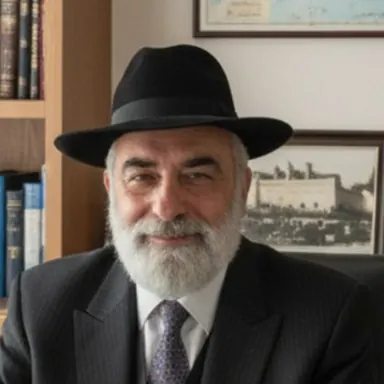
Leadership, Tradition and Redemption: The Torah and Public Work of HaGram Zeini of Blessed Memory
11 min read2,258 words
Summary
This source surveys the life and teaching of Rabbi Meir Zeini, a prominent spiritual leader who preserved the heritage of Algerian Jewry through wanderings between North Africa, Europe and Israel. The text details his public work as a community rabbi and educator, with emphasis on the uncompromising halakhic and grammatical precision he instilled in his students in order to rescue the unique tradition from oblivion. A central aspect of the text is his activist Zionist outlook, which saw in the establishment of the State the beginning of the Redemption and led many of his followers to immigrate to the Land. In conclusion, the article shows how his vision continues to live on today through Torah institutions and publishing enterprises that combine scholarly research with fidelity to the customs of the forefathers.
Historical Biography and Spheres of Activity of the Last of the Rabbis of Algeria
HaGram (HaGaon HaRav Meir, the Gaon Rabbi Meir) Zeini of blessed memory (5681–5772 / 1921–2012) embodies in his person the very essence of the Torah and cultural vitality of North African Jewry in the twentieth century, serving as a living bridge between the splendid world of the communities of Algeria, the refugee centers of post-Holocaust France, and the modern processes of the Return to Zion in the Land of Israel [cite: 1, 2]. Rabbi Zeini was born on Tu BiShvat (15 Shevat) 5681 in the town of Mécheria in Algeria to Rabbi Eliyahu Zeini, himself a respected community rabbi in several Algerian towns, among them El Bayadh, Ghardaïa and Tiaret, and to Mas'uda née Tordjman [cite: 1].
Rabbi Zeini's family lineage reaches deep into the golden Torah of Spain; the original family name was "Ajeini," derived from the name of the city of Jaén in the region of Andalusia, and it originates in a dynasty traced to Rabbi Yosef Yoshto, one of the foremost disciples of the Rif (Rabbi Yitzhak Alfasi) [cite: 1]. This illustrious family heritage laid an unshakable foundation for Rabbi Zeini's lifelong commitment to preserving, maintaining with precision and transmitting the customs of his forefathers without compromise [cite: 2, 3].
Chronological Milestones in the Life and Public Activity of Rabbi Meir Zeini of Blessed Memory
To understand the Rabbi's historical work, the following table sets out the main stations of his life, his geographical movements and his influence on his surroundings:
The Move to France and the Rebuilding of the Community in Montmartre
The Algerian War of Independence in 1962 caused a deep rupture in the lives of some 140 thousand Jews of the country, who were forced to leave their historic homeland overnight and emigrate to France [cite: 1]. The arrival of hundreds of thousands of Maghrebi refugees in France confronted the local religious establishment with an unprecedented challenge. Rabbi Meir Zeini, who reached Paris at the height of the crisis, recognized at once that the greatest danger threatening the new immigrants was not merely economic but spiritual and cultural: the loss of their distinctive customs and rapid assimilation into a secular society or into the long-established Ashkenazi communities of France [cite: 1].
To meet this challenge, Rabbi Zeini began to organize mass prayer gatherings [cite: 1]. The most prominent undertaking of those days was the organization of the High Holy Days services in the "Cirque d'Hiver" (Winter Circus) in Paris, where thousands of Algerian Jews prayed under his guidance, preserving the original melodies and liturgical rites of their communities [cite: 1]. These gatherings, which were also held in the "Eden Halls" in close partnership with the Chief Rabbi of France, Rabbi Jacob Kaplan, the last Chief Rabbi of Algeria, Rabbi David Ashkenazi, and Rabbi Yehuda Léon Askénazi ("Manitou"), prevented the disintegration of the Algerian communal structure in the Diaspora and became a source of pride and identity for the immigrants [cite: 1, 6].
In 1975 Rabbi Zeini took on the leadership of the synagogue on Rue Sainte-Isaure in the Montmartre quarter of the 18th arrondissement of Paris [cite: 1, 5]. This synagogue, which originally belonged to the local Ashkenazi community, had stood almost completely abandoned after the Holocaust [cite: 1]. Rabbi Zeini opened its gates, established a Talmud Torah in it for the children of the neighborhood, and turned it into a community center with some 600 seats [cite: 1]. His activity was not confined to the walls of the synagogue; he engaged intensively in outreach to the unaffiliated, distributed weekly food baskets to needy families, and opened his home to all comers [cite: 1]. The Rabbi also maintained close ties with the leadership of Moroccan Jewry in Israel, foremost among them the Baba Haki (Rabbi Yitzhak Abuhatzeira, rabbi of Ramla and Lod), with whom he used to stay during his visits to Israel [cite: 1].
The Educational and Pedagogical Teaching of Rabbi Meir Zeini
Rabbi Meir Zeini's educational teaching is based on the approach of "education out of belonging and precision" [cite: 1, 2]. The Rabbi saw the education of children and young people as the principal instrument of survival of the Jewish nation in the Diaspora, and he demanded that educators create a warm, encouraging and non-judgmental environment that would, on the other hand, be precise and uncompromising in liturgical and scholarly terms [cite: 1, 7].
The primacy of derekh eretz and common sense: The Rabbi stressed to his students that derekh eretz (proper conduct) and human morality come before all Torah study [cite: 1]. He rejected pilpul detached from reality and demanded "common sense" as the first tool for understanding the Torah and life [cite: 1].
Adherence to the plain sense of the verses and the depth of Scripture: In his lessons the Rabbi used to concentrate on the plain sense (peshat) of the Bible and the Talmud [cite: 1]. He held that the neglect of Bible study in recent generations had damaged the foundations of the faith of the youth, and he therefore brought Scripture back to the center of Torah discourse, giving profound lessons on the books of Psalms, Proverbs and Job [cite: 1, 8, 9].
- Phonetic and grammatical precision: Rabbi Zeini was exceptionally learned in the rules of Hebrew grammar and in the Masoretic tradition of the Bible [cite: 1]. He insisted that his students pronounce the guttural letters (ayin and chet) correctly and take care to pronounce the vowel signs and the cantillation marks properly [cite: 1, 4]. In his view, a corrupted pronunciation necessarily leads to a corrupted theological understanding [cite: 1].
- The method of examination and spiritual awakening: In his public sermons the Rabbi did not allow his listeners to remain passive [cite: 1]. He used to surprise the audience with sudden questions about the sermon or about the meaning of basic concepts such as "Shema Yisrael," with the aim of awakening self-awareness and critical thinking in his listeners [cite: 1].
His Halakhic Enterprise and the Codex of the Customs of Western Algeria
The core of Rabbi Zeini's Torah work was his uncompromising struggle against modern liturgical uniformity, which threatened to erase the local traditions of the Eastern communities and of North Africa [cite: 2, 3]. HaGram Zeini held a firm halakhic position that every well-founded communal custom must be preserved, and he regarded these customs as full-fledged laws possessing binding halakhic force [cite: 3, 8].
At the center of his halakhic activity stood his guidance of the publication of accurate prayer books and festival prayer books according to the traditional Livorno rite (such as the complete siddur "Tefillat HaChodesh" and the machzorim "Mo'adei Hashem" and "Zekhor le-Avraham") [cite: 1, 10, 11]. These prayer books were combined with the rulings of the Chida and with the halakhic rulings of his close friend, Rabbi Shalom Messas of blessed memory [cite: 1, 10, 11]. At the same time, Rabbi Zeini recorded hundreds of hours of Torah readings, haftarot, portions of the Bible and complex prayer texts for weekdays, Shabbat, festivals and the High Holy Days [cite: 1, 3]. These recordings, preserved today in the archive of the National Library and on YouTube, serve as an exclusive phonetic and scholarly reference for researchers and Torah readers who seek to reconstruct the original Algerian pronunciation and melody [cite: 1, 3].
The Codex of Western Algerian Halakhic and Liturgical Customs According to the Rulings of HaGram Zeini
To present the richness of Rabbi Zeini's rulings and customs, the following is a detailed codex gathering the customs he instituted and devoutly preserved throughout the years of his rabbinate:
His Zionist Teaching and His Bond with the Processes of Redemption
One of the most distinctive characteristics of HaGram Zeini was his pronounced and uncompromising Zionist position, which he integrated as an integral part of his halakhic and religious teaching [cite: 2, 12, 13]. In contrast to the passive approaches prevalent among some North African sages upon their arrival in Israel, Rabbi Zeini saw in the establishment of the State of Israel and the ingathering of the exiles the practical beginning of the biblical Redemption and the fulfillment of the vision of the prophets [cite: 1, 12, 13].
In his sermons he used to emphasize that Abraham the Hebrew was the first Zionist, in fulfilling the divine command "Lekh lekha" ("Go forth"), and that the Return to Zion in our generation is not merely a solution of physical refuge but a lofty halakhic obligation [cite: 12, 13]. This outlook was translated into practical directives in his community in Paris [cite: 1]:
Making fundraising conditional on a blessing for the State: Rabbi Zeini forbade emissaries of institutions from Israel to collect donations in his synagogue in Montmartre unless they agreed to bless the State of Israel and the soldiers of the IDF publicly and with intent [cite: 1].
Mass immigration of the young generation: As a result of his consistent Zionist education, a considerable proportion of the young people who grew up in his community immigrated to the Land and integrated into Israeli society and military service [cite: 1].
Ruling on Hallel with a blessing on Independence Day and Jerusalem Day: Rabbi Zeini ruled that the complete Hallel is to be recited with a blessing on these days, out of a profound halakhic recognition of the magnitude of the miracle of Jewish sovereignty in the Land of Israel [cite: 1, 8].
The Continuity of His Teaching in the Second and Third Generations
In terms of ideas and institutions, the continuity of HaGram Zeini's enterprise finds prominent expression through his sons and students, who developed his ideas into a systematic teaching combining scholarly research, uncompromising halakha and activist Zionism [cite: 12, 13].
His son, Rabbi Dr. Eliyahu Rachamim Zeini (born in Algeria in 1946), studied with his father and also with key figures such as Rabbi Yehuda Léon Askénazi ("Manitou"), Chacham Shlomo Dahan, and the philosopher Emmanuel Levinas [cite: 12, 13]. He later immigrated to the Land, completed a doctorate in mathematics at the Technion, and served as the rabbi of the Technion for decades [cite: 12, 13]. In 2001 he founded in Haifa the hesder yeshiva "Or Vishua," which is today the center for the dissemination of Rabbi Meir Zeini's teaching [cite: 12, 13].
The "Or Vishua" yeshiva is diligently engaged in publishing works based on Rabbi Meir Zeini's Torah approach, alongside translating works of Jewish philosophy and the literature of the Geonim [cite: 12]:
- The "Etz Erez" series: five volumes containing articles on halakha and thought, which address questions of the day from a rooted scholarly and halakhic approach [cite: 12, 13].
- The book "Eretz Chemdatenu": a work that formulates a distinctly right-wing Torah outlook defining the absolute prohibition on handing over territories of the Land of Israel, while engaging directly on halakhic grounds with the rulings of Rabbi Ovadia Yosef of blessed memory concerning the Oslo Accords [cite: 13].
Translation and publication of the writings of the Geonim and of Rabbi Eliyahu Benamozegh: the publication of books such as "Israel and Humanity," "Masoret ve-Hi Torah she-be-al Peh" (Tradition, Which Is the Oral Torah) and "Eimat Mafgia," which express the broad, cultural and philosophical approach of the original North African Jewry [cite: 12, 14].
In addition, in 5779 (2018) his descendants founded in the Arnona neighborhood of Jerusalem the association and synagogue "Meirim Yerushalayim," named after him [cite: 1, 7]. This community places children and young people at the center of its public activity through experiential Torah study and precise reading with the cantillation marks and piyyutim, out of a desire to continue the legacy of HaGram Zeini as a rabbi-educator, a lover of his fellow creatures and a transmitter of pure Torah truth [cite: 2, 7].
Sources14
- 1.מאיר זייני - ויקיפדיה, he.wikipedia.org/wiki/מאיר_זייני
- 2.הרב מאיר זייני זצ"ל, ravsherki.org/index.php/2013-02-13-17-15-16/156-q-156/412-2016-11-22-20-16-03/3557-q-3557
- 3.עמוד הבית - אתר הרב מאיר זייני זצ"ל, ravzini.com/
- 4.הרב מאיר זייני - אחרון רבני אל... - ספרי קודש והיסטוריה מוקלטים - Apple Podcasts, podcasts.apple.com/us/podcast/הרב-מאיר-זייני-אחרון-רבני-אלגיריה-וממשיכו-של-עולם-שנעלם/id1682490737?i=1000735936271&l=es-MX
- 5.אלג׳יר - לשון הבית, lashon.org/1/taxonomy/term/581
- 6.French Algerian Rabbi - הרב מאיר זייני - שימש כרב קהילה באלג'יר, בצרפת ובישראל - YouTube, youtube.com/watch?v=ZLVJk3Ux0As
- 7.בית כנסת מאירים ירושלים | קהילה ספרדית צעירה בארנונה, meirimj.org/
- 8.מנהגי עדות המערב ויהדות אלג'יריה - הרב מאיר זייני, ravzini.com/מנהגים/
- 9.ספר תהילים הרב מאיר זייני - תורת הר חומה, harchoma.org.il/announcement/Tehilim-Rav-Meir-Zini1.pdf
- 10.סדור תפילת החודש גדול |נוסח ליוורנו - ספריית בית אל, beitel.co.il/products/סדור-תפילת-החודש-גדול-נוסח-ליוורנו
- 11.סדור תפילת החדש - ספרי קודש ספריית עם ישראל, kodeshbook.co.il/product.asp?productid=9287
- 12.אליהו רחמים זייני - ויקיפדיה, he.wikipedia.org/wiki/אליהו_רחמים_זייני
- 13.הרב אליהו רחמים זייני – ויקישיבה, yeshiva.org.il/wiki/index.php/הרב_אליהו_רחמים_זייני
- 14.מבוא לתורה שבע"פ/בן אמוזג - ספרי קודש ספריית עם ישראל, kodeshbook.co.il/product.asp?productid=1817