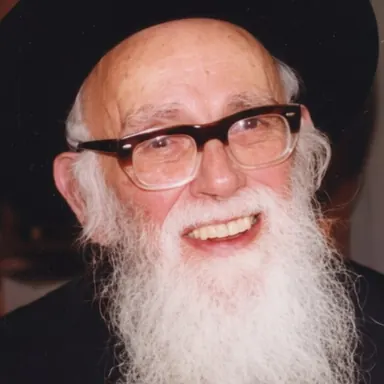
Rabbi Shlomo Zalman Auerbach
17 min read3,426 words
Summary
This survey presents the many-sided figure of Rabbi Shlomo Zalman Auerbach, who is considered the pillar of the world of halakha in the twentieth century because of his unique ability to bridge the yeshiva tradition and the challenges of modernity. The text outlines the course of his life from his roots in Jerusalem until he became a supreme authority, focusing on his innovative approach to questions of technology, medicine and ethics, based on in-depth scientific research. Beyond his halakhic leadership, the source highlights his educational work, marked by love of people and simplicity, and describes how his humble personality made him a living bridge between the different streams of religious and Haredi Judaism. The aim of the work is to shed light on the legacy of the "posek of the generation" as one who proved that Torah and halakha are able to renew themselves and respond to a changing reality without losing their deep roots.
The Posek of the Generation in the Modern Era: The Halakhic Teaching, Educational Work and Public Leadership of Rabbi Shlomo Zalman Auerbach
In the Torah world of the twentieth century, the figure of Rabbi Shlomo Zalman Auerbach (5670–5755) stands as a pillar bridging the ancient yeshiva tradition and the challenges of modernity, technology and advanced medicine. Rabbi Auerbach, whom everyone called "HaGrashaz" or "the posek of the generation," succeeded in combining in his personality exceptional scholarly genius, a capacity for pioneering halakhic rulings in technological and medical fields, and noble traits of humility and kindness that made him a rare consensus figure in every part of Orthodox Judaism.[1, 2, 3, 4] His figure represents not only the continuity of the Jerusalem on high, but also the ability of halakha to renew itself and respond to a changing reality without losing its deep roots.
Chapter 1: Jerusalem Roots and the Growth of a Torah Giant
The growth of Rabbi Shlomo Zalman Auerbach is inseparably interwoven with the history of the Shaarei Chesed neighbourhood and of Jerusalem within the walls. He was born on 23 Tammuz 5670 (1910), the first child born in the Shaarei Chesed neighbourhood, which had been founded by his maternal grandfather, Rabbi Shlomo Zalman Porush, after whom he was named.[3, 5, 6] His father, Rabbi Chaim Yehuda Leib Auerbach, was a famous kabbalist and headed the kabbalists' yeshiva "Shaar HaShamayim." His mother, Rebbetzin Tzvia, was a daughter of the old-established Porush family.[5] The home in which he grew up was marked by extreme material poverty but enormous spiritual wealth; it is told that his parents sold their furniture to cover the yeshiva's debts, and the only moment when their spirit broke was when they were forced to sell books from their Torah library.[5]
Already in his youth the wonderful diligence of the young Shlomo Zalman was evident. An exemplary story describes how on the day the first automobile entered Jerusalem, when all the yeshiva students went out to Jaffa Road to behold the wonder of the "carriage without horses," he alone remained in the beit midrash, immersed in his study.[6] At the age of 11 he already had command of the whole of tractate Kiddushin, and he continued his studies at the "Etz Chaim" yeshiva under Rabbi Isser Zalman Meltzer, who became one of his principal teachers and praised his genius already in his youth.[2, 3, 6]
The recognition of his genius crossed sectors and boundaries. Although he belonged to the Haredi public, Rabbi Auerbach held enormous respect for Maran Rabbi Abraham Isaac HaKohen Kook, who even officiated at his wedding and served as sandak for his sons.[2, 3, 7] This connection expressed Rabbi Auerbach's broad outlook, which saw the Torah as the supreme common denominator beyond political or ideological disputes.[9]
Chapter 2: The Technological Revolution and Halakha: "Meorei Esh" as a Test Case
Rabbi Auerbach's most formative contribution to the modern world of halakha began with the publication of his book "Meorei Esh" in the year 5695.[8] This book was the first comprehensive work to analyse the nature of electricity in the light of halakha, and it received enthusiastic approbations from the great scholars of the generation, among them Rabbi Chaim Ozer Grodzinski of Vilna, who described the author as one through whom "a new light shall shine upon Zion."[5, 6]
Rabbi Auerbach's method in the study of electricity was marked by scientific thoroughness. He was not content with theoretical knowledge, but sought to understand in depth the physical mechanisms of electric current, the heating of metal and the formation of a spark.[4] Unlike the view of the Chazon Ish, who saw the closing of an electric circuit as involving the prohibition of "boneh" (building), Rabbi Auerbach held that the building of the circuit itself involves no act of acquisition or permanent construction, unless the action entails the creation of heat in a filament (the labour of "mav'ir," kindling) or other labours.[10]
Another profound insight of Rabbi Auerbach concerned the use of electronic devices to transmit sound. He analysed the operation of the microphone and the loudspeaker and determined that one who hears the sound of the shofar or the reading of the Megillah through them does not fulfil his obligation.[11] The halakhic-physical reasoning was original: once the sound turns into an electric current and is produced anew by a membrane, it is no longer considered the original voice of the person but "the sound of membrane vibrations."[11] This definition, written in the era of analogue systems, has remained a cornerstone in the digital era as well, since the basic mechanism of converting sound into data and reconstructing it remains the same in its halakhic essence.[11]
His deep understanding of technology enabled him to decide questions concerning the use of grama (indirect action) on the Sabbath. He ruled that where there is need, such as opening doors with a magnetic card or using a hearing aid, one may rely on the views that are lenient regarding the use of electricity that does not involve the creation of light or heat.[12] His halakhic realism was also expressed in his attitude to the dynamic changes in the modern world, while maintaining strict principles of ruling.
Chapter 3: Medical Ethics and Halakha: Pioneering and Complexity
Rabbi Auerbach is considered the father of halakhic medical ethics in the twentieth century. He worked in close cooperation with the Schlesinger Institute and was the central posek who shaped halakhic policy on questions of fertility, emergency medicine and determining the moment of death.[5, 6, 13] The books of his student, Rabbi Prof. Avraham Sofer Avraham ("Nishmat Avraham"), and of Rabbi Yehoshua Neuwirth ("Shemirat Shabbat KeHilkhatah"), became the main sources of information for observant physicians, with almost every ruling in them having passed the meticulous approval of HaGrashaz.[5, 6, 8]
Rulings on Fertility and the Beginning of Life
Rabbi Auerbach showed deep understanding for the distress of childless couples. He was one of the first halakhic authorities to discuss at length artificial insemination and advanced methods of fertilization. In his halakhic method, he permitted artificial insemination with the husband's semen (AIH) in cases where there was no other way to conceive, and determined that the child is considered the husband's son in every respect.[4] He even permitted a bride to take contraceptive pills before her wedding in order to prevent a chuppah while she is a niddah, and permitted fertility tests involving various methods of obtaining semen for the sake of the commandment to be fruitful and multiply.[4]
At the same time, he set clear limits: he firmly opposed surrogacy and sperm donation from a Jew who is not the husband, out of concern for confusion of lineage and of the family structure.[4] His approach combined the effort to solve the medical problem with the preservation of the holiness of the Jewish family and of the tradition of the generations.
Determining the Moment of Death and Organ Transplantation
One of the most critical and intricate junctures with which Rabbi Auerbach dealt was the definition of death. He took part in the committees and discussions of the Schlesinger Institute on the subject of brain death.[14] Although the subject remained fiercely disputed among the halakhic authorities, Rabbi Auerbach developed a methodology for examining the signs of life and death according to clear physiological criteria, understanding that this determination has life-and-death consequences for those in need of organ transplants.[4, 13]
On the treatment of terminally ill patients and premature infants, Rabbi Auerbach issued a famous and complex ruling: he permitted the desecration of the Sabbath for a premature infant whose chances of survival are slim, in order to preserve the value of life among the medical staff and the public and to prevent contempt for human life.[15] He distinguished between the "momentary life" of a fetus or a non-viable newborn and a viable infant, and determined that in situations where the suffering is endless and there is no chance of life, there is no halakhic obligation to prolong life by artificial means that increase the pain, but the dignity and life of the person must be preserved as long as there is breath in him.[15]
The level of detail to which Rabbi Auerbach descended was astonishing. His rulings dealt with the use of special spring beds for patients, the use of fans and comfort equipment for hospitalized patients on the Sabbath, and even the use of modern means of communication (such as satellite and the internet under certain conditions) for urgent medical needs.[4] He upheld the principle that "simplicity is best" in solving intricate problems, provided that the halakhic model remained rigorous.[4]
Chapter 4: The Commandments Dependent on the Land: The Shemitah Controversy and "Maadanei Eretz"
One of the fields in which Rabbi Auerbach's intellectual independence and halakhic courage stood out was the commandments dependent on the Land. In the year 5609 he joined the "Kerem Zion" kollel headed by Rabbi Tzvi Pesach Frank, where he delved deeply into complex agricultural questions.[5, 6] His books "Maadanei Eretz" on tractate Sheviit (5704) and on Terumot and Maasrot (5712) became the foundational modern works on the subject.[8, 16]
Rabbi Auerbach was known as one of the significant supporters of the "heter mechirah" (the sale permit) within the Haredi-Ashkenazi public.[6, 16] In the introduction to his book, he described how this permit had been accepted by the great sages of Israel in earlier generations and that it has firm foundations in the "holy mountains."[16, 17] He explained that although there is a great commandment to rest from working the land, in a situation of economic danger to life for the settlement one must rely on the sale to a gentile, which removes the holiness of the land.[17]
His sensitivity to the public was evident in his ruling that one who buys produce from a grocer who relies on the heter mechirah does not transgress any prohibition, since with regard to the Sabbatical year in our time (which according to most authorities is rabbinic) one follows the lenient view.[16, 17] He even instructed rabbis on behalf of the Chief Rabbinate how to carry out the sale in the most exemplary way, legally and halakhically.[16] At the same time, he held enormous esteem for those who chose to be stringent with themselves and to rest completely, provided that they did not force their view on the broader public or show contempt for those who rely on the permit.[17]
The Shemitah controversy placed Rabbi Auerbach at the centre of the debate between the Haredi public (which mostly opposed the permit) and the religious-Zionist public. Rabbi Auerbach acted as a bridge, basing the permit on classical scholarly tools and explaining that the great sages of the generations (such as Rav Kook and Rabbi Yitzchak Elchanan Spektor) had not acted out of frivolity but out of a heavy responsibility for the whole of Israel.[16, 18]
Chapter 5: The Rosh Yeshiva as Educator: "Students Are More Important Than Books"
For 46 years, from the year 5709 until his death in the year 5755, Rabbi Auerbach served as rosh yeshiva of the "Kol Torah" yeshiva in Jerusalem.[3, 4, 19] This role was for him the core of his activity, to the point that he refused to accept official rabbinic posts (such as the rabbinate of the city of Jerusalem or a judgeship on the Supreme Rabbinical Court) in order to devote his time to his students.[3, 4]
His pedagogical approach was revolutionary in its simplicity and warmth. Unlike the model of the distant rosh yeshiva, Rabbi Auerbach was accessible to every student, always greeted people with a shining face and spoke calmly and with a smile.[19, 20] He believed that education must be based on love ("the right hand draws near") and that "the left hand pushes away" (anger or punishment) should be used only very rarely.[19] He firmly opposed expelling weak students, unless they were a spiritual danger to others, and argued that the rule "one does not admit a student who is not worthy" refers to adults and not to children or youths in need of guidance.[19]
His method of study in his general lectures ("shiur klali") was a model of clarity. He consciously avoided complex pilpul and intricate constructions based on outward brilliance, and preferred to go deeply into the topic while keeping it simple, so that the students would come away with a "mishnah berurah" (clear teaching).[19] In the examinations he gave the students, he did not seek to trip them up or to test technical knowledge (such as "where a certain word is mentioned"), but sought to spur them to review their learning and understand the topic in depth.[19]
He used to say that "students are more important than books," explaining why the publication of his writings had been postponed for many decades because of his devotion to education.[19] His influence reached its peak when hundreds of thousands of people, among them thousands of his students, accompanied him on his last journey, recognizing that they had lost not only a posek but a spiritual father.[3, 7]
Chapter 6: Between Sectors and Groups: The Quiet Bridge of Jerusalem
Rabbi Auerbach was a unique figure in the Israeli landscape thanks to his ability to be accepted by all factions of religious and Haredi Judaism. Although he was deeply rooted in the Lithuanian Haredi world, he held enormous respect for Maran Rav Kook and saw him as a revered figure.[2, 3, 7] He used to close the Gemara and run to peek into Rav Kook's room to see him learning, and testified that this sight gave him strength for many weeks.[7]
His attitude to religious Zionism and to the State of Israel was complex and full of respect. Although he was not an ideological Zionist in the classical sense, he greatly valued the building of the Land and the soldiers of the IDF.[9] He was in continuous contact with the Chief Rabbis (Rabbi Mordechai Eliyahu, Rabbi Yitzchak Yosef and others) and supported young men who chose to study in hesder yeshivot if this suited their character.[7] In his books he called Rav Kook by the title "Mara de-Ar'a Kadisha" (Master of the Holy Land), an expression rare in the Haredi public.[7]
He loathed politics and public disputes. In the year 5748, at the time of the great split in the Haredi public, he refused to express a position that might have increased polarization.[3] He stressed the importance of "humanity" (Menschlichkeit) as taking precedence over any halakhic stringency. Thus, for example, he rebuked one of his family members who had not said "shalom" to his niece out of excessive modesty, telling him: "One must also be a mensch."[21] His sensitivity to every Jew, secular and religious alike, was proverbial; he would greet taxi drivers warmly and ask after the welfare of their families, and he would go into the women's room to comfort mourners, in order to give them a feeling of uplift and consolation.[20, 21]
Chapter 7: The Written Legacy and Its Influence on Later Generations
Although Rabbi Auerbach saw the raising of students as the essence of his work, the Torah literature he left behind is the backbone of the modern world of halakha. His books are marked by a rare fusion of classical yeshiva learning with topical halakhic applicability.
Survey of His Main Works
- Meorei Esh (5695): the pioneering work on electricity on the Sabbath. It opened the era in which halakha confronts science with its own internal tools.[6, 8]
- Maadanei Eretz (5704, 5712): a series of books on Sheviit and on Terumot and Maasrot, which forms the basis for the study of the commandments dependent on the Land in our day.[8, 16]
- Minchat Shlomo (parts 1–3): a collection of responsa and essays on varied subjects, showing the depth of his thought and his scientific-halakhic method.[5, 6, 8]
- Halichot Shlomo: a summary of his rulings and practices on the order of prayer, the Sabbath and the festivals. The book was edited by his grandsons and became a basic book of practice in many homes.[8]
- Shulchan Shlomo: a comprehensive arrangement of his rulings according to the order of the Shulchan Arukh, allowing quick access to his decisions in all areas of life.[8]
In addition, his influence is evident through the books written under his auspices. "Shemirat Shabbat KeHilkhatah" by Rabbi Neuwirth is probably the most influential book on Jewish Sabbath observance in the last hundred years.[5, 6, 8] Volume 3 of the second edition includes corrections and additions in Rabbi Auerbach's own hand, which form a critical layer in modern halakhic ruling on the Sabbath.[8]
Chapter 8: Summary and Analysis of His Figure as "the Posek of the Generation"
Rabbi Shlomo Zalman Auerbach was not only a rabbi or a rosh yeshiva; he was a symbol of the ability of Orthodox Judaism to flourish within a changing world without giving up the tip of a yod. The secret of his charm lay in the paradoxical combination of genius and simplicity, rigour and gentleness, conservatism and innovation.
His halakhic teaching taught that reality is not the enemy of halakha, but an arena in which it is required to reveal itself. His way of taking apart technological questions (such as electricity) or medical ones (such as fertility) proved that the study of Torah with honesty and clarity can provide an answer to every human question. His educational leadership at the "Kol Torah" yeshiva set forth an alternative of love and patience in an era that was at times marked by excessive rigidity.
Above all, Rabbi Auerbach represented the concept of "a Torah of kindness." His work on behalf of the sick, the elderly, women and children proved that greatness in Torah and greatness in character are one and the same.[22] For generations of rabbis, physicians and students, the figure of HaGrashaz will always remain the lighthouse that illuminates the path of walking in the ways of the Torah while seeing the human face.[3, 4, 9] His legacy lies not only in his books, but in the thousands of "living books," his students and those who continue his path, who go on illuminating the Jewish world with his special light.
Sources22
- 1.הרב שלמה זלמן אוירבך זצ"ל: הסיפור המפתיע מאחורי גדלותו בתורה - הידברות, hidabroot.org/article/1132910
- 2.מרן רבי שלמה זלמן אוירבך זצ"ל | שורות קצרות לרגל יום ההילולא - כיכר השבת, kikar.co.il/actualy/stewiy
- 3.הרב שלמה זלמן אוירבך ז"ל - remember.bio, remember.bio/he/remember_pages/הרב-שלמה-זלמן-אוירבך-זל/
- 4.Medical H alachic D ecisions of Rabbi Shlom o Zalm an Auerbach ..., jewishvirtuallibrary.org/jsource/Judaism/Auerbach.pdf
- 5.Rabbi Shlomo Zalman Auerbach - Tzadikim, dailyzohar.com/tzadikim/298-Rabbi-Shlomo-Zalman-Auerbach
- 6.Shlomo Zalman Auerbach - Biography - JewAge, jewage.org/wiki/en/Article:Shlomo_Zalman_Auerbach_-_Biography
- 7.איש התורה והחסד | הרב אליעזר מלמד | בית המדרש | אתר ישיבה, yeshiva.org.il/midrash/2132
- 8.שלמה זלמן אוירבך – ויקיפדיה, he.wikipedia.org/wiki/שלמה_זלמן_אוירבך
- 9.A Gentle Giant : Rabbi Shlomo Zalman Auerbach, zt"l - Jewish Action, jewishaction.com/tribute/gentle-giant-rabbi-shlomo-zalman-auerbach-ztl/
- 10.חשמל בשבת - ויקיפדיה, he.wikipedia.org/wiki/חשמל_בשבת
- 11.Rabbi Shlomo Zalman Auerbach – Electronic Voices Simply Don't Count | Sefaria, sefaria.org/sheets/335465
- 12.בעקבות המחבר-שימוש בחשמל בשבת - ישיבת היכל אליהו כוכב יעקב, torat-hayim.com/ישיבת-היכל-אליהו-כוכב-יעקב-לימוד-חינם-ב/בעקבות-המחבר/בעקבות-המחבר-שימוש-בחשמל-בשבת/
- 13.דרכו של הגרש"ז אויערבך בהלכות רפואה ופיקוח נפש - מכון שלזינגר, medethics.org.il/article/r0091195a/
- 14.מוות מוחי ע"פ ההלכה – שו"ת – ספריית אסיף, asif.co.il/wpfb-file/מוות-מוחי-עפ-ההלכה-שות/
- 15.B'Mareh HaBazak Volume VIII 39:20 - Sefaria, sefaria.org/B'Mareh_HaBazak_Volume_VIII.39.20
- 16.מהדרכות רבי שלמה זלמן אויערבאך זצ"ל בענייני שביעית / הרב נחום סטפּנסקי, machonso.org/hamaayan/?gilayon=7&id=603
- 17.יסודות היתר מכירה - Mercaz Harav | מרכז הרב, mercazharav.org.il/2019/07/05/יסודות-היתר-מכירה-2/
- 18.היתר מכירה - ויקיפדיה, he.wikipedia.org/wiki/היתר_מכירה
- 19.הנהגות חינוכיות של הגרש"ז אוירבך זצ"ל - ערוץ מאיר - אתר היהדות הגדול בעולם, meirtv.com/alon-2444/
- 20.הגאון רבי שלמה זלמן אוירבך זצ"ל - ערוץ מאיר - אתר היהדות הגדול בעולם, meirtv.com/alon-1348/
- 21.אורו של עולם / רבי שלמה זלמן אוירבך - אוצר הספרים, sefer.org.il/items/3734391-אורו-של-עולם-רבי-שלמה-זלמן-אוירבך
- 22."הגאון רבי שלמה זלמן אוירבך, כמו שהיה גאון בתורה, היה גאון במידות טובות!" - דרשו, dirshu.co.il/אני-זוכר-את-הגאון-רבי-שלמה-זלמן-אוירבך/