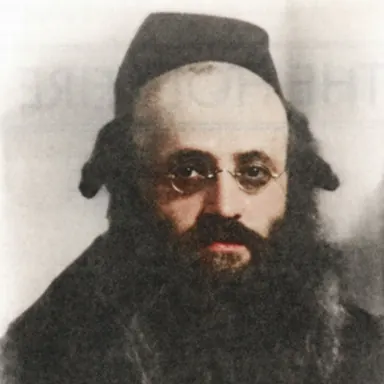
Expert Report: The Work and Torah Teaching of Rabbi Kalonymus Kalman Shapira of Piaseczna
16 min read3,152 words
Summary
This expert report explores the life and profound spiritual legacy of Rabbi Kalonymus Kalman Shapira, the Piaseczna Rebbe, tracing his evolution from a dynastic leader to a revolutionary educator and Holocaust theologian. The text highlights his strategic leadership in moving to Warsaw to establish a groundbreaking yeshiva, where he addressed the modern youth's spiritual crisis through a psychologically sensitive pedagogy focused on internal joy and personal growth. His magnum opus, Chovat HaTalmidim, shifted the educational focus toward the student's individual responsibility and emotional readiness, a foundation that later enabled him to provide spiritual guidance amidst the horrors of the Warsaw Ghetto. Ultimately, the report emphasizes his theology of crisis found in Aish Kodesh, where he maintained a defiant faith and a "renewal of the heart" even while confronting the absolute divine concealment during the Holocaust.
I. Introduction: The Dynastic and Historical Background
A. The Geographical and Ideological Context: Poland between the Two World Wars
Rabbi Kalonymus Kalman Shapira (5649–5703, 1889–1943) stood at a fascinating historical and theological crossroads. His work took place for the most part in Poland between the two world wars, a period characterized by deep social upheaval and unprecedented ideological pressures on traditional Judaism. The Hasidic hegemony in Poland (Polya) faced challenges from modernity, the socialist movements, and secular Zionism, which created an alarming spiritual attrition among the youth. As a descendant of the glorious Hasidic dynasty of Kozhnitz, Rabbi Shapira was required not only to serve as a traditional leader (Rebbe), but also to respond creatively and innovatively to the crisis of faith and identity of his generation.
One of Rabbi Shapira's earliest strategic decisions, reflecting his understanding of the depth of the crisis, was the division of his time between Piaseczna and Warsaw.[1] While Piaseczna served as the base for his traditional court, the intensive activity in Warsaw, the largest, most modern and most challenged Jewish center in Poland, attested to a proactive leadership that sought to confront modernity directly. This decision was not merely a logistical convenience; it was a strategic move that enabled him to maintain his dynastic Torah standing in Piaseczna while creating a broad and innovative focus of influence in the heart of urban Jewish activity. This move to Warsaw was necessary for the establishment of his yeshiva and for the dissemination of his advanced educational teaching. The capacity for adaptation and the insistence on maintaining an active connection with the most challenging community, as demonstrated by his choosing to head a central institution in Warsaw [1], signaled in advance his spiritual flexibility and the depth of his commitment, which were so critical at a later stage of his life.
B. A Preview of the Work and Teaching
The work of the Piaseczna Rebbe is divided into three distinct periods, each of which presents a different facet of his Torah teaching: the early dynastic period, the period of educational reform (expressed in his central work "Chovat HaTalmidim" ("The Students' Duty") [1]), and finally, the period of the theology of crisis, expressed in "Aish Kodesh" ("Holy Fire"). The course of his life is a continuous spiritual journey: from a traditional Hasidic leader, through a pioneering educator, to his being the great theologian of the Holocaust, whose sermons in the Warsaw Ghetto served as a spiritual anchor for a people in the greatest existential crisis.[1]
II. The Work of the Piaseczna Rebbe: Biography and Tenure
A. His Early Life and Establishment
Rabbi Kalonymus Kalman Shapira assumed the position of Rebbe in Piaseczna around the year 5673 (1913). He combined within himself Torah greatness, Hasidic depth, and an extraordinary sensitivity to the human soul. His traditional dynastic activity in Piaseczna was the foundation, but the recognition of him as a broader spiritual leader intensified with the move to Warsaw.
B. The Torah Centers in Warsaw and Piaseczna
The strategic move to Warsaw was intended not only to disseminate his Hasidism, but to establish a pioneering institution: in the year 5683 (1923), Rabbi Shapira founded the "Da'at Moshe" yeshiva in Warsaw.[1] The founding of this yeshiva in the Polish capital was a formative act, which established his standing not only as a local dynastic leader but as a central force in national Jewish education. The goal was to create a framework able to cope with the secular temptations of the big city, by means of a Torah that combines spiritual depth and pedagogical sensitivity.
His activity in Warsaw, alongside the founding of the yeshiva [1], allowed him to disseminate his innovative educational teaching, which focused on the training of the hearts and the empowerment of the students. The founding of the yeshiva and his pedagogical publications [1] attest that the spiritual crisis of the generation was not perceived by him as a decree from Heaven to which one must reconcile oneself, but as an active educational challenge demanding creative solutions.
C. The Rebbe as Leader and Preacher before the Holocaust
Before the Holocaust, Rabbi Shapira was a well-known and esteemed preacher and author. This fact is emphasized by the publication of his books, such as the volume Derekh HaMelekh ("The King's Way"), published in Warsaw in the year 5696 (1936).[2] This book, classified as sermons and Hasidic writings [2], established his standing as a man of spirit and of the public. The existence of these published sermons in the prewar period enables scholars to examine the continuity of his teaching, comparing the basic theological framework he presented (dealing with devekut, joy, and tikkun olam) with the radical change that was forced upon his teaching during the Holocaust.
The central activity of Rabbi Shapira can be summarized by placing it on a timeline, which highlights the transition from his dynastic activity to the national educational one, and from there to his activity in the ghetto:
Table 1: R. Kalonymus Kalman Shapira: Timeline of Life and Major Events
III. His Pedagogical and Educational Teaching: "Chovat HaTalmidim"
A. The Need for Innovative Hasidic Education
Rabbi Shapira was known as a man of education [1], and his work in this field stemmed from a deep understanding of the spiritual challenges facing the young generation in Poland. The traditional educational system, represented by the rigid "cheders," had difficulty preserving the spiritual motivation of students who had experienced the temptations of the Haskalah and the national movements. Rabbi Shapira identified that the students needed not only halakhic knowledge but also psychological and emotional tools that would enable them to maintain a religious way of life out of joy and genuine will.
B. "Chovat HaTalmidim" — An In-Depth Analysis
His central work in this field is "Chovat HaTalmidim" ("The Students' Duty") [1], which is considered groundbreaking and innovative in the Hasidic education of the period.[1] The innovation of the book lies in its focusing not on the "duty of the Rabbi" or the "duty of the institution," but on the "duty of the student" — his personal and inner responsibility for spiritual growth.
Core Pedagogical Principles:
- Preparing the Vessels: Rabbi Shapira emphasized that before entering into the depths of Torah and the commandments, one must prepare the soul and the emotion. He saw the need to develop the whole, willing and joyful person as a necessary stage before immersion in intellectual study.
- Joy as an Educational Tool: Unlike pedagogical approaches that perhaps relied on mussar based on fear, Rabbi Shapira regarded joy not only as a spiritual goal but as a necessary tool for educational success. Without joy, devekut and prayer remain mechanical and lifeless.
- The Meaningfulness of Prayer: The book places emphasis on turning prayer into a genuine emotional experience, and not merely the fulfillment of an obligation. He identified that the young generation has difficulty connecting to the fixed formulas, and proposed ways of finding inner vitality within the texts.
His emphasis on the psychology of education, as presented in Chovat HaTalmidim [1], is the key to understanding his later teaching. The recognition that a person's inner forces (both a child struggling in a lesson and an adult experiencing a crisis of faith) can be shaped through sensitivity and guidance is what prepared the ground for his theological approach in the ghetto. His educational teaching taught him how to address a broken soul, and it served as the basis for his ability to continue providing spiritual leadership under extreme distress.
IV. His Early Torah Teaching: Sermons and Discourses
Rabbi Shapira developed a rich and coherent Torah teaching even before the outbreak of the war, as attested by his published works (such as Derekh HaMelekh [2]) and those composed in preparation for publication.
A. A Survey of His Earlier Works
- Benei Machshavah Tovah ("Sons of Good Thought"): This work served as a guide for establishing fellowships (chavurot) of young married scholars and students seeking spiritual elevation. It outlines a structured course of self-repair and mussar, and provides tools for creating devekut and mutual connection within the group. The emphasis is on the acquisition of the character traits and on daily spiritual perseverance.
- Derekh HaMelekh (The King's Way): This book, which was confirmed to include sermons and Hasidic teachings [2], was published in Warsaw in the year 5696 (1936).[2] This publication, alongside his educational work [1], proves his public standing as a thinker. The sermons in the book deal with classical Hasidic subjects: the essence of prayer, the role of the tzaddik as a channel of divine influence, and the concept of the repair of the world through human service.
It should be noted that, from a rigorous research approach, one must distinguish between works of identical title. Catalogs of Torah literature point to the existence of many books titled Derekh HaMelekh by different authors (such as Kabbalistic sages, the Babylonian Talmud, or halakha and custom).[2] Therefore, research must focus specifically on the work attributed to Rabbi Kalonymus Kalman Shapira ben Elimelech, which is defined as sermons and Hasidism and was published in Warsaw in 1936.[2] This distinction makes it possible to isolate his unique theological contribution before the crisis.
B. The Conception of Devekut
In his early teaching, devekut (Attachment to God) was conceived as the center of the Hasid's service of God, with emphasis on inner aspiration and longing. Unlike other Hasidic currents that focused mainly on intellectual contemplation (such as Chabad) or on meticulous halakhic practice (such as Ger), the path of the Piaseczna Rebbe focused on emotional integrity and inner sincerity. He saw devekut as a process that must be accompanied by vitality and joy, an approach suited to the educational course he laid out in Chovat HaTalmidim. This conception, which set emotional inwardness as a supreme value, is what enabled him, theologically, to contain the ultimate suffering of the ghetto.
V. The Theology of Crisis: "Aish Kodesh" and the Ghetto Sermons
The period of the Holocaust and the stay in the Warsaw Ghetto (1939–1943) brought a dramatic peak in Rabbi Shapira's Torah teaching, which he expressed in his book Aish Kodesh. This work, consisting of sermons delivered between the years 5701 and 5703, constitutes the most profound contribution of Hasidic theology to the crisis of the Holocaust.
A. Leadership in the Warsaw Ghetto
In the Warsaw Ghetto, Rabbi Shapira continued to fulfill his spiritual mission, turning traditional leadership into a tool of existential resistance.[1] He continued to conduct a "Hasidic table" (tish) every Shabbat [1], which was an act of spiritual defiance in the face of decline and hunger. These gatherings were not merely ceremonial; they served as a stage on which the sermon was adapted to the existential situation of the listeners.
He delivered sermons in accordance with the circumstances of the times [1], which confronted head-on the question of God's justice and boundless human suffering. The fact that Rabbi Shapira maintained the format of the sermon (as he did in his book Derekh HaMelekh [2]) even under ghetto conditions attests to an attempt to preserve an anchor of spiritual order and conceptual continuity, even when the outside world collapsed. It was testimony that his theological teaching developed from a solid foundation prepared even before the war.
B. Aish Kodesh: The Theology of the Hiding of the Face
"Aish Kodesh" is a piercing theological response to the question of individual providence (Hashgacha Pratit) in an age of mass destruction. Rabbi Shapira grappled with immeasurable afflictions, ones that exceeded any framework of "the righteous who suffers," or of judgment and justice.
The Theological Core of "Aish Kodesh":
- The Possibility of Containing Inconceivable Pain: Rabbi Shapira argued that the magnitude of the suffering in the ghetto cannot be contained or explained by the tools of traditional theology. Instead of trying to justify God, he focused on strengthening a person's ability to continue choosing faith. He in effect permitted, and even sanctified, the right to complain before the Lord, to burst out and to express pain and protest, as an integral part of the service of God. This radical approach went beyond the limits of the traditional pietism that emphasized accepting suffering with complete love.
- Profound Hiding of the Face: He described the situation as a hiding of the face so profound that it is almost a divine relinquishing of the world. Nevertheless, he argued that it is precisely in such moments that the strength of Israel's bond with God is tested: choosing faith even when God is hidden.
C. The Meaning of the Commandment in an Age of Destruction
The thought of the Piaseczna Rebbe emphasized that the fulfillment of the commandments in the ghetto does not stem from the hope of reward or from habit, but from an existential declaration. The commandment became a spiritual testimony to a person's refusal to surrender to evil:
- Renewal of the Heart: Rabbi Shapira taught that even when external life fades and hope vanishes, it is possible to find inner vitality within the heart. The ability to "renew the heart" and to preserve spiritual fervor is an act of inner resistance.
- Continuation of Free Choice: He saw in the observance of the commandments, and especially in Torah study and prayer, the only way to protect a person's freedom of spiritual choice when the body is subject to the control of evil.
The connection between his early educational teaching and the theology of crisis is central to understanding his work. The psychological sensitivity that characterized Chovat HaTalmidim [1], which enabled him to guide young students through understanding their souls, is the same sensitivity that enabled him to approach shattered souls in the ghetto. In both cases, he focused on the inner forces of the individual, whether the drive to improve or the compulsion to survive spiritually. The ability to continue to conduct the tish [1] and to deliver sermons in accordance with the circumstances of the times [1] attests to the application of his pedagogical outline under extreme conditions, changing the content radically while preserving the framework of spiritual guidance.
The following is a comparative analysis that illustrates the evolution of his Torah teaching as a response to changing challenges:
Table 2: Evolution of R. Shapira's Theological Philosophy
VI. His Legacy and Influence
A. The Publication of His Writings and Their Rediscovery
A central part of Rabbi Shapira's legacy stems from the miracle of the preservation of his writings. Rabbi Shapira himself buried the manuscripts of his sermons, known today as Aish Kodesh, in the "Oneg Shabbat" archive (the Ringelblum Archive) in the Warsaw Ghetto. He did so out of recognition of the theological importance of this testimony for future generations. After the war, the discovery of the writings and their publication made him immediately one of the central figures in Holocaust theology. These texts presented a unique approach, which does not ignore despair and pain, but contains them as part of the service of God.
B. Influence on Later Generations
Rabbi Kalonymus Kalman Shapira became the archetype of the "Witness-Rebbe" — a leader who continued his spiritual role until his last moments, and documented his experiences. His influence is evident in a number of currents in modern Judaism:
The Theology of the Holocaust and of Suffering: Aish Kodesh is today a foundational text in Holocaust studies and religious testimonial literature. His teaching enabled the development of theological conceptions that do not require full "reconciliation" with suffering, but respect human pain.
Spiritual Psychology in Education: His book Chovat HaTalmidim [1] continues to influence religious pedagogues and educators, both in Hasidic circles and in national-religious and modern Orthodox education, thanks to its emphasis on psychological and emotional preparation as the basis of a whole religious life.
The work of the Piaseczna Rebbe, which moved between the founding of an innovative yeshiva in Warsaw [1] and piercing sermons at the Hasidic table in the ghetto [1], presents a model of spiritual leadership that responded continually, creatively and with psychological sensitivity to every challenge placed before it, from the educational crisis of the 1920s to the existential crisis of the Holocaust.
Summary and Conclusions
The detailed analysis of the work and Torah teaching of Rabbi Kalonymus Kalman Shapira leads to the conclusion that he was a thinker and educator of impressive conceptual continuity, who was forced to radicalize his teaching in order to cope with historical circumstances.
- Continuity between Pedagogy and Theology: There is a direct link between his prewar educational teaching, as it appears in Chovat HaTalmidim [1], and the theology of crisis of Aish Kodesh. Rabbi Shapira, who was known even before the war for his innovative works in the field of Hasidic education [1], developed an approach that placed inner vitality, emotional sensitivity, and the personal choice (agency) of the individual at the center. The leadership skills based on psychological sensitivity that he developed as an educator served him as a spiritual guide in the ghetto, where it was necessary to adapt the message "to the circumstances of the times."[1]
- Strategic Leadership Facing Modernity: Rabbi Shapira's move to Warsaw and the founding of the Da'at Moshe yeshiva in 1923 [1] attest to a deep understanding of the modern challenge. Instead of withdrawing into Piaseczna, he chose to confront the dangers of secularization in the heart of the great Jewish center, thereby positioning his pedagogical teaching as a broad national response.
- Documentation and Theological Contribution: The publication of his earlier book, Derekh HaMelekh, in 1936 [2], positions him as a recognized and public Hasidic thinker even before the Holocaust. But his most revolutionary and influential theological contribution remained Aish Kodesh, which made him a central and resonant figure in postwar research and religious life. His work represents the most piercing attempt of a traditional Hasidic leader to contain the absurdity of absolute evil, while maintaining a demand that a person continue to choose faith.
Sources2
- 1.הרב קלונימוס קלמיש שפירא, האדמו"ר מפיאסצנה - מטח, historynet.cet.ac.il/pages/item.asp?item=16127
- 2.Otzar HaHochma's full catalogue רשימת הספרים המלאה של מאגר אוצר החכמה, otzar.org/otzaren/BOOKLIST3.ASP