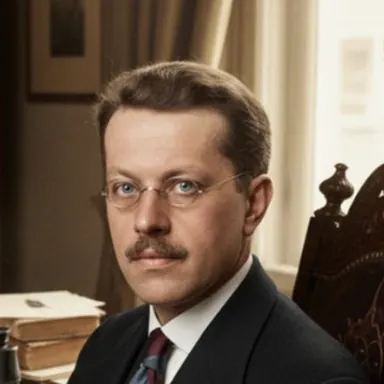
פרנץ רוזנצווייג
17 min read3,382 words
The Architecture of Existence: A Comprehensive Analysis of the Life, Philosophy, and Legacy of Franz Rosenzweig
Franz Rosenzweig (1886–1929) represents one of the most significant pivots in the history of Western thought, marking the transition from the absolute idealism of the nineteenth century to the religious existentialism and dialogical philosophy of the twentieth.[1, 2] His intellectual trajectory—from a scholar of Hegelian political theory to a theologian of Jewish redemption—was not merely a personal shift but a symptomatic response to the collapse of European rationalism in the face of the Great War.[3, 4] Through his foundational work, The Star of Redemption (1921), and his practical educational initiatives in the Freies Jüdisches Lehrhaus, Rosenzweig sought to bridge the chasm between philosophy and theology, between the abstract universal and the concrete individual.[5, 6, 7] This report provides an exhaustive examination of Rosenzweig’s biography, his systematic philosophical contributions, his innovative educational theories, and his enduring influence on modern thought.
Biographical Foundations: From Assimilation to the Threshold of Conversion
Franz Rosenzweig was born on December 25, 1886, in Kassel, Germany, to Georg and Adele Rosenzweig.[1, 8] His family belonged to the prosperous, acculturated Jewish bourgeoisie that had flourished under German emancipation.[9] Georg Rosenzweig was a successful dye manufacturer and a member of the city council, embodying the civic responsibility and cultural integration typical of his class.[1] Adele Rosenzweig was noted for her sensitivity and cultivation of the arts, creating a home environment where literature and music were central, while religious practice was largely perfunctory and confined to social expectations.[1, 10]
Educational Development and Hegelian Scholarship
Rosenzweig’s academic journey was characterized by an early multidisciplinary brilliance. He initially studied medicine at the universities of Göttingen, Munich, and Freiburg, driven by a desire for a concrete, scientific understanding of reality.[1, 8] However, he soon became disillusioned with the technical and impersonal nature of medical science, turning instead to modern history and philosophy.[1, 9] Under the mentorship of Friedrich Meinecke at the University of Freiburg, Rosenzweig embarked on a study of the political doctrines of G.W.F. Hegel.[1, 11]
His doctoral research culminated in Hegel and the State (Hegel und der Staat), a work that remains a standard in Hegel scholarship.[5, 11] In this period, Rosenzweig also discovered a manuscript in Hegel's hand, which he identified as The Oldest Systematic Program of German Idealism (1796).[8, 9] This discovery was crucial as it revealed the early idealist preoccupation with creating a system that combined ethics, physics, and aesthetics into a "new mythology" designed to unify the masses and the philosophers.[9, 11] Rosenzweig’s deep immersion in Hegelian thought provided the very categories he would later dismantle in his quest for a philosophy of the individual.[5, 8]
The Crisis of 1913: The Leap and the Turning
The year 1913 served as the crucible of Rosenzweig’s adult life. Influenced by his cousin Hans Ehrenberg and his close friend Eugen Rosenstock-Huessy—both of whom were Jews who had converted to Christianity—Rosenzweig faced a profound spiritual crisis.[1, 10] Rosenstock-Huessy argued that the abstract "world-spirit" of philosophy could only be brought to life through a personal, dialogical faith, which he identified with modern Protestantism.[1] Convincing himself that Judaism was a relic of the past and that "we are Christian in all things," Rosenzweig resolved in July 1913 to undergo baptism.[12, 13]
However, Rosenzweig insisted on entering Christianity "as a Jew," much like the apostles, rather than as a "heathen" seeking a new identity.[1, 7] This resolution led him to attend Yom Kippur services at a small Orthodox synagogue in Berlin on October 11, 1913.[8, 9] Although he never provided a full discursive account of what transpired that day, the experience was transformative.[1, 8, 14] He emerged from the synagogue with the conviction that the faith and orientation he sought in the church were already present in the synagogue.[1] He famously concluded that while the Christian must "come to the Father" through the Son, the Jew "is already with the Father".[4, 15] This realization marked his return to Judaism, or his becoming a baal teshuva, and set him on a path to revitalize Jewish thought from within.[8, 10]
The Star of Redemption: A New Systematic Philosophy
The outbreak of World War I in 1914 interrupted Rosenzweig’s immediate plans but provided the grim context for his most significant work. Serving in the German army on the Balkan front, Rosenzweig experienced the fragility of life and the failure of nineteenth-century historical optimism.[3, 4] In the trenches, he began writing The Star of Redemption (Der Stern der Erlösung), often composing sections on military postcards sent home to his family.[9, 11, 16] The book, published in 1921, is not merely a "philosophy of religion" but a comprehensive critique of Western philosophy's attempt to reduce reality to a single, abstract principle.[16, 17, 18]
The Critique of Hegelian Totalization
The "Old Thinking," according to Rosenzweig, was characterized by the desire to grasp "The All" (das All) through reason.[4, 5] From the Ionian pre-Socratics to Hegel, philosophy sought to eliminate the "Other" by absorbing God, Man, and World into a unified logical system.[3, 19] Rosenzweig argued that this systematic drive was "diseased" because it sought to "quench the cry of death" by reducing the unique, suffering individual to a mere moment in the development of Universal Spirit.[4, 20]
Rosenzweig’s "New Thinking" (Das neue Denken) begins where philosophy traditionally ends: with the concrete individual’s "fear of death".[4, 19, 21] Death is the ultimate fracture in any totalizing system; it is the point where the individual asserts their "I-I-I" against extinction.[4, 20] By accepting the finitude of human existence, the "New Thinking" moves from the monologue of abstract logic to the dialogue of "speech thinking" (Sprachdenken).[1, 4]
The Three Elements and Three Paths
The architecture of The Star of Redemption is built upon two interlocking triangles that form the Star of David.[1, 8, 22] The first triangle consists of the three primordial and irreducible elements of reality: God, World, and Man.[1, 15, 22]
- God: Not a theological abstraction, but a metaphysical reality.[2, 16]
- World: A pluriform, "metalogical" reality that cannot be reduced to human consciousness.[2, 23]
- Man: A "metaethical" self, a solitary and mute individual who exists prior to any relation.[13, 23, 24]
The second triangle represents the "Paths" or relations that connect these elements, transforming the isolated "pre-cosmos" into a living reality [15, 24, 25]:
- Creation (God-World): The act through which God affirms the world’s existence.[15, 24] Creation is not a past event but an ongoing divine "Yes" to the physical universe.[15, 25]
- Revelation (God-Man): The "beating heart" of the system.[24] Revelation is the moment when God addresses the individual in love.[15, 24] This address breaks the "mute" isolation of the self, awakening it into a "soul" that can speak and respond.[13, 23, 24]
- Redemption (Man-World): The process by which the soul, empowered by divine love, turns toward the neighbor and the world.[15, 22] Redemption is the "ensouling" of the world through human acts of love and responsibility.[8, 15]
The Grammar of Eros and Speech Thinking
In Part II of The Star, Rosenzweig develops his "grammar of eros," using the Song of Songs as the paradigm for revelation.[23, 24] He rejects the idea that language is merely an analogy for divine truth; rather, language is the very medium of truth.[16, 23, 24] Revelation is a "speech event" where God’s call—"Abraham, Abraham!"—meets the human response—"Here I am".[24] This dialogical structure establishes that selfhood is not a monologue but a response to being summoned by name.[4, 5, 24]
Rosenzweig’s concept of "speech thinking" emphasizes the temporal and relational nature of existence.[1, 4] Unlike logical thinking, which is timeless and objective, speech requires a specific "Thou," a specific moment in time, and an openness to the future.[1, 4, 13] This philosophical shift had a profound impact on Martin Buber, although Rosenzweig critically engaged with Buber’s "I-Thou" concept, arguing that Buber’s "I-It" was too close to idealism.[8, 26] Rosenzweig proposed instead that the counterpart to "I-Thou" should be "He-It"—the world as God’s creation, rather than an object of human cognition.[8]
Judaism and Christianity: The Eternal Fire and the Eternal Rays
One of the most radical and influential aspects of Rosenzweig’s thought is his "dual covenant" theology, which grants equal redemptive legitimacy to both Judaism and Christianity.[2, 15, 27] He famously employs the metaphor of the Sun and its Rays to describe their relationship within the drama of redemption.[15, 28]
Judaism: The Fire at the Center
Rosenzweig portrays the Jewish people as the "eternal people" who live outside of world history.[2, 10, 28] By existing beyond the boundaries of specific states and the vicissitudes of political power, the Jews already dwell in a state of eternity.[2, 28] Their life is defined by the biological continuity of the "blood" and the cyclical pattern of the liturgical calendar.[15, 29]
- The Liturgical Year: Festivals like Passover, Shavuot, and Sukkot allow the Jew to "step out" of linear time and experience the redemptive future in the present moment.[4, 10, 15]
- Non-Territoriality: Because Judaism is focused on the "eternal life" of the community rather than the "eternal way" of expansion, it eschews the need for a state.[15] This informed Rosenzweig’s opposition to political Zionism, as he feared it would "embroil the Jews into a worldly history" that they had transcended.[8, 30]
Christianity: The Rays Reaching Outward
Christianity is described as the "eternal way," tasked with carrying the light of revelation to the "pagan" nations of the world.[15, 28] While the Jew is "already with the Father," the Christian is "ever on the way," transforming history and stripping it of its pagan foundations through proselytization and mission.[15, 28] The Christian mission is essential for the eventual redemption of the entire world, as it prepares the nations for the kingdom of God.[28]
Rosenzweig argues that Judaism and Christianity are interdependent. The living presence of the Jewish people serves as a "counterweight" to the pagan impulses within Christianity, preventing the Church from becoming a merely worldly institution.[10, 29] Conversely, the Christian mission ensures that the Jewish revelation reaches the farthest corners of the earth.[15, 28] Both are "laborers at the same task".[29]
The Freies Jüdisches Lehrhaus: A Renaissance of Jewish Learning
After the war, Rosenzweig moved to Frankfurt, where he sought to translate his philosophical insights into a practical pedagogical program. In October 1920, he founded the Freies Jüdisches Lehrhaus (Free Jewish House of Study).[6, 12, 13] This institution was not a traditional university or a yeshiva, but an adult education center designed to bring "disengaged" Jews back to their heritage.[6, 12, 31]
The Pedagogy of "Learning in Reverse"
Rosenzweig’s educational philosophy, termed "New Learning," was based on the concept of the Center and Periphery.[6]
- The Old Way: Traditionally, Jewish learning began at the "Center" (the Torah and the Law) and led outward into "Life".[6]
- The New Way: In the modern, emancipated world, the "Center" had been lost to many Jews who lived on the "Periphery" (the world of secular professions and German culture).[6]
- The Mechanism: Rosenzweig proposed a "reverse order" of learning: starting from the concrete experience of life—from the perspectives of the chemist, the physician, or the artist—and moving "backward" to the ancient sources.[6, 31]
The Lehrhaus was characterized by its intellectual diversity. Two-thirds of its teachers were from secular professions rather than the rabbinate.[6] Rosenzweig himself emphasized that "in being Jews we must not give up anything... but lead everything back to Judaism".[6] This approach allowed participants to foster a "dual identity"—to be both German and Jewish—by contextualizing their secular reality within a living Jewish dimension.[6] The Lehrhaus proved remarkably successful, enrolling over 1,100 students from a total Jewish population in Frankfurt of only 26,000.[31]
Die Schrift: The Buber-Rosenzweig Bible Translation
In 1925, Rosenzweig embarked on one of his most ambitious projects: a collaborative German translation of the Hebrew Bible with Martin Buber.[1, 32, 33] Their goal was to produce a translation that was "authentically Jewish" while being accessible to a modern German audience, both Jewish and Christian.[33, 34]
Methodology: Gesprochenheit and the Colon System
The translators rejected the standard literary German of their time, opting instead for a style that reflected the Gesprochenheit ("spokenness") of the original Hebrew.[32, 35] They believed the Bible was essentially an oral text—the "speaking voice of God"—and that the written word was merely a musical score for public recitation.[34]
- The Colon Principle: The text was organized into cola (breathing units) rather than standard verses or paragraphs, mimicking the natural rhythm of a speaker.[33, 35]
- Root Repetition: To capture the primordial meaning of the Hebrew, they intentionally retained the repetitive use of word roots, often creating new German compounds to mimic the idiosyncrasy of the original.[34]
- The Redactor as Rabbenu: While acknowledging modern biblical scholarship (Higher Criticism), they viewed the final redactor (R) not as a mere editor but as "Moses our Teacher" (Rabbenu), the one who unified the various sources into a living whole for the community.[2, 7, 34]
Translating the Divine Name
The translation of the Tetragrammaton (YHWH) was perhaps their most distinctive contribution. Rather than using the traditional "Lord" (Herr), they used personal pronouns—Ich, Du, and Er (I, You, He)—that shifted depending on the speaker’s perspective.[26, 36] For Rosenzweig, the divine name was not a static title but a declaration of God’s "being-there-for" humanity, as revealed in the "I am that I am" of Exodus 3:14.[36]
The Heroism of Suffering: ALS and the Late Years
In early 1922, Rosenzweig was diagnosed with amyotrophic lateral sclerosis (ALS), an often fatal form of progressive paralysis.[1] The disease rapidly stripped him of his ability to move, speak, and breathe independently.[1, 8] Despite this catastrophic physical decline, Rosenzweig’s intellectual clarity and spiritual vitality remained undiminished—a period often described as a "heroism of the spirit".[1]
With the help of his wife, Edith, Rosenzweig developed a painstaking method of communication.[8] Edith would recite the alphabet, and Rosenzweig would signal with a slight movement (eventually only a blink) when she reached the correct letter.[8] Later, he used a specialized typewriter plate to point to letters.[8] Through this method, he completed several volumes of the Bible translation, wrote numerous essays and record reviews, and maintained a vast correspondence.[1]
His final communication, dictated via the typewriter method, was a partial sentence regarding a revelation he received in his sleep: "And now it comes, the point of all points, which the Lord has truly revealed to me in my sleep, the point of all points for which there—".[8] The sentence was interrupted by his doctor, and Rosenzweig died on the night of December 10, 1929, in Frankfurt, at the age of 42.[1, 8]
Legacy and Contemporary Influence
Franz Rosenzweig’s influence on twentieth-century and contemporary thought is vast, extending into philosophy, theology, and political theory.
Emmanuel Levinas: Totality and Infinity
Perhaps the most prominent heir to Rosenzweig’s philosophy is Emmanuel Levinas.[23, 37, 38] Levinas explicitly acknowledged his debt to Rosenzweig in the preface to his masterpiece, Totality and Infinity (1961), stating that the opposition to the "idea of totality" in The Star was "too often present in this book to be cited".[23, 37]
- Responsibility for the Other: Levinas expanded Rosenzweig’s "speech thinking" into a radical ethics where the "Face of the Other" disrupts the ego’s totality and imposes an inescapable responsibility.[19, 38, 39]
- Ethics as First Philosophy: Following Rosenzweig, Levinas argued that ethics is not a derivative of metaphysics but the very foundation of all philosophical inquiry.[40, 41]
Leo Strauss and Political Theology
Leo Strauss also confessed a significant debt to Rosenzweig, noting that Rosenzweig’s return to Jewish revelation provided the impetus for his own critical examination of modern philosophy.[37] Strauss dedicated his first major book, Spinoza’s Critique of Religion, to Rosenzweig’s memory.[37] While Strauss eventually moved in a different direction—exploring pre-modern rationalism—he remained deeply engaged with Rosenzweig’s challenge to the Hegelian "end of history".[11, 37]
Contemporary Academic Critiques
In recent years, scholars such as Peter Eli Gordon and Leora Batnitzky have offered fresh interpretations of Rosenzweig’s work, moving beyond "post-Holocaust hagiography" to situate him within the larger stream of German philosophy.[17, 42]
- The Heidegger Connection: Gordon explores the intellectual kinship between Rosenzweig and Martin Heidegger, arguing that both were grappling with the themes of finitude, isolation, and the "break" with traditional idealism.[17]
- Idolatry and Representation: Batnitzky argues that Rosenzweig’s philosophy is essentially a critique of "idolatry"—the reduction of the active relation between God and humanity to fixed, static representations (Vorstellung).[42]
- Imperialism and Mission: Some contemporary critics have examined the "imperial" undertones of Rosenzweig’s theology of Christian mission, noting how his vision of a "proselytized world" mirrored nineteenth-century European colonial discourses.[28]
Conclusion: The Persistence of the New Thinking
Franz Rosenzweig’s life and work represent a heroic attempt to reclaim the "living truth" from the abstractions of academic reason.[1, 4, 18] By centering philosophy on the "fear of death" and the "joy of love," he offered a path for modern individuals to find religious meaning without sacrificing their intellectual honesty.[14, 16, 21] His vision of a redemptive community grounded in dialogue and the "New Learning" remains a potent resource for contemporary Jewish and interfaith discourse.[6, 12, 27, 31]
Ultimately, Rosenzweig’s "Star" serves as a compass for navigating the tensions between tradition and modernity, eternity and history, and the solitary self and the redeeming Word.[1, 4, 15] Though he died before the darkest years of the twentieth century, his thought provided a foundation for rebuilding a Jewish identity that is both deeply rooted in the past and courageously open to the future.[9, 10, 14]
Sources42
- 1.Franz Rosenzweig | Jewish Philosopher, Theologian & Translator | Britannica, britannica.com/biography/Franz-Rosenzweig
- 2.Franz Rosenzweig | Encyclopedia.com, encyclopedia.com/people/philosophy-and-religion/philosophy-biographies/franz-rosenzweig
- 3.The Star of Redemption by Franz Rosenzweig | Research Starters - EBSCO, ebsco.com/research-starters/literature-and-writing/star-redemption-franz-rosenzweig
- 4.Franz Rosenzweig - Jewish Virtual Library, jewishvirtuallibrary.org/franz-rosenzweig
- 5.Rosenzweig, Franz (1886–1929) - Routledge Encyclopedia of Philosophy, rep.routledge.com/articles/biographical/rosenzweig-franz-1886-1929/v-1
- 6.UNIVERSITY OF OKLAHOMA GRADUATE COLLEGE ... - ShareOK, shareok.org/bitstreams/86dde4ae-b22f-4a19-8499-5bdf73fd30c3/download
- 7.Franz Rosenzweig and the Founding of the Lehrhaus | My Jewish Learning, myjewishlearning.com/article/franz-rosenzweig-and-the-founding-of-the-lehrhaus/
- 8.Franz Rosenzweig - Wikipedia, en.wikipedia.org/wiki/Franz_Rosenzweig
- 9.Franz Rosenzweig | Research Starters - EBSCO, ebsco.com/research-starters/history/franz-rosenzweig
- 10.Judaism, History and Eternity According to Franz Rosenzweig - The Schechter Institutes, schechter.edu/judaism-history-and-eternity-according-to-franz-rosenzweig/
- 11.Franz Rosenzweig (Stanford Encyclopedia of Philosophy), plato.stanford.edu/entries/rosenzweig/
- 12.A Renaissance of Jewish Learning, bjela.org/blog/a-renaissance-of-jewish-learning
- 13.proposal for a jewish house of study in kassel inspired by franz rosenzweig's frankfurt lehrhaus, bjpa.org/content/upload/bjpa/meir/Meir_The Rosenzweig Lehraus.pdf
- 14.Franz Rosenzweig: His Life and Thought, presented by Nahum N. Glatzer, commentary.org/articles/reinhold-niebuhr/franz-rosenzweig-his-life-and-thought-presented-by-nahum-n-glatzer/
- 15.The Star of Redemption, by Franz Rosenzweig – Commentary ..., commentary.org/articles/michael-meyer-3/the-star-of-redemption-by-franz-rosenzweig/
- 16.כוכב הגאולה - המכלול, hamichlol.org.il/כוכב_הגאולה
- 17.Rosenzweig and Heidegger: Between Judaism and German ..., researchgate.net/publication/236720046_Rosenzweig_and_Heidegger_Between_Judaism_and_German_Philosophy_review
- 18.כוכב הגאולה - מוסד ביאליק, bialik-publishing.co.il/index.php?dir=site&page=catalog&op=item&cs=405
- 19.“Immanence, Transcendence, and Exceedance in Rosenzweig's Star of Redemption and Levinas' Totality and Infinity” Jacob, uc.pt/fluc/dfci/rosenzweig_2021/abstracts/immanence_transcendence_and_exceendance
- 20.Jewish Spiritual Leaders Series: Franz Rosenzweig - Valley Beth Shalom, vbs.org/worship/meet-our-clergy/rabbi-harold-schulweis/sermons/jewish-spiritual-leaders-series-franz
- 21.מפגש 60: הרב שמואל עוזיאל – הגותו של פרנץ רוזנצווייג | היסוד של האמונה על פי "כוכב הגאולה", youtube.com/watch?v=BN8y1f51M80
- 22.כוכב הגאולה – ויקיפדיה, he.wikipedia.org/wiki/כוכב_הגאולה
- 23.(PDF) Is There a "Correlation" between Rosenzweig and Levinas? - ResearchGate, researchgate.net/publication/236757904_Is_There_a_Correlation_between_Rosenzweig_and_Levinas
- 24.Franz Rosenzweig's Account of Revelation in Light of Its Protestant Background | Harvard Theological Review | Cambridge Core, cambridge.org/core/journals/harvard-theological-review/article/franz-rosenzweigs-account-of-revelation-in-light-of-its-protestant-background/92EB57FFE850EAEA7A630285313095B7
- 25.Diachronics of Redemption: A Systems Theoretic View of Rosenzweig's Star - PDXScholar, pdxscholar.library.pdx.edu/cgi/viewcontent.cgi?article=1274&context=sysc_fac
- 26.Franz Rosenzweig - Jewish Virtual Library, jewishvirtuallibrary.org/rosenzweig-franz
- 27.פרנץ רוזנצווייג | עברית - חנות ספרים, e-vrit.co.il/Author/5516/פרנץ_רוזנצווייג
- 28.Empire, Mission, and Messianism: Franz Rosenzweig's Understanding of the Relation between Judaism and Christianity | Journal of the American Academy of Religion | Oxford Academic, academic.oup.com/jaar/article/91/3/633/7630134
- 29.Christian, Muslim, Jew - First Things, firstthings.com/003-christian-muslim-jew/
- 30.Judaism in Modernity: Franz Rosenzweig's 'On Jewish Learning' and Its Philosophical Impacts - Georgia Southern Commons, digitalcommons.georgiasouthern.edu/cgi/viewcontent.cgi?article=1279&context=aujh
- 31.Our Story - New Lehrhaus - The Bay Area Hub for Adult Jewish Education, newlehrhaus.org/our-story
- 32.Views of orality and the translation of the Bible - VU Research Portal, research.vu.nl/ws/portalfiles/portal/371609804/Views_of_orality_and_the_translation_of_the_Bible.pdf
- 33.The Buber—Rosenzweig Translation of the Bible within Jewish-German Tradition - Liverpool University Press, liverpooluniversitypress.co.uk/doi/pdf/10.18647/1710/JJS-1993?download=true
- 34.Die Schrift: A Non-Territorial Translation of “The Land” - TheTorah.com, thetorah.com/article/die-schrift-a-non-territorial-translation-of-the-land
- 35.Chapter 25: The Faith of the Bible - Religion Online, religion-online.org/book-chapter/chapter-25-the-faith-of-the-bible/
- 36.“The Great Vindication of Our Translation of the Name”: Franz Rosenzweig on the Threefold Unity of Divine Pronouns in - Brill, brill.com/view/journals/jjtp/32/2/article-p292_3.xml
- 37.'Freedom Depends Upon Its Bondage': The Shared Debt to Franz Rosenzweig (Chapter 3) - Leo Strauss and Emmanuel Levinas, cambridge.org/core/books/leo-strauss-and-emmanuel-levinas/freedom-depends-upon-its-bondage-the-shared-debt-to-franz-rosenzweig/F071FB4BC415113AE77BAA3C2FE65389
- 38.Correlations in Rosenzweig and Levinas : Gibbs, Robert, 1958- : Free Download, Borrow, and Streaming - Internet Archive, archive.org/details/correlationsinro0000gibb_r4z1
- 39.Totality and Infinity Emmanuel Levinas | Duquesne University Press, dupress.duq.edu/products/philosophy5-paper
- 40.Wrestling With an Angel - First Things, firstthings.com/004-wrestling-with-an-angel/
- 41.Wrestling With an Angel - First Things, firstthings.com/article/2008/10/004-wrestling-with-an-angel
- 42.Ochs - Rosenzweig as Postcritical Jewish Philosopher - JCRT 2.1, jcrt.org/archives/02.1/ochs.shtml