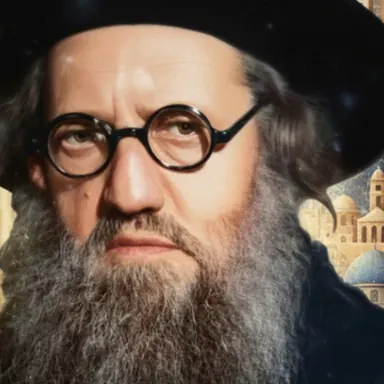
The Toil of Torah and Redemption: The Work and Thought of Rabbi Yaakov Moshe Charlap (1882–1951)
14 min read2,789 words
Summary
Rabbi Yaakov Moshe Charlap was a central spiritual leader in the Land of Israel in the first half of the 20th century, who began his path in personal mystical asceticism but became the foremost disciple of Rav Kook. The formative encounter with Rav Kook turned his personal spiritual work into an engine of national-spiritual redemption, which he expressed in his monumental series of philosophical writings, "Mei Marom". Charlap served as a district rabbi and as head of the Merkaz HaRav yeshiva, and displayed a syncretic leadership that bridged different circles in Jerusalem. Although he identified sovereignty and the IDF as holy and as an irreversible part of "the beginning of the redemption", he opposed on theological grounds any concession of territories of the Land and emphasized the supreme importance of the wholeness of the Land of Israel.
Rabbi Yaakov Moshe Charlap (HaRaham Charlap) was a central and exceptional figure in the Torah and spiritual leadership of the Land of Israel in the first half of the 20th century.[1] He served as a rabbi, a spiritual leader and a prominent Torah scholar, and was the foremost and closest continuer of the path of Rav Kook.[1, 2] His work extends over the world of halakha, ethics and mystical thought, while the heart of his teaching lies in the doctrine of national-spiritual redemption, as expressed in his monumental series of books, "Mei Marom".[2, 3]
Part One: His Figure and the Biographical Framework (His Public and Personal Work)
1. The Formative Years and Early Asceticism (1882–1904)
1.1. Family Background and Early Loss
Rabbi Yaakov Moshe Charlap was born on 29 Shevat 5642 (1882) in Jerusalem.[2, 4] He came from an important family of rabbis and halakhic decisors.[1] His father, Rabbi Zevulun, served as a judge in the rabbinic court of the Gaon Maharil Diskin.[4] The origin of his family name is attributed to one of his forefathers, who was called "Chiya Rosh le-Yehudei Polin" (Chiya, head of the Jews of Poland).[4] Rabbi Charlap studied first in the "Etz Chaim" institutions [4], and later, in 5656 (1896), began to study regularly with his father.
His early period of study was accompanied by an experience of loss. He drew close to the Gaon Rabbi Yehoshua Leib Diskin of Brisk [2], who befriended him, and Rabbi Charlap hoped to learn from him. However, Rabbi Diskin died on the eve of Rosh Chodesh Shevat 5658 (1898), when Rabbi Charlap was sixteen.[4] Nine days later his father died as well. The double, untimely loss of the two central spiritual leaders in his life may explain his search for absolute spiritual depth and his early inclination toward stringency.
1.2. The Shaping of His Figure as a "Parush" and the Spiritual Foundation
After his father's death, Rabbi Charlap drew close to study with Rabbi Yehoshua Tzvi Michel Shapira, who served as his teacher and master and instilled in him the element of depth in study and the dimension of asceticism and self-imposed stringency.[4] For a short period he also studied at the "Torat Chaim" yeshiva and was one of the pillars of the Torah circle "Beit Va'ad la-Chakhamim".[4]
Rabbi Charlap's personal conduct was distinguished by devotion and a certain asceticism: he used to fast, immersed himself in a cold mikveh on winter nights, and devoted himself completely to praying at sunrise (vatikin) and to Torah study.[2, 4] It can be seen that Rabbi Charlap began his path as a figure representing the ideal asceticism of the Old Yishuv, while building a spiritual foundation of stored-up energy and intense mystical devotion. This power, which had not yet found its national and public goal, was ready for the ideological change that would come with the encounter with Rav Kook.
2. The Formative Encounter with Rav Kook and the Spiritual Transformation
2.1. The Encounter and the Bond of Souls
In 5664 (1904), a few days after Rav Kook's immigration to the Land of Israel, Rabbi Charlap met him for the first time in Jaffa, on the morning of the festival of Shavuot.[4] The meeting was decisive: Rabbi Charlap was captivated by the sight of Rav Kook's face and the devotion of his prayer, and was especially impressed by the way he recited "Akdamut" "with trembling and with weeping".[4]
From that first meeting on, Rabbi Charlap clung to Rav Kook with "a fierce love", and became his disciple and devotee forever.[2, 4] The intensity of the bond of souls was so great that Rabbi Charlap described how "I was shaken to the foundation of my soul... my soul, which bound itself to the soul of the Rav, is lifted up to the heights of the upper worlds".[4] Rav Kook himself testified to his special affection for his disciple, and recognized his uniqueness.[4]
2.2. Philosophical Breakthrough and the Balancing of the Spirit
Rav Kook's influence was transformative, and determined Rabbi Charlap's "type of divine service".[4] Rav Kook, who was concerned for his disciple's health because of his inclination to severe asceticism, sharpened in him the element of "love of life".[4] This encounter did not cancel Rabbi Charlap's personal asceticism, but shifted the emphasis from personal asceticism to the building of the Land and of the community, and turned the asceticism into "a public and philosophical momentum".
The results of the meeting were highly significant in shaping Rabbi Charlap's spiritual figure and in consolidating his public authority.[4] Rabbi Charlap became the ideal vessel for Rav Kook's doctrine of redemption: he combined mystical depth (the supernal secrets) with love of life and the active demand for national revival. As his writings testify, many foundations of Rav Kook's teaching, and above all the centrality of the Land of Israel, were deeply imprinted in his teaching.[4]
3. Roles of Rabbinic and Educational Leadership
3.1. The Rabbinate of Shaarei Chesed and Rehavia – Syncretic Leadership
In 5664 (1904) Rabbi Charlap was appointed rabbi of the Shaarei Chesed neighborhood in Jerusalem, a community that was initially characterized as Haredi and composed of Torah scholars.[2, 4] His role expanded when the Rehavia neighborhood was founded in its vicinity, and he served as the rabbi of the entire area.[4] The Rehavia neighborhood had a different character, and many of its residents were people of intellect and education, some of whom were not religious.
This dual role illustrates Rabbi Charlap's rare ability, inspired by his master, to address all parts of the people. In the synagogue of Shaarei Chesed he preached on matters of halakha and the fear of Heaven out of the depth of the idea, whereas in the synagogue of Rehavia – where many of the city's men of science prayed – he wove ideas about Torah and the building of the Land.[4] This syncretic leadership, which bridged the ideological and social gaps in Jerusalem, enabled his study hall to become a spiritual center for the entire public and for yeshiva students in particular.[4]
3.2. Heading the Merkaz HaRav Yeshiva and the Beit Zevul Yeshiva
Rabbi Charlap was a central figure in the teaching staff of the Merkaz HaRav yeshiva, and later even served as head of the yeshiva.[2, 4] His lectures were distinguished by great depth and by the extensive preparation he invested in them.[2] Rabbi Charlap also worked to establish an independent Torah institution that served to disseminate his teaching, and in 5705 (1945) he founded the "Beit Zevul" yeshiva in Jerusalem.[3] This yeshiva was the center from which extensive parts of his writings were published, including the "Mei Marom" series.[3]
After his death on 7 Kislev 5712 (1951), he was succeeded as head of the yeshiva by Rabbi Tzvi Yehuda Kook.[4] In this way Rabbi Charlap filled a critical role as a "patriarch of transition", who ensured the preservation, consolidation and transmission of Rav Kook's teaching to the founding generation of national religious Zionism in the yeshivas, precisely in the period of the establishment of the State.
Part Two: His Torah Work: The "Mei Marom" Series and the Structure of His Thought
Rabbi Charlap's Torah work is extensive and includes lectures on halakha and Talmud, on the Bible and on faith.[2, 4] His principal books are divided into halakha (such as Beit Zevul) and thought (such as Mei Marom and Tovim Meorot).[4]
4. The Literary Architecture of "Mei Marom"
4.1. The Structure and Contents of the Series
The series of books Mei Marom, published by the Beit Zevul yeshiva [3], is the principal body of Rabbi Charlap's philosophical teaching. The series comprises between 19 and 20 volumes, and its main concern is matters of thought and faith.[2, 3] This body of work presents a comprehensive theological and philosophical approach:
- Foundations of ethics and philosophy: the first volumes include an explanation of the Eight Chapters of Maimonides (Rambam) and a commentary on tractate Avot.[2] These works establish the necessary foundation of character traits and the rational-spiritual preparation as a preliminary stage to understanding matters of redemption and the supernal secrets.
- The mystical dimension (the supernal secrets): the volume Lechem Abirim is devoted to "chapters on the exaltedness of Israel... and the opening of gates to the holy gates of the supernal secrets".[2] This definition testifies to a distinctly kabbalistic and mystical dimension in his teaching, which emphasizes the supernal essence of the soul of the nation. This depth is the harnessing of the early asceticism to create mystical insights directed outward – toward the exaltedness of Israel.
- Festivals and prayer: the series includes comprehensive volumes on matters of prayer [4], the three pilgrimage festivals, the Passover Haggadah, and also Ori ve-Yishi on Rosh Hashanah and Yom Kippur.[2] Talks on the weekly Torah portion were also collected, including five volumes of profound talks delivered at the time of "Raava de-Raavin" (the third Sabbath meal).[2]
4.2. "Maayanei HaYeshua": The Teaching of Redemption and National Revival
The central part of his religious-national teaching is collected in Maayanei HaYeshua, which deals with the people of Israel and the Land of Israel.[2, 5] In these books Rabbi Charlap engaged in in-depth clarifications concerning the holiness of the Land of Israel and the character of the redemption in our generation.[2, 4]
The core of his teaching concerns the idea that the redemption taking place is not merely a political change, but a spiritual process imprinted in the holiness of the Land and in an active expectation of salvation.[6] The stamp of Rav Kook's teaching is especially evident in this part, since it anchors the practical and physical processes of revival (such as agriculture, the army, sovereignty) in the dimension of supernal holiness, as irreversible processes in the fulfillment of the vision of the prophets.[4]
Part Three: Rabbi Charlap and the National Reality: State, Army and Unity
6. His Attitude toward the State of Israel and the Wholeness of the Land
6.1. Sorrow over the Partial Nature of the Redemption in 5708
Rabbi Charlap, as a central leader in the Torah world of the Land of Israel, reacted in a complex manner to the establishment of the State of Israel in 5708. Despite the recognition of the spiritual importance of the renewed sovereignty, he and his circle (such as Rabbi Tzvi Yehuda Kook) experienced joy mixed with deep sorrow on the day of the declaration.[7]
It was reported that Rabbi Charlap could not rejoice completely because of "the tearing of the heart of the Land of Israel".[7] In his eyes the sovereignty that was declared was deficient, since the meaning of the decision included giving up extremely important parts of the Land, foremost among them Shechem and Hebron.[7] Rabbi Tzvi Yehuda Kook (who was with him at the time) expressed the painful feeling in a lament: "Where is our Shechem? Where is our Hebron?".[7] This position established a clear theological principle: the holiness of the whole Land is an ideal that stands above the temporary political reality, and parts of it may not be given up, even if sovereignty is attained only partially.
6.2. His Thought and Guiding Principles toward the State
This conception, which recognizes the sovereignty of the State as "the beginning of the redemption" but does not accept its laws absolutely when they stand in contradiction to theological principles, provided the ideological basis for later disputes in the religious-national public.[7] Rabbi Charlap's position, which upholds the supremacy of the holy, sets the theological limit to political obedience.
This stands out especially with regard to certain institutions, such as the Supreme Court, and with regard to the duty of full obedience to the orders of the army, especially in the case of the evacuation of settlements from the Land.[7] Through his thought on the uncompromising holiness of the Land, Rabbi Charlap provided the foundation for justifying disobedience in the event of harm to the holiness of the Land, as later found expression in the debates over the ruling on refusing orders among the halakhic decisors of religious Zionism.
7. The Israel Defense Forces and the Doctrine of "the Unity of Blood"
7.1. The IDF as an Instrument of Redemption and Heavenly Assistance
Rabbi Charlap recognized absolutely and explicitly the value of the Israel Defense Forces.[8] He argued that the heroism of the soldiers is blessed and that the army acts with "siyata di-shmaya" (help from Heaven).[8] He praised the fighters for the courage with which they struck the enemy with force.[8]
In his outlook, military action is not merely a matter of secular defense, but takes on a status of holiness that is integrated into the process of redemption. He also expressed deep gratitude and recognition of the importance of those who gave their lives for the people and the Land.[8] This recognition gave the IDF a high place in the national theological hierarchy.
7.2. The Theology of "the Blood Is the Soul" and the Dialectical Unity of Crisis
Rabbi Charlap engaged in analyzing the inner dispersion within the people of Israel, which includes "a physical dispersion and also a dispersion of opinions".[8] He taught that these disputes and the distancing from Judaism are only external and do not cancel the deep bond that exists among all parts of the people.
Rabbi Charlap emphasized that when the blood of Israel is harmed, "a deep shock is created in the entire soul of the people, for the blood is the soul".[8] He stated that at the moment the enemy tries to destroy the people, "the masks" of the disputes "disappear".[8] This theology holds that true national unity does not depend on political or ideological agreement, but arises and is revealed out of crisis and the bond of blood, which testifies to the inner and unified essence of the soul of the nation.
Part Four: Summary, Legacy and Influence
8. Rabbi Charlap as Mediator and Shaper of a Path
Rabbi Yaakov Moshe Charlap was one of the great rabbis of his generation, and contributed greatly to the world of Torah and of the Jewish spirit.[1] His important standing stemmed not only from the depth of his Torah and halakhic knowledge [1], but also from his historical role as a mediator.
Rabbi Charlap was the foremost disciple of Rav Kook and the vessel that made possible the absorption of Rav Kook's doctrine of redemption into the center of the Jerusalem Torah world. He created an ideological bridge between the stringent and ascetic Old Yishuv and the modern vision of national revival, by turning mystical devotion (the supernal secrets) into an engine of national action (the building of the Land).[2, 4]
His principal legacy lies in the series of books Mei Marom, which is a fundamental source for understanding the philosophy of redemption in our generation.[5] His theological work regarding the holiness of the Land of Israel, the expectation of salvation [6], and the sanctification of the institutions of sovereignty (such as the IDF), alongside the uncompromising demand for the wholeness of the Land, continues to shape the foundations of faith and practice of the engaged religious-national public. Rabbi Charlap left behind a legacy of depth, devotion and syncretic leadership that influenced generations of Torah scholars and men of the spirit.
Sources8
- 1.הרב יעקב משה חרל"פ - רב, מנהיג רוחני וחוקר תורני - כיכר השבת, kikar.co.il/tags/rabbi-yaakov-moshe-charlap
- 2.סט מי מרום כ' כרכים | הרב חרל"פ, divreishir.co.il/חנות-ספרי-קודש-אונליין/ספרי-אמונה-והשקפה/סט-מי-מרום-כ-כרכים-הרב-חרלפ
- 3.מי מרום - ישיבת בית זבול - חנות ספרי קודש - זול ספר, zolsefer.co.il/site/Shop/manufacture/manufactureCat.asp?depart_id=171616&manufacture_id=29844
- 4.הרב יעקב משה חרל"פ - Mercaz Harav | מרכז הרב, mercazharav.org.il/רבותינו/הרב-יעקב-משה-חרלפ/
- 5.מעייני הישועה - מתורתו של הרב חרל"פ | מדרשת הרובע - מדרשה תורנית גבוהה לבנות, harova.org/מבית-המדרש/אמונה/מעייני-הישועה-מתורתו-של-הרב-חרל-פ/
- 6.הציפיה לישועה במשנת הרב חרל"פ - Mercaz Harav, mercazharav.org.il/2020/07/24/הציפיה-לישועה-במשנת-הרב-חרלפ/
- 7.הציונות הדתית – תמונת מצב | הרב יובל שרלו - ישיבת ההסדר מבית רוח הגולן, ypt.co.il/4101
- 8.וְגָבַ ר יִשְׂרָ אֵ ל, your-books.shop/wp-content/uploads/2023/12/שות-וגבר-ישראל-גרסת-מייל.pdf