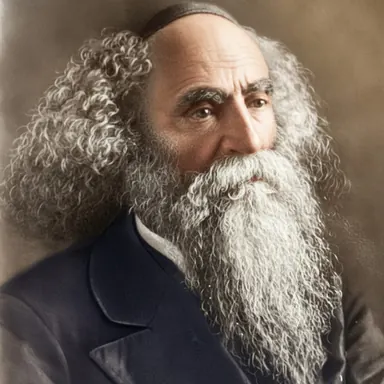
The Work, Life and Torah Teaching of the Rogatchover Gaon (Rabbi Yosef Rosen)
15 min read3,020 words
Summary
The text surveys the extraordinary figure of Rabbi Yosef Rosen, known as "the Rogatchover," and sketches his portrait as a Torah prodigy with an encyclopedic memory and an original mode of thought without equal. The article focuses on the conceptual method of analysis he developed, which converts particular halakhic discussions into abstract categories combining practical ruling with Maimonidean philosophy and inquiries into the essence of time and matter. In addition to describing his public leadership in Dvinsk and his ties with Chabad Hasidism, the text details his extensive writing enterprise, which includes tens of thousands of responsa and a series of books under the title "Tzafnat Pa'aneach." The aim of the source is to shed light on the methodological uniqueness of the Gaon and on the interpretive efforts made over the generations to decipher his concise and enigmatic style.
Introduction: The Figure and Uniqueness of the Rogatchover in the World of Torah
Rabbi Yosef Rosen (5618, 1858 – 11 Adar 5696, 1936), known in the world of Torah by the title "the Rogatchover Gaon" (or "the Rogatchover," after his native town of Rogachev), is regarded by scholars of the history of halakha and Jewish thought as one of the most original, brilliant and mysterious figures in the history of Talmudic literature [cite: 1, 2]. His extensive work, whose scope is attested by the series of books "Tzafnat Pa'aneach," presents a unique Talmudic-halakhic conception that has no direct parallel in the rabbinic history of the modern era [cite: 1, 3]. The Rogatchover was characterized by a total diligence—his mouth never ceased from study all the days of his life, literally—while abstaining completely from every matter that was not Torah [cite: 4]. His phenomenal encyclopedic memory encompassed all parts of the Torah, including the Babylonian Talmud, the Jerusalem Talmud, the Tosefta, the halakhic and aggadic midrashim, and the literature of Maimonides (Rambam) in all its branches [cite: 4, 5].
The Rogatchover's intellectual importance stems not only from the enormous scope of his knowledge or from the quantity of responsa and novellae he left behind—it is estimated that he wrote more than 50,000 halakhic responsa to questions addressed to him from all corners of the globe [cite: 1, 6]—but chiefly from the revolutionary methodology of study that he developed. This method turns the particular halakhic discussion into an abstract conceptual analysis, combining practical halakha with metaphysical and philosophical foundations based chiefly on Maimonides' philosophical book, "Guide of the Perplexed" [cite: 7, 8].
| Parameter | Description and data |
|---|---|
| Years of his life | 5618 (1858) – 11 Adar 5696 (1936) [cite: 2, 6] |
| Place of birth and main rabbinic post | Born in Rogachev; served as rabbi of the Hasidic community in Dvinsk (Latvia) for about 40 years [cite: 2, 9] |
| Hasidic affiliation | Chabad-Kapust Hasidism [cite: 3] |
| Main work | The series of books "Tzafnat Pa'aneach" (on Maimonides, the Talmud, the Pentateuch and the responsa) [cite: 1, 2, 7] |
| Scope of halakhic writing | Estimated at more than 50,000 halakhic responsa (She'elot u-Teshuvot) [cite: 1, 6] |
| Principal decipherers and scholars of his teaching | Rabbi Shlomo Yosef Zevin, Rabbi Menachem Mendel Kasher, Rabbi Moshe Shlomo Kasher, the Lubavitcher Rebbe [cite: 3, 7, 10, 11] |
His Life, Main Stations and Public Work
The Years of His Torah Growth and the Influence of Hasidism
Rabbi Yosef Rosen was born in the town of Rogachev in the Mohilev province (today in Belarus) in 5618 (1858) [cite: 2, 4]. Already from his earliest childhood he displayed supreme talents, quick comprehension and an exceptional memory. At a very young age he was sent to study with the great men of the generation, among them Rabbi Yosef Dov HaLevi Soloveitchik (author of "Beit HaLevi"), with whom he maintained a deep bond of mutual esteem [cite: 12]. During his studies with the "Beit HaLevi," the power of his analysis and the speed of his comprehension already became famous, when he was able to examine complex responsa and raise immediate objections to them even before the meal had ended [cite: 12].
In his youth he drew close to Chabad Hasidism, and in particular to the Chabad-Kapust branch, a movement that left a deep mark on his spiritual and intellectual worldview [cite: 3]. His Hasidic inclination was combined with uncompromising devotion to the study of the revealed Torah. His way of life was characterized by complete disregard for the ordinary conventions of the world; a prominent testimony to this was his avoidance of regular haircuts, because he saw in them a neglect of Torah study and a distraction from the thoughts of study, a matter that he based on an analysis of the ruling of the Jerusalem Talmud in tractate Nazir concerning hair matted because of sweat [cite: 12].
The Rabbinate in Dvinsk and Public Leadership
In 5649 (1889) the Rogatchover was appointed to serve as the Hasidic rabbi of the city of Dvinsk (Daugavpils, Latvia), a post he held for about forty years until the day of his death [cite: 2, 9]. The city of Dvinsk gained its fame in the Jewish world thanks to its exceptional dual leadership: alongside the Rogatchover, the rabbi of the Lithuanian community (the "Mitnagdim") was the Gaon Rabbi Meir Simcha HaKohen, author of the books "Or Same'ach" and "Meshech Chochmah" [cite: 9]. The two led the community in parallel with extraordinary mutual respect, and Dvinsk became a pilgrimage destination for complex halakhic questions from all over the world [cite: 1, 9].
The Rogatchover's public work was characterized by firm and uncompromising positions in everything concerning the preservation of the tradition of Israel and the purity of Jewish education. During the First World War, while he was staying in Petersburg, he was in continuous contact with the Rebbe Rashab of Lubavitch (Rabbi Shalom Dovber Schneersohn), and together they fought against attempts by modern associations and organizations to bring about changes in the traditional education network and in the chadarim in Russia [cite: 13]. His halakhic responsa were characterized by astonishing brevity and an immediate leap to the primary Talmudic sources, with precise references to dozens of discussions in the Babylonian and Jerusalem Talmud, without dwelling on routine halakhic pilpul [cite: 1, 6]. This dense style made his writings a challenge for ordinary scholars, and required special interpretive enterprises in later generations in order to decipher the hidden depths of his words [cite: 10, 11].
His Torah Teaching and Conceptual Method of Analysis
The Conceptual Foundations of Halakhic Analysis
The Rogatchover's methodology of study is not an ordinary quantitative advance within the text, but a qualitative transformation in the organization of halakhic knowledge [cite: 3, 7]. Whereas most of the sages of his generation engaged in local textual analysis or in focused pilpul, the Rogatchover built a comprehensive conceptual system that maps every particular law into a broad ontological category [cite: 3, 14]. The first foundation of his method is based on a sharp distinction between laws that apply to the "cheftza" (the object or the objective reality) and laws that apply to the "gavra" (the person and the acting subject) [cite: 14].
Another central foundation of his teaching rests on the difference between an "ila" (a generating cause) and a "siman" (an indicator for identification) [cite: 14]. This distinction exemplified his conception of the definitions of the Torah; once it has been established that a certain criterion is a cause, it constitutes the very creation of the legal status, whereas if it is merely a sign, its function is limited to revealing a reality that exists in any case [cite: 14]. Thus, for example, in the laws of forbidden foods, the Rogatchover distinguished between the signs of purity stated explicitly in the Torah (such as chewing the cud and the split hoof), which constitute the cause of purity itself, and signs established by the words of the Sages (such as head and spine), which are no more than tools of identification [cite: 14]. Likewise, his analyses frequently deal with the separation between a "process" extending over a temporal continuum and a discrete "result," as well as with the discussion of whether a certain law applies to the very essence of a thing (substance) or only to its accidental properties (accidents) [cite: 8].
The Revolutionary Combination of Halakha and Maimonidean Philosophy
One of the deepest innovations in the Rogatchover's teaching is the complete abolition of the accepted separation between the practical halakhic part and the philosophical-intellectual part [cite: 8, 11]. For the Rogatchover, Maimonides' "Guide of the Perplexed" is not an apologetic or detached philosophical work, but an essential methodological key to understanding the deep structure of the laws of the "Mishneh Torah" [cite: 7, 8].
He used Maimonides' philosophical premises in the second part of the "Guide of the Perplexed"—which deal with the definitions of space, time, infinity, temporal continuity and the indivisible part—in order to resolve complex halakhic issues in the tractates Shabbat, Sukkah, Mikva'ot and Nazir [cite: 8]. This complexity finds expression in the understanding of the concept of "change" in halakha: does a change in legal status require the creation of an entirely new reality (passing away and coming into being), or is it merely a change of an accidental property while the original substance remains as it was?
The Unique Standing of the Jerusalem Talmud
Another distinctive characteristic of his teaching is the heavy and almost exclusive weight he gave to the Jerusalem Talmud and to the halakhic midrashim [cite: 5, 12]. The Rogatchover was drawn to the conceptual approach of the Yerushalmi, which frequently presents abstract halakhic definitions that are more direct and sharper than the convoluted discussion in the Babylonian Talmud [cite: 5]. His comprehensive knowledge of the Yerushalmi enabled him to decide grave doubts, to locate hidden sources that had escaped the eyes of other decisors, and to reveal the inner logic embedded in the structure of Maimonides' rulings [cite: 5, 12].
| Axis of comparison | The classical / yeshiva approach (for example: Brisk) | The Rogatchover's approach ("Tzafnat Pa'aneach") |
|---|---|---|
| Focus of inquiry | Distinction between cheftza and gavra at the level of the particular law and the local Talmudic text | Ontological abstraction and classification of the law in philosophical-physical categories [cite: 3, 8] |
| Use of sources | Focus on the Babylonian Talmud and the central discussions of the Talmud | Total scope: Bavli, Yerushalmi, Tosefta, midrashim and the Guide of the Perplexed together [cite: 4, 5, 8] |
| Definition of time and place | Local legal definitions | Discussion of the physical-metaphysical structure of time and place (continuity versus discreteness) [cite: 8] |
| Writing style | Detailed essays, gradual analysis and clear stages of logic | Extreme brevity, allusions to multiple sources, fragmentary formulation [cite: 6, 10, 11] |
His Works and Literary Creation: The "Tzafnat Pa'aneach" Series
The Rogatchover called all of his written work by the comprehensive name "Tzafnat Pa'aneach"—a name alluding to the author's role as one who deciphers the hidden secrets of the Torah and reveals its concealed treasures [cite: 1, 2]. His most famous work is "Tzafnat Pa'aneach on Maimonides," which revolves around the book "Mishneh Torah" [cite: 1, 2]. This work does not interpret Maimonides following the standard order of the text, but uses Maimonides' wording as a point of departure for a comprehensive conceptual journey through the whole of the literature of the Sages, linking distant laws between which there is apparently no substantive connection.
Alongside the commentary on Maimonides, the series "Responsa Tzafnat Pa'aneach" occupies a central place in his work [cite: 1]. The thousands of responsa included in it were written in reply to complex halakhic questions sent to him from all over the world [cite: 1, 6]. These responsa deal with the most topical questions of the beginning of the 20th century—including new medical problems, agunot, technology and the status of the Sabbath—and decide them through a unique conceptual prism [cite: 1, 6].
He also composed "Tzafnat Pa'aneach on the Torah," in which he presented the close connection between the plain meaning of the verses, the aggadah and the abstract halakhic foundations [cite: 2, 6], as well as a series of novellae on the tractates of the Talmud and fundamental glosses on Maimonides' "Guide of the Perplexed" [cite: 7]. The Rogatchover's writings were known for their stenographic style: short sentences, rapid leaps between subjects, and numerous references in the formulas "see there," "see Yerushalmi," and "see the Guide of the Perplexed" [cite: 8, 12]. This dense structure posed a heavy challenge to scholars, and required in later generations a comprehensive work of deciphering and annotated editing [cite: 10, 11].
His Reception, the Study of His Teaching and the Assessment of Generations of Scholars
The Esteem of the Great Men of His Generation and the Study by Rabbi Shlomo Yosef Zevin
The Rogatchover won unprecedented admiration from the great rabbis of his generation, from all worlds and circles, who saw in him a singular phenomenon in the world of Torah [cite: 1, 6]. His halakhic authority was unchallenged, and his responsa were accepted as binding rulings [cite: 1].
Rabbi Shlomo Yosef Zevin, one of the principal editors of the Talmudic Encyclopedia, devoted to the Rogatchover the longest and most detailed chapter in his fundamental book "Ishim ve-Shitot" (63 pages—a scope far greater than that devoted to Rav Kook or to Rabbi Chaim of Brisk) [cite: 3]. Rabbi Zevin defined the Rogatchover as one who created an entirely new Talmudic language and a way of study whose like had not been found for hundreds of years [cite: 3, 4].
The Rogatchover's Teaching in Chabad Thought and the Lubavitcher Rebbe
A unique bond existed between the Rogatchover and the Rebbe Rashab and the Lubavitcher Rebbe (Rabbi Menachem Mendel Schneerson) [cite: 3, 13]. The Lubavitcher Rebbe, who met him in his youth, showed enormous interest in his teaching and frequently quoted him and relied on his foundations in his talks and discourses [cite: 3, 7, 15]. The Lubavitcher Rebbe defined the Rogatchover's method of study as a unique event in spiritual history—the revelation of a special Torah light given from on high in the generations before the coming of the Messiah [cite: 7]. The Rebbe closely followed the publication of his books and novellae, and in his letters expressed criticism of attempts to reduce the Rogatchover's teaching to the material halakhic dimension alone while ignoring its intellectual and philosophical layers [cite: 11].
The Enterprises of Deciphering and Modern Research
During the 20th and 21st centuries a number of Torah scholars and researchers arose who devoted their work to deciphering the Rogatchover's teaching and making it accessible [cite: 10, 11]. Rabbi Menachem Mendel Kasher established the "Tzafnat Pa'aneach" Institute and published the fundamental book "Mefa'aneach Tzefunot," which serves as a methodological key and a dictionary of concepts for the Rogatchover's method [cite: 8, 10, 16]. His son, Rabbi Moshe Shlomo Kasher, published the works "Introductory Chapters to the Teaching of the Rogatchover" and "The Teaching of Our Master Yosef – the Rogatchover," which systematically catalogued the conceptual rules emerging from his writings [cite: 8, 17].
At the same time, Rabbi Moshe Grossberg and Rabbi Menachem Mendel Tenenbaum published pamphlets and books analyzing his method of study [cite: 8, 11, 18]. Academic research in Jewish thought and Jewish philosophy as well (such as the studies of Prof. Shalom Rosenberg and other scholars) has noted the close connection between the Rogatchover's analysis and issues in medieval logic, Aristotelian physics, and the relation between language, time and reality [cite: 8, 19].
Summary
The figure of Rabbi Yosef Rosen, the Rogatchover Gaon, stands as a unique summit in the history of Talmudic and halakhic creativity [cite: 2, 6]. His work comprises more than fifty thousand halakhic responsa and a comprehensive series of works that changed the way in which one can look at the Talmudic and Maimonidean text [cite: 1, 2, 7]. The deep analysis of his teaching shows that he demonstrated the complete unity of the Torah: the halakhic system is not detached from the ontological structure of reality, and practical laws are founded on abstract conceptions of time, place, substance and accident [cite: 7, 8].
His conceptual method rested on an absolute encyclopedic mastery of all parts of the Oral Torah—Bavli, Yerushalmi, Tosefta and midrashim alike [cite: 4, 5]. Although his writings were written in an encrypted and dense style, the enterprise of the sages of the following generations made his teaching a cornerstone of modern halakhic thought [cite: 3, 7, 10]. The Rogatchover remains an unprecedented model of absolute devotion to the Torah, revealing the hidden logical-philosophical structure underlying halakhic law [cite: 4, 8].
Sources19
- 1.הגאון הרוגצ'ובי - תולדות חייו של רבי יוסף רוזין / יאיר בורוכוב - המרכז לספרי קודש, seferkodesh.co.il/product-page/הגאון-הרוגצובי-תולדות-חייו-של-רבי-יוס/
- 2.הגאון הרוגצ'ובי - ספרי אור החיים, sifreiorhachaim.co.il/product/הגאון-הרוגצובי/
- 3.מדוע הרוגצ'ובר לא הסתפר? – תשעים שנה לפטירתו של הגאון רבי יוסף רוזין - מדברים פדגוגיה, pedagogy.herzog.ac.il/מדוע-הרוגיצובר-לא-הסתפר-תשעים-שנה-לפט/
- 4.טעימה מתורתו של הרבי - BeitChabad.com - בית חב"ד, he.chabad.org/library/article_cdo/aid/2977072/jewish/-.htm
- 5.רבי מאיר שמחה הכהן מדווינסק | מקורות מתוך ספריית ספריא, sefaria.org.il/topics/meir-simha-hakohen-dvinsk
- 6.הגאון הרוגצ'ובי - תולדות חייו של שר התורה גאון הגאונים רבי יוסף רוזין זצ"ל - אוצר הספרים, sefer.org.il/items/6204805-הגאון-הרוגצ-ובי-תולדות-חייו-של-שר-התורה-גאון-הגאונים-רבי-יוסף-רוזין-זצ-ל-הוצאה-לאור-ספרי-אור-החיים
- 7.THE RESPONSA OF THE GAON OF ROGACHOV תשובות הגאון מרוגוטשוב עם העמק תשובה | eBay, ebay.com/itm/177059874308
- 8.מחלוקתו של ר' יוסף רוזין על שלמה מימון ו ג'ון לוק - אוניברסיטת בר אילן, jewish-faculty.biu.ac.il/files/jewish-faculty/shared/JSIJ20/belfer_meitlis.pdf
- 9.הרב מאיר שמחה הכהן מדאוגבפילס (דווינסק) – Rabi Meir Simcha of Dvinsk (1843–1926), lat-est.org.il/historic_archive/3794/
- 10.כשר, מנחם מנדל (1895-1983) - הספרייה הלאומית, nli.org.il/he/a-topic/987007306834605171
- 11.תוכן העניינים, magnespress.co.il/api/magnes/book/8901/preview
- 12.רבי יוסף רוזין זצ"ל - ספרי אור החיים, sifreiorhachaim.co.il/wp-content/uploads/2023/09/2216.pdf
- 13.שלושה מכתבים בכתב-יד הרוגוצ'ובר שנשלחו אל האדמו"ר הרש"ב מליובאוויטש - Kedem Auctions, kedem-auctions.com/he/שלושה-מכתבים-בכתב-יד-הרוגוצובר-שנשלחו-אל-האדמור-הרשב-מליובאוויטש-נגד-אגודות-יהודיות-המבקשות-לפגוע
- 14.סימן סיבה והבדלה/חלק ב - ויקיטקסט, he.wikisource.org/wiki/סימן_סיבה_והבדלה/חלק_ב
- 15.| Page 1476 | קדם בית מכירות פומביות בע״מ - Kedem Auctions, kedem-auctions.com/he/search?page=1475
- 16.מפענח צפונות -- כשר, מנחם מנדל, 1895-1983 - HebrewBooks.org Sefer Detail, hebrewbooks.org/7039
- 17.פרקי מבוא לתורת הרוגאצ'ובי / רבינו יוסף רוזין ; בעריכת משה שלמה כשר | ספר - הספרייה הלאומית, nli.org.il/he/books/NNL_ALEPH990020685510205171/NLI
- 18.שיטת לימודו של הרוגוצ'ובי ז"ל - הספרייה הלאומית, nli.org.il/he/books/NNL_ALEPH990010386500205171/NLI
- 19.אודות - פרופ' שלום רוזנברג ז"ל - הגות ומחשבת ישראל, shalomrosenberg.com/אודות/