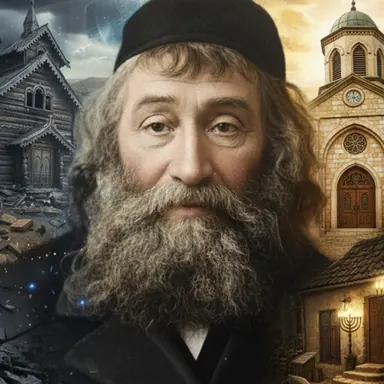
Leadership, Teaching and Thought: The Torah and Hasidic Work of the Rebbe, the "Sefat Emet" of Gur
21 min read4,254 words
Summary
This text surveys the multifaceted work of Rabbi Yehuda Aryeh Leib Alter, the third Rebbe of the Gur dynasty, under whose leadership the Hasidic movement became the central and most influential stream in Polish Jewry. The article draws his portrait as a leader who combined personal humility and modesty with public power, alongside an in-depth analysis of his teaching, which makes the Kotzk conception of absolute truth accessible to the practical life of the average Hasid. The heart of the work deals with his monumental literary enterprise, which includes his concise homilies on the Torah and his scholarly novellae on the Talmud, which to this day are foundational books in the Torah world. Through an examination of concepts such as the renewal of creation and the holiness of nature, the source reveals how the "Sefat Emet" created a unique synthesis between intellectual toil in Torah and a spiritual devotion that identifies the divine point within material reality.
Introduction: The Quiet Revolution of Gur Hasidism in Poland
During the second half of the 19th century, Polish Jewry underwent profound social, economic and demographic changes, which confronted the Orthodox and Hasidic leadership with unprecedented existential challenges. Against the background of processes of industrialization, rapid urbanization and the growth of national and secular movements, Gur Hasidism took shape as the largest, most influential and most central Hasidic court in Poland.[1, 2, 3] The person who stood at the head of this process of growth in strength and charted the spiritual path of the movement was the third Rebbe of the dynasty, Rabbi Yehuda Aryeh Leib Alter (1847–1905), known throughout the Jewish world by the name of his monumental work, the "Sefat Emet."[1, 2, 4]
The Torah teaching of the "Sefat Emet" is a unique synthesis of the deep and incisive scholarship of the school of Peshischa and Kotzk and the public need to lead masses of Hasidim in a changing reality.[3, 5, 6] His thought is not merely classical textual interpretation, but a complete philosophical-Kabbalistic system that offers ways of existential coping, of locating the divine point within the material world of nature, and of absolute devotion to inner truth.[3, 5, 7]
Chapter 1: The Stations of His Life, the Features of His Character and Milestones in His Leadership
Rabbi Yehuda Aryeh Leib Alter was born in Warsaw on 29 Nisan 5607 (15 April 1847) to his parents, Rabbi Avraham Mordechai Alter and Esther Landstein.[3, 8] In his early childhood he suffered a grievous personal tragedy when he was orphaned of his mother in 1849, and of his father when he was only about eight years old.[8] Following his orphanhood, he grew up and was educated in the home of his grandfather, Rabbi Yitzchak Meir Alter (author of the "Chiddushei ha-Rim"), the founder of Gur Hasidism.[1, 3, 8] The education of the child, who was known by the family nickname "Leibel," was marked by asceticism and very strict demands, which included intensive Torah study of about 18 hours a day, rising before dawn and a constant striving for a daily Torah novella.[3, 8] When he was about ten, his grandfather took him on a visit to the Rebbe of Kotzk, Rabbi Menachem Mendel, an encounter that left an indelible mark on his soul and shaped his conception of the uncompromising striving for truth.[3, 8] In 1862 he married Yocheved Rivka, the daughter of Yehuda Leib "Yidel" Kaminer.[8] In order to prevent a duplication of names between the groom and his father-in-law, his official name was changed from "Yehuda Leib" to "Yehuda Aryeh Leib," a change that caused him deep inner sorrow because of his attachment to his original name.[8]
Upon the death of his grandfather, the "Chiddushei ha-Rim," in 1866, many Hasidim sought to crown the 18-year-old youth as Rebbe.[1, 8] Out of deep humility and a sense of unreadiness, he refused to take the yoke upon himself, and instead subordinated himself and the Hasidim to the leadership of Rabbi Chanoch Henich of Alexander.[1, 8] Only after the death of the Rebbe of Alexander in 1870, when he was only 23, did he yield, having no choice, to the many entreaties and take upon himself the leadership of Gur Hasidism.[1, 3, 8] Alongside his spiritual leadership, he served as head of the rabbinic court in the town of Góra Kalwaria.[1]
Under his leadership Gur became the leading Hasidic center in Poland.[1, 2, 3] He built a spacious beit midrash, initiated the construction of housing for his Hasidim, and even helped indirectly in laying a special railway line between Warsaw and the town of Gur ("the Rebbe's line") to enable the masses to reach him.[3] Despite his exalted status, he displayed an egalitarian and modest style of leadership; he used to sit in the middle of the table at the tish and not at its head, and firmly refused to accept "pidyonot" money from his Hasidim.[1, 3] His source of livelihood was a small shop selling haberdashery, kerosene and tar, which his wife ran.[1, 9] On one occasion, when those close to him tried to lead him through a back door in order to spare him the smell of the tar and kerosene in the shop, the Rebbe whispered to them that the difficult task of a Jew is to pass through the tar and kerosene of this world and still smell only Torah.[9]
The period of his leadership came to its end in the shadow of political storms and personal and military crises. At the beginning of September 1901 his first wife, Yocheved Rivka, died.[8] About a year later, in 1902, a huge fire consumed the buildings of the Hasidic court in Góra Kalwaria, including the Rebbe's home and his beit midrash.[8] Later he married his second wife, Reizel, the daughter of Rabbi Baruch Halberstam of Gorlice.[8] During the Russo-Japanese War (1904–1905), many of his young Hasidim were conscripted into the Tsar's army and sent to the Manchurian front.[8] His boundless concern for their welfare, which found expression in writing daily letters of encouragement, undermined his frail health.[8]
He died on 5 Shevat 5665 (11 January 1905) at the age of 57.[8, 10] More than 20,000 people took part in his funeral, the trains from Warsaw were packed to capacity, and many Hasidim fainted because of the great crush in the carriages.[8] During the Mincha prayer in the open field in the course of the funeral, the rabbi of Sochatchov (author of the "Avnei Nezer") delivered a short eulogy that made a powerful impression on the mourning crowd.[8] He was buried in a shared ohel beside his grandfather in the cemetery of Góra Kalwaria.[2, 8] He was succeeded by his eldest son, Rabbi Avraham Mordechai Alter (the "Imrei Emet") [1, 4, 8], although a small part of the Hasidim turned to his brother-in-law, Rabbi Pinchas Menachem Justman of Piltz (author of the "Siftei Tzaddik").[8]
Chapter 2: The Literary Enterprise – the Character, Editing and Style of the "Sefat Emet"
The books of the "Sefat Emet" have won a special status as foundational books both in the world of Torah scholarship and in the world of Hasidic thought and piety.[3, 11, 12] His writings fall into two main genres: philosophical homilies on the Torah and the festivals, and scholarly novellae on the Babylonian Talmud.[11]
Sefat Emet on the Torah and the Festivals
The homilies that appear in the book are based on the words of Torah that the Rebbe delivered at the tables ("tishen") on Sabbaths and festivals.[11] He used to write these novellae down himself on Sunday morning, while still wearing the tefillin of Rabbenu Tam.[11] Because of the speed of the writing and the attempt to condense complex ideas, expressions such as "in brief" or "jumbled words" sometimes appear in the manuscript.[11]
The "Sefat Emet" adopts an especially short, concise and concentrated style of writing, explaining that "brevity in short words is best" because of the difficulty of expressing spiritual depth in writing.[5, 11] His novellae are not a literal commentary on the verses, but use the words and the midrashim as points of departure and symbols expressing complex Kabbalistic and Hasidic conceptions.[11] Biblical figures become in his hands archetypes of forces of the soul and of stages in spiritual work.[11] Many homilies open with a quotation of a short saying of his grandfather, the "Chiddushei ha-Rim," and its expansion into an ordered teaching.[11]
The work was originally printed in five parts between 1905 and 1908, with the homilies for the festivals integrated into the homilies on the weekly Torah portions according to the seasons of the year.[11] In the modern "Or Etzion" edition a structural change was made, and the work was divided into two separate series (Torah and Festivals) extending over seven volumes.[11] In addition, words of Torah that he wrote in his youth, before his appointment as Rebbe, were collected and printed as a separate book entitled "Sefat Emet – Likkutim" by his nephew, Rabbi Avraham Yissachar Binyamin Eliyahu of Pabianice.[11]
Chiddushei Sefat Emet on the Talmud
In parallel with his Hasidic homilies, the "Sefat Emet" conducted regular classes of in-depth study of the Talmud and the halakhic decisors with members of his family and his close disciples.[11] These novellae were written down concisely and were edited after his death mainly by his son-in-law, Rabbi Yaakov Meir Biderman, and his brother-in-law, Rabbi Chanoch Tzvi HaKohen Levin.[11]
The book "Sefat Emet" is regarded among students of Hasidism as a work that demands special intellectual and spiritual effort, because of the extreme brevity of its language and the need to decipher the brilliance of the idea hidden in every short sentence.[11] The title of the book itself was determined by the last verse that the Rebbe wrote, about two weeks before his death, in his last homily: "The lip of truth shall be established forever" (Proverbs 12:19).[2, 11, 13]
Chapter 3: "Keep Far from a False Matter" – The Philosophy of Truth and Coping with the Legacy of Kotzk
Gur Hasidism grew out of the great crisis of Kotzk Hasidism.[3, 5, 6] Whereas Rabbi Menachem Mendel of Kotzk demanded an absolute, extreme and total truth that led to withdrawal from the masses and to existential despair because of man's inability to attain perfection, the "Sefat Emet" wisely took the foundations of Kotzk and translated them into a spiritual language that makes the leadership of the masses possible.[5, 6] This democratization of truth rests on a deep categorical division of the concept of truth in the soul and in reality.[5, 14]
The Ontology of Truth and Falsehood
According to the "Sefat Emet," truth is not merely a correct factual description of reality, but an eternal existential foundation in which there is no change from its beginning to its end.[14] Falsehood, by contrast, is defined as change and instability.[14] A person given to changes and inner fluctuations is regarded as one who is not in truth.[14] The gravity of falsehood is so great that the Sages compared one who goes back on his word to an idol worshipper, since in both cases it is a denial of the absolute reality of the Creator.[15] Between truth and falsehood lies the concept of "kazav" (deceit) – something that has a temporary interruption (as in "nachal achzav," a failing brook), which is not entirely the opposite of truth as falsehood is, but lacks the foundation of eternal existence.[14]
Within the world of truth itself, the "Sefat Emet" distinguishes three main levels:
By means of this distinction, the "Sefat Emet" resolved the impasse of Kotzk. Whereas Rabbi Menachem Mendel of Kotzk demanded of every Hasid that he reach at once the level of "emet le-amito" (truth in its full truth) and saw every spiritual compromise as "geneivat da'at" (deception) and falsehood [6], the "Sefat Emet" offers a place for the "beinoni" (the intermediate person).[14] The service of the beinoni, although it is not inwardly perfect and does not reach absolute truth, is defined as "wholehearted and true service."[14] It is entirely true relative to the person's present level, and thereby he grants religious legitimacy to gradual and human spiritual effort.[14]
In addition, the "Sefat Emet" emphasizes the Torah's command "Keep far from a false matter."[15] This keeping away requires a person to avoid even creating a false impression or appearing to be about to lie, such as a disciple sitting in the court and keeping silent in a way that lends validity to a false claim.[15] This work of clarifying the truth and preventing self-falsification is the very soul of Hasidism, reflected in a person's efforts to fulfill even his resolutions made in thought.[15]
Chapter 4: A Cosmology of Renewal and the Dynamics of Time
One of the most original intellectual contributions of the "Sefat Emet" is his conception of continually renewed creation and its implications for man's duty of creativity.[5]
The Dynamism of Creation versus Stasis
The "Sefat Emet" grapples with the question of why the Torah detailed the order of the days of Creation separately.[5] His answer rests on the conception that creation is not a one-time historical event that has ended, but a dynamic divine process that takes place anew at every moment.[5] The Holy One, blessed be He, makes new abundance and light flow into the world every single day.[5] Since every day has a unique illumination of its own, unlike the illumination of yesterday, a person must discover the specific light of that day and build from it a new connection with the Creator.[5]
This idea is explained by means of the song of the Levites in the Temple, who would change their song every day in keeping with the renewed illumination dawning on that day, as is learned from the verse "Blessed be the Lord day by day" – that each day must be given the blessing particular to it.[5] From this the "Sefat Emet" derives a person's duty to bring forth new Torah insights and daily spiritual work.[5] This explanation resolves the puzzle of why earlier generations did not discover these novellae: they simply could not discover them, since the special divine light that is revealed today and makes this specific novella possible had not yet broken forth and descended into the world in their days.[5]
The Dialectic of the Child and the Old Man in the Human Soul
Out of the principle of ceaseless renewal, the "Sefat Emet" develops a profound psychological distinction between two movements of the soul, represented by the good inclination and the evil inclination, and called in the language of the Sages "a poor and wise child" as against "an old and foolish king" [5]:
- The child (the good inclination): represents the power of renewal and change.[5] He is called a "child" because he is characterized by inner flexibility, the ability to learn, humility and the capacity for inner submission before the truth and before others.[5]
- The old man (the evil inclination): does not necessarily represent simple physical sin, but rather stasis, rigidity and spiritual petrification.[5] He is called a "king" because he refuses to accept the yoke of the kingdom of Heaven and expects his honor to be preserved, and he is called "old" because he lacks the ability to listen, to change and to submit.[5]
Submission and humility are therefore the key to the capacity for renewal, whereas pride and rigidity turn a person into a closed and petrified system cut off from the divine abundance flowing through creation.[5]
Another brilliant illustration of the process of the soul's spiritual dismantling and rebuilding is offered by the Rebbe in his explanation of the position of Maimonides (Rambam), according to which one who slept in the Temple must sanctify his hands and feet a second time even though he did not leave the precincts of the sanctuary.[5] The "Sefat Emet" explains that during sleep a person's soul leaves his body, and therefore its return to the body is regarded as a new entry into the sacred, requiring a renewed and fresh sanctification.[5]
Chapter 5: The Holiness of Nature, the Space of the Land of Israel and the Relationship with Zionism
In contrast to the tendencies toward withdrawal and self-mortification that were widespread in some of the Hasidic courts, the teaching of the "Sefat Emet" offers a fascinating dialectical approach to the world of matter and nature, one that joins heaven and earth and seeks to raise physical reality to the level of holiness.[3, 7]
The Inner Point of Vitality and the Service of the Patriarchs
The "Sefat Emet" explains the difference between the level of Moses our teacher and the level of the Patriarchs.[7] Moses our teacher cleaved to a level entirely above nature – in the aspect of the name Havayah (the Tetragrammaton), whose greatness has no end and which does not clothe itself in the laws of the world.[7] The service of the Patriarchs, by contrast, was conducted within the world of nature and darkness.[7] They served under the name "Shaddai," which expresses the divine contraction and limitation that make the existence of physical creation possible ("that there is enough [dai] in His divinity for every creature").[7]
The task of the Patriarchs – and, following them, of every Jew – is to reveal that nature is not a partition cutting one off from God, but a disguise concealing an inner point of vitality that is above nature.[3, 7] By keeping the Torah and the commandments, a person connects the physical deed to its spiritual root and draws the supernal light into everyday reality.[7]
Exile, Home and the Land of Israel
This cosmic approach is closely bound up with the "Sefat Emet's" conception of geographical and national space:
The essence of exile: exile is not merely a physical punishment, but an existential state of consciousness.[10] The Rebbe coins the incisive saying that "one can go into exile even at home, when you know that you are not at home."[10] Exile is spiritual estrangement, a sense of a mismatch between the outward situation and the proper root of the soul.[10]
The Land of Israel as a spiritual medium: the Land of Israel is not merely a national territory, but the only geographical place in which the encounter between the sacred and nature can reach perfection.[3] Only in the Land of Israel is the people of Israel able to fulfill its true destiny and raise the whole system of nature to the level of holiness.[3]
Position toward the Zionist movement: despite his support in principle for the practical building and settlement of the Land of Israel, the "Sefat Emet" opposed the modern Zionist movement that arose in his day.[1, 12] This opposition stemmed from the fact that Zionism sought to define Jewish nationalism and the return to the Land on a purely secular and political basis, severing the physical dimension of settling the Land from its spiritual, religious and transcendent root – which in his eyes constituted a grave distortion of the concept of truth and a turning of the sacred into the profane.[1, 3, 12]
Chapter 6: Paths of Spiritual Service, Fear of Heaven and Attachment to the Tzaddik
At the center of the daily divine service of the "Sefat Emet" stands the demand for constant strengthening in Torah study, which he defines as the only instrument capable of giving a person inner resilience in times of crisis and exile.[9]
The Torah as a Purifying and Consoling Force
The "Sefat Emet" emphasizes on the portion of Emor that the words of the Torah are "pure words" that raise a person and all of creation from impurity to purity.[16] The commandments and the Torah were given to man in order to draw purity to all creatures.[16] This path of service demands self-sacrifice [9, 16]:
- The self-sacrifice of Moses our teacher: on the portion of Terumah the Rebbe explains that by the merit of the self-sacrifice of Moses our teacher for the children of Israel, the later generations merited constant spiritual help and support that accompany them at all times.[9]
- The consolation of exile: on the portion of Va'etchanan it is made clear that the Written and Oral Torah is the true and only source of consolation of the children of Israel in the bitter and dark exile, as it is said: "Unless Your Torah had been my delight, I would then have perished in my affliction."[9]
- Preparation in holiness: on the portion of Miketz the Rebbe teaches that a person must make use of the "good days" – times in which holiness is revealed and accessible – in order to fix these lights deep in the heart, and thereby create spiritual reserves for hard days in which holiness is hidden.[9]
The Counting of the Omer and the Sabbath: the days of the Counting of the Omer are perceived as a mechanism that prepares the physical and material person to receive the Torah by refining matter and turning it into a spiritual vessel.[16] This holiness is also expressed in the Sabbath, in which the children of Israel have an active part in creating the holiness of the day through the commandment "Remember... to sanctify it."[16]
The Psychology of Fear and Love
The "Sefat Emet" offers a fundamental definition of the relation between the fear of Heaven and the love of God: "Fear is the work of man; love – the gift of the Creator."[10] A person is required to toil hard to acquire the trait of fear, which is the basis and the vessel for containing the divine light, whereas the trait of love is ultimately granted to him as a free gift from above.[10] Moreover, he divides the concept of repentance into two paths: repentance out of fear, intended to erase active sins and practical wrongdoings, and repentance out of love, whose role is to repair the lack of good deeds and missed spiritual opportunities.[10]
Although the trait of fear is the foundation, the "Sefat Emet" is deeply moved by the commandment "And you shall love the Lord your God," and explains on the portion of Va'etchanan that there is in it an immense wonder that astounds the angels and the supernal princes – how the Creator, exalted above all, asks for and longs for precisely the love of a simple creature of flesh and blood.[9] This love requires a person to understand his place in this world, which is like a vestibule before the hall of the world to come, and to toil at preparing himself within the physical vestibule.[9] Some souls of Israel are "vessels for receiving the light" of God, whereas the souls of lofty tzaddikim are themselves the light that illuminates reality.[10]
The Relations of Hasid and Tzaddik
In the teaching of the "Sefat Emet," the bond between the Hasid and the tzaddik is not based on blind adulation or spiritual passivity.[9] In one of his incisive talks the Rebbe asked a Hasid who had addressed him with the title "Rebbe": "Vos hostu fun mir gelernt, az du rufst mir rebbe?" (What have you learned from me, that you call me Rebbe?).[9] With this the Rebbe made clear that true attachment to a tzaddik requires practical learning of his ways and his spiritual service, and one who does not learn from the tzaddik cannot pride himself on the title of being his "Hasid."[9]
Summary
The Rebbe, the "Sefat Emet" of Gur, reshaped the face of Polish Jewry, and turned Gur Hasidism into a spiritual and organizational power that decisively influenced hundreds of thousands of Jews.[1, 3] His success as a leader stemmed from a unique combination of uncompromising principles of inner integrity, total toil in Torah and personal modesty with a deep understanding of the needs of the generation and the giving of a place and a response also to the simple Hasid and to the "beinoni" seeking his path.[3, 11, 14]
His teaching, characterized by striking concision, sharp scholarship and Kabbalistic depth, broke through the boundaries of the court of Gur.[3, 5, 11] His books on the Torah, the festivals and the Talmud have become enduring treasures of Torah study and Jewish thought, held in enormous esteem among all parts of the Torah and scholarly public.[3, 11, 12] His Torah path offers an existential model combining a constant striving for an inner and uncompromising truth with a deep commitment to practical action, the refinement of matter and the revelation of the divine spark within the world of nature and everyday human reality.[3, 5, 7]
Sources16
- 1.יהודה אריה ליב אלתר | מקורות מתוך ספריית ספריא, sefaria.org.il/topics/yehudah-aryeh-leib-alter
- 2.יהודה אריה ליב אלתר - ויקיפדיה, he.wikipedia.org/wiki/יהודה_אריה_ליב_אלתר
- 3.רבי יהודה אריה לייב בעל "השפת אמת" מגור | כתבות באתר ישיבה, yeshiva.org.il/article/12377
- 4.חסידות גור - ויקיפדיה, he.wikipedia.org/wiki/חסידות_גור
- 5.לאור שפת אמת - פרופ' אבי וינרוט - ספרים, aviweinrothbooks.com/wp-content/uploads/2022/02/לאור-שפת-אמת.pdf
- 6.סוחר מורשה במטבעות - ארץ ישראל הטובה - משפחתו של ד"ר יעקב קפלן - לידרמן, liderman.co.il/משפחתו-של-אלי-גורן
- 7.שפת אמת/וארא - ויקיטקסט, he.wikisource.org/wiki/שפת_אמת/וארא
- 8.Yehudah Aryeh Leib Alter - Wikipedia, en.wikipedia.org/wiki/Yehudah_Aryeh_Leib_Alter
- 9.צפו: הרב מנחם מנדל פומרנץ שליט''א לרגל הילולת ה'שפת אמת' - דרשו, dirshu.co.il/p202509/
- 10.יהודה אריה ליב אלתר - ויקיציטוט, he.wikiquote.org/wiki/יהודה_אריה_ליב_אלתר
- 11.שפת אמת (ספר) – ויקיפדיה, he.wikipedia.org/wiki/שפת_אמת_(ספר)
- 12."שפת אמת תכון לעד" – 120 שנה לפטירתו של ה'שפת אמת' זצ"ל - מדברים פדגוגיה, pedagogy.herzog.ac.il/שפת-אמת-תכון-לעד-120-שנה-לפטירתו-של-השפת-א/
- 13.שפת אמת | ספריית ספריא, sefaria.org.il/Sefat_Emet
- 14.תניא לעם - פרק יג בליקוטי אמרים | חב"ד - אור אין סוף, abc770.org/article_node_4366/
- 15.פרק ב - אמירת אמת - פניני הלכה, ph.yhb.org.il/category/ליקוטים-ב/02-הלכות-אמירת-אמת/
- 16.שפת אמת/אמור - ויקיטקסט, he.wikisource.org/wiki/שפת_אמת/אמור